Echoes of the Battlefield
Some men return from war whole, while others like Caleb Mercer return only in appearance. Caleb often joked back when he still had a sense of humor that he had left half of himself buried in the mountains overseas, trapped beneath the weight of dust, gunfire, and the echoes of voices that never made it home. What remained was a man who looked ordinary enough. He was a broad-shouldered father in his late thirties living in a quiet Columbus neighborhood, spending his days handling school pickups and cutting the crusts off sandwiches. Yet, beneath that surface, he operated like a flickering light that never quite steadied.
His left knee remained stiff from the explosion that ended his final deployment, a constant reminder of a past he refused to discuss. His service medals stayed hidden in a shoebox at the back of his closet, buried under old documents and a broken flashlight. To anyone who asked, Caleb was simply a man doing his job. But when the house fell silent at night, the past inevitably crept into his dreams and dictated how he scanned the faces of strangers.
Anchoring him to his responsibilities was Rook, a black Labrador mix with a graying muzzle and one torn ear. Rook did not perform tricks or shower strangers with affection; he observed and waited with an unnerving, steady gaze. They had served together in silence and precision, and when Caleb returned to civilian life, there was never a question that Rook would follow. If Rook tied Caleb to a complicated past, his six-year-old daughter, Lila, pulled him toward the future. She was a child of vibrant imagination who drew chalk gardens on the driveway—loops and spirals she called safe places meant to keep bad things away.
That Saturday started as a beautiful, ordinary summer day. Lila was busy adding flowers to her garden while Caleb, nursing a painful knee, stepped inside for a moment to grab ice. Everything was normal until a thin, choked sound cut through the air. Caleb dropped the ice tray and sprinted to the door, bursting outside to a nightmare.
A man in a worn, dark hoodie stood near an oak tree, one arm locked around Lila’s chest while he pressed a damp cloth to her face. She was kicking, her tiny hands clawing at his sleeve. Rook stood only a few feet away, coiled and perfectly still, waiting for a signal. Caleb did not raise his voice; he simply spoke with a flat, final authority that commanded the man to put his daughter down. When the man panicked and threatened Lila, Caleb gave a subtle hand signal.
Rook moved like a blur, hitting the attacker’s thigh with controlled precision. The man screamed, his grip shattered, and Lila fell into her father’s arms. After the assailant scrambled into an idling car and fled, the police arrived to manage the chaos. While Caleb and Lila survived the physical encounter, the emotional toll was profound. Lila stopped speaking entirely, slipping into a shell of trauma that doctors identified as selective mutism. For months, she remained tethered to her father and the loyal dog, sleeping only when she felt the steady rise and fall of Rook’s breathing beside her.
Three months later, the police apprehended a local handyman named Ethan Kade. Kade presented himself as a calm, professional, and wronged man, even as he stood trial. His defense team aggressively attacked Caleb’s credibility, painting the veteran as an unstable man suffering from post-traumatic stress who had hallucinated a threat. They leveraged Lila’s silence against them, arguing that there was no verbal confirmation of the events.
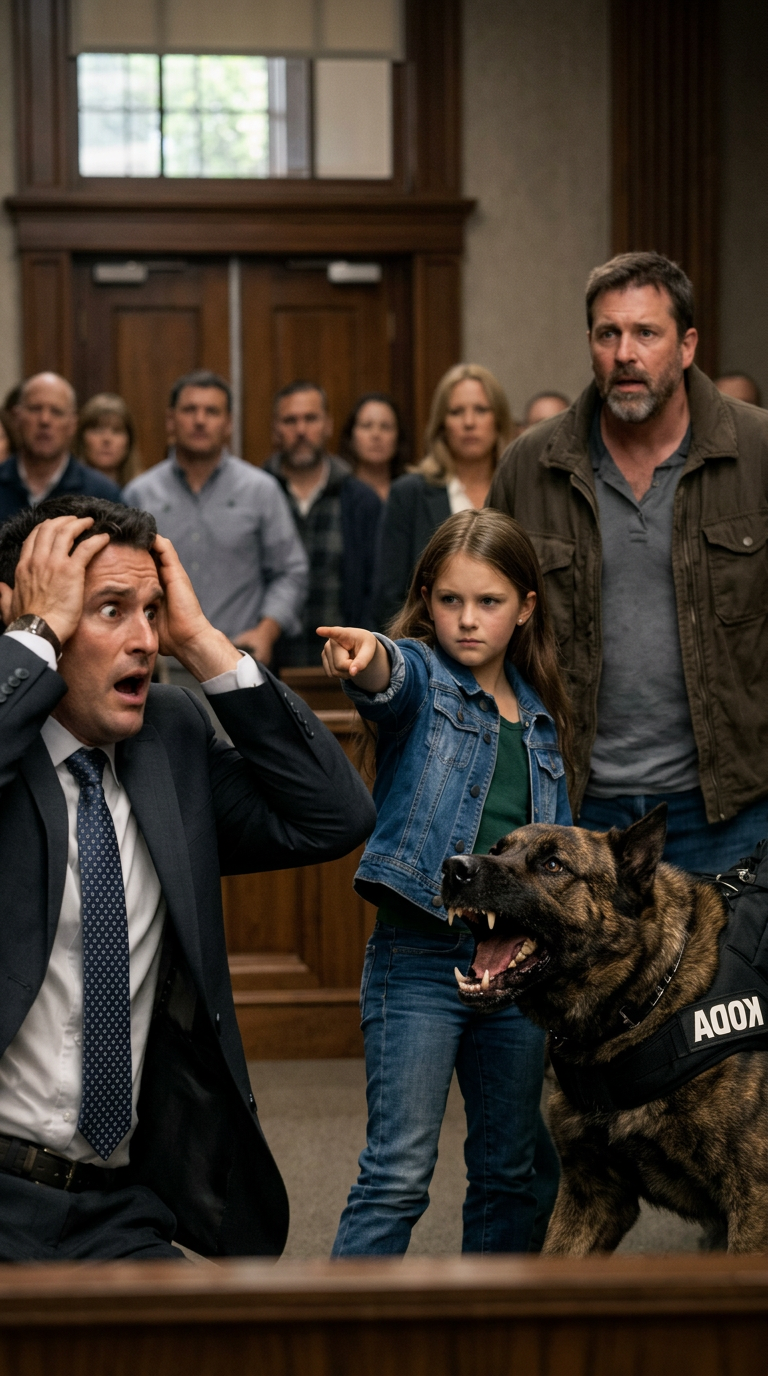
During the proceedings, the prosecutor brought Rook forward for a demonstration. Kade, maintaining his facade of innocence, whispered a friendly greeting to the dog. Rook did not react until the prosecutor played a recording of the car engine from the day of the attack. At the specific, mechanical whine of that engine, Rook stiffened and emitted a low, bone-deep growl that captured the attention of the entire gallery.
Kade broke, stumbling back and shouting that the dog was going to attack him—a panicked admission of guilt. In that moment of revelation, Lila finally found her voice. She climbed off her chair, pointed a steady finger at Kade, and told the court that he smelled like her chalk drawings and had told her that no one would hear her. She then turned to her father, confirming that Rook had saved her.
Kade confessed within the hour, revealing a history of similar crimes. When the courtroom finally emptied and the family stepped out into the sunlight, the weight of the ordeal had lifted. Caleb took Lila’s hand, with Rook walking between them, his silent vigil finally complete. The story serves as a reminder that truth does not always arrive in loud declarations; sometimes it waits in the instincts we overlook and the quiet loyalty of those who refuse to stop protecting us until the darkness is finally held to account.