From Garbage-Dump Stray to Beloved Family Dog: Pan Pan’s Remarkable Recovery
At first glance, Pan Pan seems like an ordinary cheerful dog. He races over open grass, plays easily with other dogs, and meets each new day with the confidence of an animal who knows he is safe and loved. Nothing in the way he moves now suggests the life he once knew. It is difficult to connect this happy companion with the frightened stray who used to hide near a garbage station, search through discarded food for something edible, and flee whenever a person came too close.
The first reports described a stray dog living around a garbage dump. A compassionate woman heard about him and went to see the situation for herself. The sight waiting for her was far worse than she had expected.
The dog was terribly underweight. His ribs pressed visibly against his dirty coat, and every step exposed a serious limp. He moved from one pile of rubbish to another, searching for scraps. As soon as he realized a stranger had entered the area, he retreated immediately. He kept well away from the woman and watched her closely, ready to escape if she moved toward him.
His behavior made one thing clear: people frightened him. No one knew exactly what had happened to him before, but his fear suggested that his earlier experiences had taught him to expect danger rather than kindness.
The woman did not chase him or try to corner him. Instead, she placed food where he could find it and backed away.
Only after she had left did the starving dog creep out from his hiding place. He ate everything quickly, with the urgency of an animal who could not be sure another meal would ever come. Before the woman departed completely, she turned and saw him watching her. He was still afraid, yet there seemed to be a faint change in his expression, as though hope had appeared beside the fear.
She came back the following day.
Then she returned again, and continued returning after that.
Every visit brought food, fresh water, and something just as important: reliability. For a stray who had survived by never knowing what the next day might bring, the repeated appearance of the same gentle person slowly began to matter.
In time, the dog started to recognize her. He did not disappear quite as quickly when she arrived. Sometimes he remained nearby, watching her hands and following her movements with his eyes. He was still cautious, but curiosity was beginning to compete with the instinct to run.
Then, without warning, he was gone.
The woman arrived with food and found the place where he normally waited empty. She searched around the garbage station, checked the surrounding spaces, called for him, and looked anywhere a frightened dog might hide. The longer she searched without finding him, the more worried she became.
She returned the next day with members of her family so they could search together.
After hours of looking, they finally heard barking in the distance.
They followed the sound and found the dog trapped among dense grass and tangled vines. He had somehow become caught so badly that he could not work himself free. From his exhausted condition, it appeared possible that he had been stuck there through an entire day without access to food or water.
The dog was terrified. When several people moved in to help, he struggled with all the strength he had left. He did not yet understand that they were trying to save him, and fear made every attempt to free him difficult.
This time, however, the rescuers would not leave him behind.
Once they managed to get him out, they took him home. His first temporary shelter was a simple cardboard box. It was hardly a luxurious bed, but to a dog accustomed to exposure, hunger, and isolation, that small protected space was safer than anything he had known.
His rescuers gave him a name: Pan Pan.
The first days at home were difficult. Pan Pan remained intensely timid. Strange noises made him jump. New surroundings overwhelmed him. Even when a person approached slowly and gently, he often reacted as if something painful might happen.
His physical condition showed how much he had endured outside. Mites had caused severe disease across his skin, and large areas of his body had lost fur. His hind legs were badly deformed as well, so normal walking was both awkward and painful.
His rescuers began treating each problem patiently.
Medicated baths were used to soothe and heal his damaged skin. Better food gradually put weight back on his thin frame. He received deworming treatment, vitamins, and continuing veterinary attention for health issues that may have been ignored throughout much of his life.
While his body was recovering, another change was happening more slowly.
Pan Pan was learning that humans could be trusted.
The smallest signs of progress became important. When he wagged his tail for the first time, the people caring for him saw it as a breakthrough. When he voluntarily moved toward his rescuer instead of retreating, it felt like another major victory. When he finally chose a new bed rather than hiding in the cardboard box that had become his first safe refuge, it showed that his world was beginning to expand.
Veterinary examinations eventually explained why his hind legs had caused so much difficulty. The deformities were congenital, and the doctors concluded that surgery would be needed if Pan Pan was ever going to walk comfortably.
The operation was arranged.
As the date approached, everyone around him worried. Pan Pan had already survived hunger, illness, fear, and painful movement. Sending him into surgery was frightening for the people who had grown attached to him, but they also knew that the procedure offered his best opportunity for a normal, active life.
When the day came, Pan Pan was taken to the city hospital.
The change from the dog at the garbage station was remarkable. The stray who once fled at the sight of a person remained calm during the preparations. His rescuer stayed close, and that familiar presence seemed to reassure him that he was safe.
The surgery lasted for two long hours.
It worked.
The doctors explained that recovery would require time, but the result gave them reason to be hopeful.
Recovery demanded constant care. Pan Pan needed medicine, wound treatment, injections, and patient supervision. Once again, he surprised the people around him. He tolerated the procedures, endured the discomfort, and cooperated as though he somehow understood that all of it was meant to help him.
Then came a moment no one in the room would forget.
The doctors encouraged Pan Pan to try standing without help.
He shifted carefully and began pushing himself upward.
Everyone watched in silence.
Pan Pan rose onto his legs.
He stayed upright.
No one was holding him. He did not immediately fall. The legs that had made every movement painful were finally supporting him in a new way.
The room filled with excitement. The dog who had once limped among piles of garbage had just taken a decisive step toward a life that had once seemed unreachable.
His progress became faster as the weeks passed. The surgical wounds healed well. Fur returned to areas that had once been bare. His body became stronger, and his movements grew more confident. Before long, he was walking freely, investigating his surroundings, and forming friendships with other dogs.
Eventually, Pan Pan was able to leave the hospital and go to his permanent home.
This was no temporary box or improvised shelter. It was a real home where food appeared reliably, warm places to sleep replaced cardboard, and companionship replaced the loneliness of the streets.
Pan Pan continued improving there. His confidence grew together with his strength, and happiness became visible in the way he behaved.
One day, he ran through a park for the first time.
For the people who remembered how he had once struggled simply to stand and walk, seeing him sprint over the grass was deeply emotional. He was no longer dragging painful legs through rubbish. He was moving freely, with the wind in his fur and the joy of a dog discovering a life he had almost missed completely.
His story soon gained another unexpected chapter.
A tiny stray kitten became part of the household.
The kitten quickly attached itself to Pan Pan and followed him everywhere. Pan Pan, once the frightened animal who needed protection from everything around him, accepted the kitten with surprising tenderness and became a protective older companion. The pair grew inseparable, bringing playful disorder and warmth into the home as they grew together.
Fifty days after Pan Pan’s rescue, the change in him was already striking. After 500 days, the difference seemed almost impossible to believe.
The frightened stray who once hid beside the garbage station had disappeared in every way that mattered. In his place was a healthy, confident dog who belonged to a family and knew he was loved.
Photographs from his earliest days still affect the people who see them. The thin body, damaged skin, fearful eyes, and deformed legs make a painful contrast with the dog running freely today. His recovery shows what can happen when compassion is followed by patience instead of being limited to a single moment.
One woman stopped when others might have continued past.
She returned when it would have been easier to assume the stray could manage alone.
She searched when he disappeared.
And after finding him, she and the people around her stayed committed through fear, treatment, surgery, and recovery.
Because of those choices, Pan Pan found what life near the garbage dump had never given him: a family, a safe home, dependable care, and a future worth enjoying.
Today he runs toward life instead of away from people. His story is a reminder that an animal whose beginning is filled with neglect can still reach a very different ending when someone is willing to offer steady compassion.
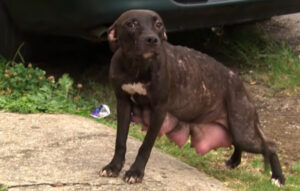
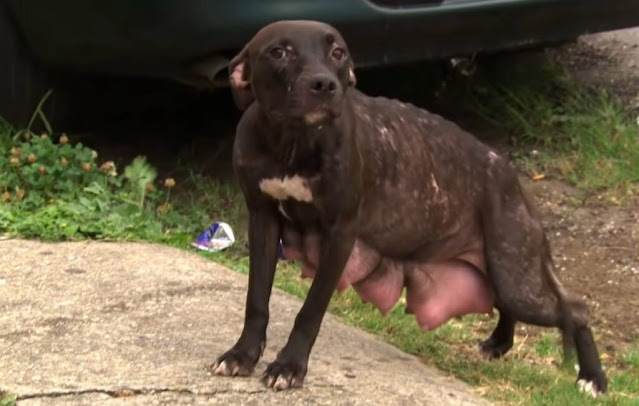
The page also included another rescue account involving animal workers in New Orleans. They responded after receiving a report about an abandoned mother Pit Bull in extremely poor condition. The rescuers were especially concerned because her puppies were missing.
When the team arrived, the mother’s behavior changed immediately. Instead of avoiding the strangers, she wagged her tail intensely and approached them. Her reaction suggested that she recognized the visitors as people who might help. She then led the rescuers toward a nearby house, as though showing them where the puppies could be found.
There, the rescuers learned more about what had happened. The mother dog belonged to a man who had recently been jailed. After his imprisonment, she and her puppies had been left in the care of his roommate.
The roommate claimed that he was caring for the animals, but the rescuers concluded that the reality did not match what he said. The team tried to persuade him to surrender the puppies, yet he refused.
Unable to take the pups without authorization, the rescuers turned to legal channels. Once they obtained the permission they needed, they returned and were finally able to remove the puppies and bring them back to their mother.
The reunion was immediate and emotional. Although the puppies were tired, they quickly moved toward their mother and began nursing. The mother dog’s relief was visible as she settled with them again. Her behavior toward the rescuers conveyed the gratitude and release of an animal whose family had been restored.
The article invited readers who were moved by the rescue to share the story with others who might appreciate it as well.
Among the surrounding links was a separate, unrelated headline about a dog that had been chained for 19 years.