
My dog noticed something strange in the grass during an ordinary walk through the park
An account shared online begins with what appeared to be a routine outing in a park with a dog. Nothing dramatic was anticipated, there was no search underway, and the landscape offered no obvious sign that anything unusual was nearby. The dog had reportedly been moving calmly next to the person holding the leash when its conduct changed without warning. Rather than walking on, it came to a stop and fixed its attention on one little area of grass. The story says the animal became unusually alert and stayed focused on something its owner had not seen. A moment that had seemed completely uneventful suddenly gave the walker a reason to inspect the ground more closely.
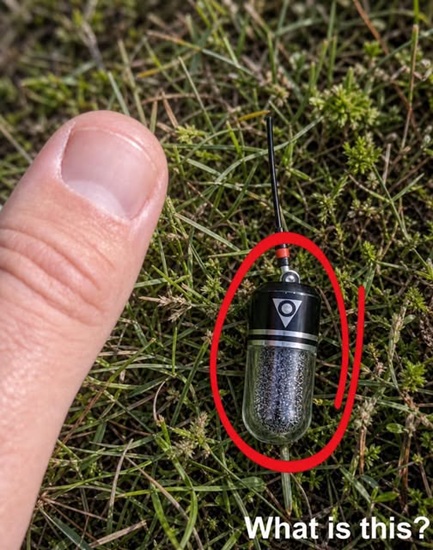
The item described in the story was extremely small and blended easily into the plants around it. It looked somewhat like a miniature capsule, with a thin wire or antenna projecting from one end. With no context to explain an unfamiliar object that seemed electronic, the walker could not immediately determine what it was. The original description conveys uncertainty; it does not supply proof that the device presented any danger. That is an essential difference, since unfamiliar equipment should not be labeled threatening merely because its function is unknown. Something can seem mysterious for the simple reason that the person looking at it has never learned what it does.
The account says the walker did not instantly pick the item up. Instead, it was observed from a limited distance. The person reportedly used a phone camera to get a closer look, which offered a way to examine details without handling the object at once. Magnification made its form more apparent. Its tiny body and antenna-like extension suggested that it could belong to a family of compact tracking tools. That explanation is consistent with real science, because wildlife researchers do use miniature radio transmitters. Even so, a picture without a maker’s mark, research label, known owner, or laboratory inspection cannot always prove the exact origin or model of an unidentified device.
Wildlife scientists have relied on radio telemetry for many decades to follow animal movements. In a common arrangement, a lightweight transmitter produces a radio signal, while researchers locate that signal with an appropriate receiver and antenna. The Smithsonian’s National Zoo and Conservation Biology Institute notes that scientists have employed this method since the nineteen-sixties to find animals and trace where they travel. The tag remains with the animal, and field workers listen for it using receiving equipment. With certain transmitters, the changing strength of the signal as researchers approach can indicate an animal’s general position. The technique makes it possible to investigate species that cannot be watched directly every hour of the day.
As electronics have become smaller, tracking has become practical for species of increasingly modest size. Scientific papers discuss transmitters whose mass is far below one gram, though every reduction creates compromises involving battery duration, signal distance, available power and other engineering limits. A scientific review published in 2025 considered miniature transmitters for free-ranging wildlife, including applications involving little birds, bats, rodents and insects. Engineers and biologists continue trying to shrink this equipment while retaining signals that can actually be detected. In general, the aim is to obtain meaningful movement information while placing as little weight and disruption as possible on the animal. The best device varies according to both the species and the question researchers want to answer.
Some examples are almost unbelievably tiny. One peer-reviewed experiment reported radio-frequency tags with weights of roughly 152 to 160 milligrams. The units were only a few millimeters wide and just over a centimeter long. Measurements on that scale show why authentic research hardware may look insignificant or unfamiliar once it is separated from its scientific setting. A transmitter among blades of grass bears little resemblance to the larger electronic products people use in daily life. Its small scale is not evidence of a hidden or suspicious mission. In animal research, minimal size can be a basic necessity when the creature expected to carry the tag is itself very small.
The Motus Wildlife Tracking System is a practical example of how this type of equipment functions beyond a single project. Motus is an international partnership of researchers using automated radio telemetry to examine the behavior and travel of small animals. The organization says its studies encompass birds, bats and insects. When an animal carrying a compatible tag comes within the reach of a participating receiver station, the system can record that passage. Those observations help scientists analyze migration corridors, resting points, habitat selection, survival and other patterns of movement. A transmitter that seems trivial to a person walking past it may therefore be one tiny component in an enormous cooperative research network.
Researchers have also tested radio telemetry on creatures as small as bumble bees. In August 2026, the U.S. Fish and Wildlife Service reported on a project that placed tiny transmitters on bumble bees to learn how they crossed their environment while seeking food, nesting locations and shelter. The agency observed that radio tracking is usually associated with mammals or birds, but sufficiently light equipment can reveal information about much smaller animals too. Work of this kind illustrates how quickly miniature tracking tools are advancing. A useful tag does not necessarily require GPS, a video camera or an uninterrupted internet connection. With the proper network of receivers, a basic radio signal may provide valuable evidence.
The word “tracking” can invite an unnecessarily alarming picture in the imagination. In wildlife science, it ordinarily refers to research questions involving movement, habitat, migration, behavior, conservation and survival. A radio tag intended for an animal is not inherently a microphone, a camera, or a machine designed to monitor people standing nearby. Each technology has distinct abilities, and those abilities should not be merged without evidence. Many straightforward tags do little beyond broadcasting an identifying signal that specialized receivers can recognize. An accurate explanation offers far more information than speculation about features the object has never been shown to possess.
According to the original story, nobody saw a camera on the item. This point matters because a wire or antenna does not demonstrate an ability to capture video or sound. A radio transmitter needs an antenna precisely so it can send a signal. The visible extension is therefore entirely compatible with conventional telemetry. Without technical confirmation, it would be reckless to assert that a strange item was secretly observing people. The careful conclusion is only that its appearance was consistent with a miniature transmitter; its individual identity, ownership and previous use were never independently verified.
The dog’s response should be treated with the same restraint. The published account says the animal noticed, detected or showed interest in that spot before the human walker saw the object. Dogs possess exceptionally sensitive senses, particularly an advanced sense of smell, but the report does not establish what attracted this particular dog. It may have noticed an odor, a slight movement, a scent left on the object, or some unrelated feature close by. Nothing in the article shows that the dog understood the item was electronic or recognized its scientific function. The sound description is simply that the dog’s changed behavior directed the walker’s attention to the location.
That detail remains engaging without any supernatural claim. Animals routinely perceive sensory information that passes unnoticed by humans, especially odors too faint for people to detect. Yet one reaction from one dog in an anecdote cannot reveal which precise stimulus caused the interest. The animal could have responded to the device, to something that had previously touched it, or to another object or scent in the same patch of grass. Because there was no controlled observation, those options remain unresolved. Keeping the uncertainty intact separates what the story actually reports from ideas supplied by imagination.
If the item was indeed a wildlife transmitter, there are several normal ways it might have ended up on the ground without an animal. Some tags are attached so that they remain in place only for a planned period, while others may come loose by accident or when adhesive or another attachment material gradually weakens. Scientists working with small mammals have evaluated methods that gather useful data for a time and later show evidence of releasing from the animal. The appropriate method differs between species and may involve a collar, harness, adhesive, or another specialized arrangement. A tag can therefore become separated eventually. That possibility fits established research practices, though it does not prove what occurred in this individual case.
Scientific tools found away from their expected environment often appear more mysterious than they are. A microscope is ordinary inside a laboratory but would seem bizarre beside a woodland path. The same change in perception applies to radio tags. Fastened to a documented study animal, a transmitter has an obvious role. Found alone among plants, the identical object raises questions because the passerby cannot see the scientist, animal or project that once supplied its context. Whether technology seems strange or routine often depends on where it is encountered and what explanation accompanies it.
Telemetry is useful because keeping an animal in direct view every minute is generally impossible. Birds can cross immense regions, bats travel in darkness, and small mammals often remain beneath ground or inside dense cover. Researchers need techniques that produce information without requiring someone to follow every animal physically at all times. Radio signals are one option among several. Depending on the system, detections can help reconstruct the route an animal followed or the areas it occupied. Those records then support broader investigations in ecology and conservation biology.
Movement evidence becomes particularly important with migratory species. Researchers benefit from knowing where animals pause, feed, sleep, reproduce and pass from one habitat into another during different parts of a year. A bird visible at one location today could cross hundreds or thousands of kilometers as its migration continues. Direct observation cannot realistically document each phase of that trip. Networks of receiving stations combined with carefully designed transmitters can recover some of the missing information. This practical value is why animal tracking has developed into a significant research method rather than remaining a technological curiosity.
Animal welfare is also part of the design process. Equipment that is excessively heavy or attached badly can alter natural movement, create an ethical problem and corrupt the study’s results. Researchers therefore weigh the animal’s body size, the mass of the transmitter, the attachment technique, the expected duration of data collection and any likely effect on behavior. These constraints are especially strict for very small animals. Continued work on lighter tags is intended partly to reduce such burdens. Scientific discussions of miniature transmitters repeatedly emphasize the balance between engineering capability, data quality and the wellbeing of the animal.
An unknown device also raises the practical question of how a passerby should respond. It should not automatically be considered harmless merely because it resembles research equipment. Conversely, there is rarely a sound reason to invent terrifying explanations without evidence. Leaving an unidentified object untouched can be sensible, particularly when it is broken, has exposed battery parts, includes a sharp component, or displays a warning. A person who believes there is an immediate hazard can contact the property manager or an appropriate local authority. If clear information identifies a university or research group, contacting that organization may help explain or return the equipment.
The walker in the published story reportedly decided not to remove the item. Nothing in the article independently confirms who owned it or whether a research team eventually collected it. Any firm story about an animal that previously carried it would therefore be guesswork. A connection to wildlife study is possible, but the available account does not identify a species, project, scientist, time in service or reason for detachment. Those gaps should remain acknowledged instead of being filled with invented details. A story can hold attention without transforming every unanswered question into a dramatic certainty.
Even with those limits, the encounter is a useful doorway into a genuine branch of science. Most wildlife telemetry remains outside ordinary public awareness because people seldom see the tags, receiving towers, field workers and databases that make it possible. Scientists throughout the world nevertheless use this equipment to answer precise questions about how animals move. Signals from a tiny electronic unit can reveal patterns that direct observation would rarely capture. When results from many animals and locations are combined, one small transmitter may contribute to a study far larger than its physical dimensions suggest. What resembles a bit of plastic, circuitry and wire may represent years of ecological and engineering work.
It remains vital to separate statements about what this technology is capable of doing from claims about what one unknown object unquestionably did. Miniature radio tags demonstrably exist, and their use in wildlife research is well established. Birds, bats, insects and small mammals have all been investigated with radio-telemetry systems, and engineers have produced smaller units as the technology has improved. The original report alone, however, cannot identify the research effort—if any—that produced the exact object photographed in the grass. A general scientific explanation should not be mistaken for a verified history of that particular item.
Similar care is needed when someone says a device was “watching.” Radio tracking often involves no watching in the ordinary visual meaning of the term. Many tags simply transmit signals, which receivers register when the animal comes within range and conditions permit. They need no ordinary camera and do not visually inspect the surroundings. Researchers infer movement from the location and time of each detection. Explaining that mechanism clearly prevents standard field equipment from being recast as an unsupported tale about covert surveillance.
An animal wearing a transmitter has no need to understand the tag. A bird continues to fly, feed, migrate and rest according to its normal routines. A bat travels between roosts and feeding grounds while researchers or automated stations detect radio signals. A small mammal moves through cover as the device supplies clues about location. Scientists later evaluate the records to answer their research questions. The carrier does not operate the transmitter the way a person uses a phone, navigation device or other interactive tool.
Large contemporary projects can create substantial datasets when they include many tagged animals and numerous receiver sites. One detection may appear unimportant by itself, but thousands of records can expose meaningful patterns. Researchers can compare different seasons, individuals, habitats and years. They may learn which travel corridors are repeatedly used or which landscapes correspond with particular behavior. Findings of that kind can inform ecological understanding and sometimes support decisions about conservation. The scientific benefit comes from systematic gathering and analysis, not from making the hardware appear mysterious.
Seen against that wider background, the park story becomes less frightening and more genuinely fascinating. If the object was a wildlife tag, the remarkable fact would not be that it secretly observed a passerby. It would be that research equipment can now be built lightly enough for animals that weigh very little to carry it. Every reduction in the size of a target species makes the technical challenge harder. Batteries, circuits, antennas, total mass, usable range and operating duration must all be balanced. Miniature telemetry sits at the intersection of biology, electronics, engineering and difficult fieldwork.
Insects are not automatically too small for this kind of investigation anymore. The U.S. Fish and Wildlife Service’s 2026 bumble-bee project is a recent illustration of how scientists can use very light transmitters to trace movements missed by ordinary surveys. Tagged individuals can be followed as they forage and travel among different kinds of habitat. The evidence can answer questions that occasional visual checks would struggle to resolve. Tracking tools do not replace researchers in the field, but they add another form of observation. As devices become still smaller, additional species may become practical candidates for study.
There is also something memorable about finding advanced equipment in an everyday place. People commonly imagine scientific instruments inside laboratories, hospitals, universities, research stations or other spaces clearly associated with technical work. Wildlife biology operates differently because the natural landscape effectively becomes part of the laboratory. Field teams work in marshes, forests, coastlines, grasslands, deserts, farms and city parks. Their tools can therefore appear in places where other people are walking dogs, exercising or simply passing through. Someone can unknowingly cross a location where scientific information has been collected.
Of course, that does not mean every strange electronic item outdoors belongs to a scientist. Objects are lost, discarded or displaced for innumerable reasons, and a visual resemblance can mislead. Proper identification needs evidence rather than an assumption based on outline or size. A serial number, frequency marking, institutional label, manufacturer’s name, research contact or expert inspection is more persuasive than appearance alone. When none of these details is available, cautious phrases such as “looked like” or “may have been” are more honest than a definitive label. Accuracy often depends on openly marking what remains unknown.
That careful approach is the most useful way to read the published account. The reported observations are limited but clear: a dog became interested in a grassy spot, its walker noticed a very small object, and the item’s appearance was interpreted as resembling a wildlife tag. The scientific idea supporting that interpretation is legitimate and extensively documented. The complete history of the individual device is not. The article provides no independently confirmed identity for an animal that might have carried it and no name for researchers who might have installed it. Recognizing those boundaries makes the narrative more trustworthy, not less compelling.
The dog’s part in the story remains charming without added mythology. The walker probably would not have noticed the object if the animal had not suddenly shown interest, according to the account. That observation is not the same as saying the dog identified a transmitter or detected radio waves. The available facts support no such claim. Its behavior merely caused a human being to examine a tiny spot in the grass. An ordinary animal reaction can be enough to initiate a surprising discovery.
Once the initial surprise fades, the more valuable lesson concerns curiosity instead of fear. Strange objects naturally raise questions, especially when they seem technological. A responsible observer looks for supporting facts before deciding what they are. Wildlife telemetry offers a credible explanation for the general form presented in this story. Research institutions and peer-reviewed publications establish that extremely small tracking transmitters are real and commonly used in animal studies. That verified background is more compelling than unsupported theories about concealed cameras or secret monitoring.
A quiet park trail can intersect with field science in ways most visitors never realize. Somewhere nearby, a bird might carry a tag whose signal contributes to research on migration. A receiver might log a bat as it passes. Biologists may be mapping the movements of small mammals through fields and woods. In especially specialized work, even an insect can carry equipment light enough to reveal how it uses the landscape. None of these activities requires the surroundings to resemble an indoor laboratory.
This may be the most intriguing part of the entire encounter. Modern wildlife research often proceeds almost invisibly, using tiny devices to collect information as animals travel through familiar environments. People sharing those places may never know the work is happening. A transmitter can be smaller than many common objects while still serving a serious scientific purpose. Finding one unexpectedly makes an otherwise abstract concept visible and physical. It turns a discussion about animal tracking into an object a person can see among ordinary grass.
The original story starts with a commonplace walk and ends with questions about a miniature object that could easily have gone unseen. A responsible reading needs no claim of danger, inexplicable technology or hidden surveillance. The simple scientific possibility is strong enough: exceptionally small radio transmitters truly are used to investigate wildlife. Whether this precise item came from a specific animal or belonged to a named research project cannot be determined from the information provided. The account should preserve that uncertainty rather than disguising it.
Ultimately, the story is strongest when verified science and unresolved details remain side by side. Its human-interest element is straightforward: a dog stopped, the walker looked toward the grass, and an unfamiliar object came into view. Established research supplies a wider explanation: radio telemetry has tracked animal movement for decades, and present-day tags can be extraordinarily small. Any fact that cannot be confirmed should remain a possibility instead of being presented as certainty. That distinction keeps the piece informative, prevents needless alarm, and allows a simple moment in a park to introduce the remarkable technology scientists use to understand wildlife.

