
The first photo of Joy shows a dog behind the rusted wire of a farm cage in South Korea. The caption beside it said just one word: “Helpless.” The second photo tells a very different story.
Life on a dog meat farm
Joy was one of the dogs whose stories were shared in 2015 after a rescue mission by Humane Society International (HSI).
At the time, more than two million dogs were bred each year on dog meat farms across South Korea. Dogs on these farms often spent their early months in tiny, filthy cages, peering out through rusted wire.
That was Joy’s life. Her “before” photo was captioned simply: “Helpless: Joy in captivity.”
A mission to empty a farm
HSI’s third rescue mission took the team to a dog meat farm in Chungcheongnamdo, South Korea.
More than 100 dogs were rescued from the farm. They were flown to the United States, to be adopted into loving forever homes.
By then, HSI had rescued and rehomed 186 dogs from South Korea in total.
Terrified at first
HSI’s director of companion animals, Kelly O’Meara, remembered what the team saw when they first met the dogs.
“The first time we saw the dogs, it was really shocking,” she said. “They were clearly terrified.”
But something changed once the dogs began to understand who these strangers were.
“Once they realised we weren’t there to hurt them, their tails started wagging, eager for the slightest show of affection,” she said.
“These dogs are going to make wonderful canine companions.”
Starting over in America
For dogs who had only ever known a farm cage, a new life in the United States meant learning everything from scratch.
Joy’s fellow rescues show what that journey looked like.
Luna, a Korean Jindo cross-breed, was shy and unable to trust humans when she was rescued. Her new owner, David Wyttenbach, said she arrived with “no skills, no knowledge, no life.”
“It was amazing to see how she took in everything quickly,” he said. “She has also learned how to swim, play and run.”
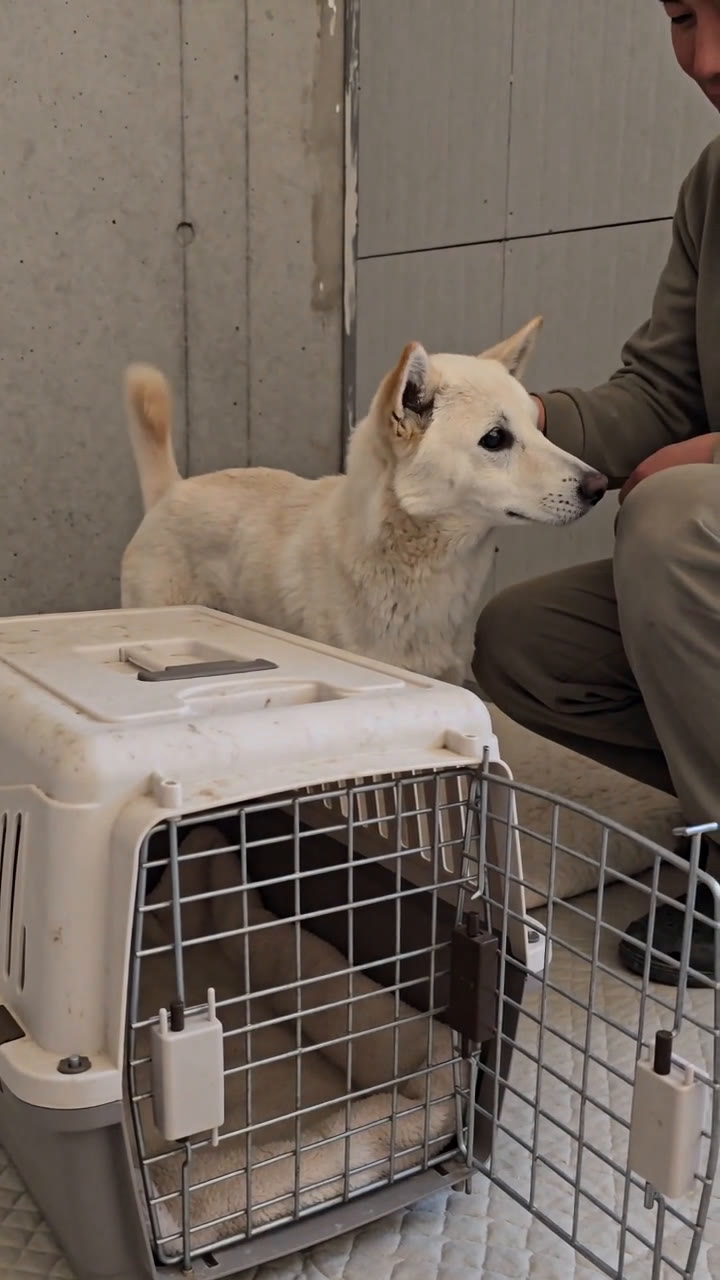
“She is a joy to my life,” he said.
Milo, another rescue, now lives in California with Michael and Sharaun Young and their rescue dog Zoey. When Sharaun first met him at the shelter, he wouldn’t let her touch him at all.
“Jump forward six months and he is a completely different dog – happy, healthy, always ready to play and always happy to see us,” she said.
“He never cowers in fear when I put a leash around his neck.”
Joy’s new home
And then there’s Joy.
The dog who was once pictured behind the rusted wire of a farm cage was photographed again after her adoption. This time she is in a soft dog bed, surrounded by toys.
The caption on that photo reads: “Adoption: Joy at her new home.”
No more cage. No more rusted wire. Just a bed, some toys, and a home of her own.
The difference a chance makes
The contrast between Joy’s two photos says what words can’t.
In the first, she is a dog nobody had chosen. In the second, she is a dog somebody chose, and brought home.
As Luna’s owner put it: “Dogs can be so much more to human beings than just a meal. Luna is living proof of that every day.”
So is Joy.
Why stories like Joy’s matter
Joy’s rescue was part of a much bigger effort. HSI said that getting to know the rescued dogs only made them more determined.
“Rescuing them and getting to know their personalities makes us even more determined to end the cruel dog meat trade,” Kelly O’Meara said.
The work of rescuers, transport teams and adopting families turned more than 100 farm dogs into family dogs.
One of them was a dog called Joy, who went from a rusted farm cage to a bed full of toys. ❤️
Story retold from public reporting (2015). Credit: Humane Society International / The Mirror (https://www.mirror.co.uk/news/world-news/saved-dinner-plate-meet-adorable-6736909). Photos are reference only; usage rights are pending and images will appear only once permission is granted.
Images in this article are illustrative recreations made for this story, not photographs of the dog.
