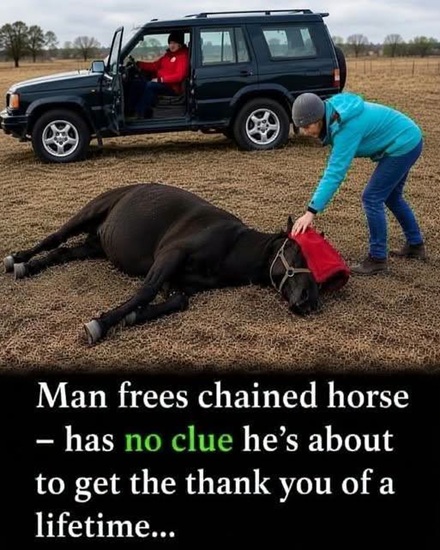
A widely circulated video capturing an animal rescue in Romania shows veterinarian Ovidiu Roșu assisting a free-roaming horse whose movement was severely restricted by a metal chain. The horse was discovered in the Letea region of the Danube Delta, an area renowned for its population of semi-feral horses. The chain’s presence hindered the animal’s ability to move normally and posed a risk of injury to its legs due to potential cuts or abrasions from the metal. Roșu approached the horse with caution and carried out the rescue in a controlled and careful manner. Once the horse was immobilized, the chain could be safely removed without exposing the animal or the rescuers to unnecessary danger. The incident gained widespread attention because of what happened immediately after the horse was freed. Video associated with the event depicts a second horse coming toward Roșu and touching him at close range. Numerous viewers read that conduct as an expression of gratitude or even described it as a “kiss.” While such an interpretation is understandable from a human perspective, it should not be regarded as a scientifically confirmed indication of the horse’s intentions. Horses communicate regularly through body language, proximity, movement, and physical contact. A brief nuzzle can occur in various social contexts and does not provide definitive insight into what an animal is thinking. The most accurate description is that another horse approached and touched Roșu after the chained horse was released.
The rescue also drew attention to a controversial method of restraint that has been documented in certain parts of Romania. Chains or other types of hobbles are sometimes attached to a horse’s legs to limit how far or how quickly the animal can move. In 2016, Horse Illustrated reported that unpadded metal restraints may wound a horse by pressing into its skin or through an excessively tight fit. For Roșu’s case, the restraint was so severe that veterinary intervention was necessary. Removing such equipment from a frightened, free-roaming horse is not a simple task that can be accomplished with a pair of cutters. The size and strength of these animals mean that trained handling techniques and veterinary judgment are crucial to ensure the safety of everyone involved. Ovidiu Roșu’s work with horses in the Danube Delta was part of a broader veterinary effort. The organization FOUR PAWS identified him as one of the veterinarians involved in managing the free-roaming horse population around Letea. His responsibilities included field immobilization, health assessments, and fertility-control procedures aimed at humane population management. A scientific study published in 2021 also listed Roșu as a co-author, evaluating chemical immobilization methods for feral horses in Romania. This research highlights the practical challenges faced when treating animals that cannot be approached and handled as domesticated horses are. Veterinary teams must weigh needed treatment against the dangers of tranquilizing and managing animals across exposed terrain. A complex past shapes the Danube Delta horse population that defies simple labels such as “wild,” making their classification incomplete and nuanced.
FOUR PAWS characterizes the local horse population as semi-feral and notes that these animals have inhabited the region for many centuries. Historical records cited by the organization link part of this population’s ancestry to horses that were left in the area centuries ago. The population experienced significant growth following the collapse of Romania’s communist regime in 1989, a period during which agricultural cooperatives underwent restructuring, leaving some working horses without their previous management. Over the subsequent decades, these free-roaming horses reproduced across the Danube Delta, leading to a rise in their numbers. This growth sparked concerns related to animal welfare and also prompted disputes over their impact on protected habitats. The Letea Forest, a designated protected area within the Danube Delta, became a focal point of conservation issues as the expanding horse population posed potential threats to its delicate ecosystem. Romanian authorities and conservationists voiced worries that uncontrolled grazing could harm the region’s sensitive vegetation. Simultaneously, proposals aimed at reducing the horse population raised serious concerns among animal-welfare groups. This debate underscored the complex balance between safeguarding individual animals and preserving the broader ecosystem, illustrating that sometimes difficult decisions are necessary rather than relying on simple slogans. Allowing the population to grow unchecked can exert pressure on available food sources and habitat space. Conversely, removing animals through inhumane methods such as capture or slaughter introduces its own welfare concerns. These conflicting issues became especially apparent in 2011. According to FOUR PAWS, more than 70 horses were rounded up in May of that year with the intention of transporting them to a slaughterhouse. The organization intervened, successfully halting the transport, and rescued over 40 of the animals. Following roughly half a year of recovery and care, those rescued animals went back to the Danube Delta. This incident marked a turning point in FOUR PAWS’ involvement with the Letea horse population. Instead of relying on repeated removals, the organization proposed a long-term management plan centered on fertility control. Starting in 2012, veterinary teams began implementing a birth-control program for the free-ranging horses. One of the methods employed was immunocontraception using porcine zona pellucida, commonly abbreviated as pZP. This treatment aims to temporarily reduce fertility in mares rather than permanently sterilize each treated animal. Since the effects are not necessarily permanent, veterinarians need to identify individual horses, administer the treatment, and return for follow-up procedures. This approach is more complex than a single intervention but allows for gradual population control without resorting to mass culling. FOUR PAWS reports that Romanian veterinary teams have utilized this program for over a decade. Population management was only one aspect of their efforts; the program also included veterinary care for sick, injured, and elderly horses, as well as ongoing herd monitoring. During winter months when forage was scarce, the organization provided hay to support the horses. Veterinarians also tracked the effects of fertility control measures and observed changes in the herd over time. These activities demonstrate that dramatic rescues of individual animals constitute only a small part of the organization’s long-term animal welfare work. Removing a single horse can immediately alter its circumstances, but maintaining a healthy population requires years of careful observation and repeated interventions.
The widely shared rescue involving Roșu stands out because it encapsulates a much broader issue within a brief, human-animal interaction. Viewers can immediately grasp that an animal, immobilized by a metal restraint, requires help. The subsequent close contact with another horse adds an emotional layer to the footage. However, accurately describing this scene necessitates avoiding assumptions about the animals’ feelings that cannot be confirmed solely from the video. It is reasonable to state that the second horse approached or nuzzled the veterinarian. Yet, labeling this behavior as an expression of gratitude crosses from simple observation into interpretation. This distinction is important because online descriptions of animal behavior often anthropomorphize, attributing human-like emotions or intentions that may not be justified. Horses are capable of forming social bonds, seeking contact, and reacting to the behaviors of other animals around them. These facts do not, however, allow humans to confidently assign specific thoughts or feelings to every movement or gesture. A video can be deeply moving without the need to invent an internal monologue for the animals involved. In this particular case, the observable events are already compelling: a horse restrained by chains received veterinary care, the chains were removed, and afterward, another horse approached Roșu. Maintaining this straightforward description preserves the emotional impact without turning interpretation into an unverified fact.
The situation involving the horses in the Letea area also evolved organizationally after more than ten years of involvement by FOUR PAWS. The organization announced that starting in 2025, it would transfer its equine programs in Romania and Jordan to the relevant local authorities. In Romania, the program had included work with both working horses and the semi-feral horses of the Danube Delta. FOUR PAWS characterized this transition as the culmination of a long period of direct intervention, rather than an indication that the core welfare responsibilities had been abandoned. Managing horse populations over the long term still demands ongoing oversight, veterinary support, and decisions regarding population size and habitat conditions. The handover signifies that these responsibilities are increasingly shifting to Romanian institutions and local organizations. This transfer underscores why a single rescue operation cannot be mistaken for a comprehensive solution. While individual animals may require urgent aid when injured or restrained, broader population management involves complex considerations such as animal health, reproduction, available habitat, and the condition of protected areas. Sustainable management also depends on resources and consistent effort, as fertility-control programs cannot succeed without repeated monitoring. The experience in the Danube Delta illustrates how veterinary medicine, animal welfare, and environmental management are interconnected. None of these responsibilities disappear once a viral rescue video ceases circulating online. The terminology used to describe the horses also warrants careful attention. FOUR PAWS has occasionally referred to the animals as “wild horses” in public materials, even though they are more accurately described as semi-feral or feral. True wild horses, and populations that descend significantly from domesticated ancestors, are not biologically identical categories. The horses in Letea live largely free from daily human management, which explains why they are often called wild in popular media. Nonetheless, their history includes domesticated ancestors and horses that were released or abandoned following major social and economic upheavals.
Describing these animals as either free-roaming or semi-feral provides a more precise understanding for readers. Visitors who come across free-roaming horses should keep in mind that these animals are not props for photographs. Even horses that appear calm can react swiftly if they become frightened, crowded, or approached too closely. Responsible observation involves maintaining a respectful distance and adhering to the guidelines established for the protected area. Additionally, feeding wildlife or semi-feral animals can alter their natural behavior and lead them to associate humans with food, which can have negative consequences.
The well-known rescue story involved trained veterinary professionals working under circumstances that necessitated intervention. It should not be treated as encouragement for visitors without proper training to go near these horses or attempt physical contact. Ovidiu Roșu’s encounter with the restrained animal remains compelling precisely because the events are verified and do not require embellishment. A veterinarian working in Romania’s Danube Delta encountered an animal whose movement had been severely restricted by a harmful metal restraint and assisted in removing it. Following this intervention, another horse approached and made physical contact with the veterinarian. This incident occurred within the context of a broader effort aimed at improving the welfare and management of the Letea horse population.
This larger initiative included veterinary treatments, ongoing population monitoring, and a long-term immunocontraception program, rather than relying solely on emergency rescues. The short rescue video is therefore connected to a much wider history of efforts to address the challenges faced by these horses. The horses in the Danube Delta have been shaped over centuries by human activity, evolving alongside changing agricultural practices and the distinctive landscape they now inhabit. Their population presents genuine challenges related to both animal welfare and habitat conservation.
Over the past decade, the response to these challenges has demonstrated that addressing population concerns does not necessarily require choosing between neglect and immediate mass culling. Veterinary care and fertility management have provided alternative solutions, though such programs demand ongoing commitment. Their success hinges on institutions continuing the work after the initial organizations step back. This account relies on publicly available reports and information from FOUR PAWS concerning veterinarian Ovidiu Roșu together with the Danube Delta horse population in Romania. The account consistently uses an outside, third-person viewpoint and does not claim that the author resides in Romania, witnessed the rescue firsthand, represents Romanian residents, or claims to represent FOUR PAWS, nearby communities, or any government body.
The text separates observed equine behavior from human interpretations about emotion, and the contact between the second horse and Roșu is not presented as scientifically proven gratitude. The article employs the terms “free-roaming” and “semi-feral” where appropriate, avoiding assumptions that every horse in the population is truly wild. The aim is to recount the verified rescue within the wider story, while avoiding fabricated eyewitness claims and never treating conjecture as established fact.