Can You Find Every One of the Four Objects Hidden in This Bed?
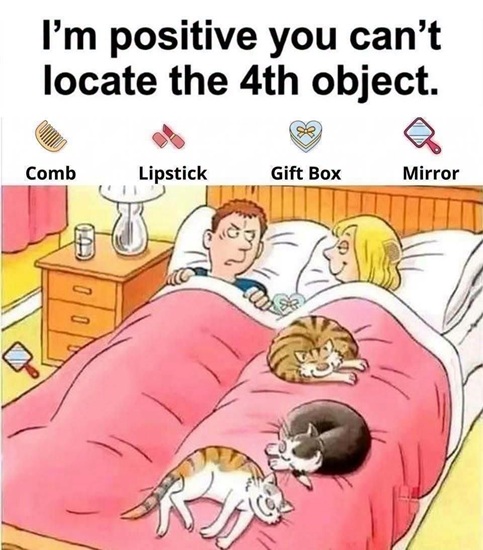
At a quick glance, this bedroom drawing seems perfectly straightforward. A man and woman are together in bed, with familiar furniture, sheets, walls, and part of the floor around them. Nothing looks especially strange at first, and that ordinary appearance is precisely what makes the visual challenge work. Four common items are concealed in the scene, but each has been placed somewhere people would not normally expect it. The goal is to find a comb, a small gift box, a mirror, and a lipstick tube.
Every item has been merged with another element of the illustration so that nearby shapes encourage the wrong interpretation. The difficulty comes from the way human vision distributes attention. Viewers usually focus first on the couple’s faces, the middle of the mattress, and the room’s largest features. Fine marks around those focal points are easy to dismiss because the brain rapidly settles on an explanation for what it sees. A dark mark among hair may register only as part of the hairstyle, while a rectangle on the covers can be mistaken for another fabric fold. The hidden objects are not truly invisible. They remain in plain sight, but their surroundings cause the viewer to classify them incorrectly.
The comb is one of the concealed targets. Rather than resting on a bedside table, dresser, or bathroom counter, it has been incorporated into the woman’s hair. Its teeth align closely with the strands and texture of her hairstyle, so they initially seem to be normal hair lines. Anyone searching only for a separate grooming tool may look straight past it. A useful clue is to notice a row of parallel marks that appears more evenly spaced than real strands would be. As soon as the comb is identified, its shape becomes much more apparent.
This hiding place shows a classic technique in visual puzzles. An illustrator disguises an item by matching its most recognizable feature to a pattern already present elsewhere. A comb has a repeated line of teeth, and hair is also drawn with many narrow strokes. Combining those similar patterns lets one form conceal the other. Expectation completes the illusion: because a person does not anticipate finding a comb embedded within a hairstyle, the mind selects “hair” as its first explanation.
The next target is the little gift box. It sits on the bed between the two people, where several shapes, edges, and folds overlap. The box’s straight boundaries merge with pillows, bedding, and the crowded space formed by the couple. The center of the picture already contains a great deal of information, allowing a small geometric form to vanish more effectively than might seem possible. Someone can stare at that spot repeatedly without realizing the item is there. Concentrating on square corners, rigid lines, or a compact box outline makes it easier to separate from its background.
The gift illustrates the effect that visual clutter has on attention. When many outlines cross or overlap, the mind tends to combine them into one larger scene instead of examining every boundary on its own. Blankets naturally produce corners, blocks of color, shadows, and creases, giving the artist plenty of camouflage for a rectangle. The box does not need to be fully covered. It only has to resemble the surrounding shapes closely enough. Once the viewer temporarily stops interpreting the area as “the bed” and starts looking strictly for geometry, the object can suddenly become obvious.
The mirror is the third item to locate. Unlike the comb and the present, it is not placed in the most attention-grabbing area. It appears down toward the floor, so anyone who continues searching only around the couple may miss it entirely. Its outline blends with the lower room and can initially be read as flooring, furniture, or decoration. This placement pushes solvers to move their eyes away from the main figures and examine the bottom of the illustration, where details were probably skipped during the first scan.
Mirrors can also be tricky targets because they do not share a single standard silhouette. One may be circular, another oval or rectangular, and a handheld version may include any number of frame styles. In this image, searching for the suggestion of a reflective surface or framed border is more effective than imagining one specific household mirror. If there is a handle, its thin extension may stand out before the reflective part does. Looking for components instead of a fully formed object is often the most productive method in this kind of puzzle.
The remaining hidden object is lipstick. It lies along the lower-right area of the comforter near the floor. The cosmetic’s slim shape follows the blanket’s edge and design closely enough to resemble a decorative stroke instead of a separate tube. Lipstick usually appears on a vanity, beside a mirror, or inside a purse, so its strange location works against recognition. The eye reports bedding before the mind considers makeup. Searching for a narrow cylindrical form helps the tube emerge from the surrounding fabric.
This placement uses another reliable puzzle trick: put a familiar thing where it makes almost no practical sense. People recognize objects partly through context. A toothbrush next to a washbasin is quickly understood because both the form and setting match expectations. Hide the same shape among branches and recognition takes longer because the environment argues against it. Here, the lipstick has always been visible, yet its position on the comforter persuades the brain to treat it as part of the textile. The location becomes camouflage.
Together, these four locations explain why the picture remains challenging even after the solver knows the names of all the targets. The task is not merely to understand what a comb, present, mirror, and lipstick look like. It is to detach those shapes from the visual structures that surround them. Context normally lets people make sense of complicated scenes very quickly, which is enormously useful in daily life. A puzzle designer simply turns that same shortcut against the audience. A recognizable outline becomes unexpectedly elusive when it appears in an illogical place.
One effective way to approach the challenge is to divide the illustration into smaller zones instead of sweeping across the whole scene again and again. Begin with the people, checking their hair, clothes, hands, and nearby outlines. Move next to the mattress and study the pillows, sheets, comforter, and the gap between the figures. Then examine the bedside furniture, wall, floor, and outside edges. Working section by section reduces the quantity of information being processed at once and prevents the same dominant region from continually pulling attention back.
It also helps to search for the defining feature of each target. For the comb, seek a regular series of close parallel teeth rather than waiting for the complete grooming-tool outline. For the gift, concentrate on straight sides, squared corners, a possible lid, or something resembling ribbon. For the mirror, isolate a framed reflective shape or a slim handle. For lipstick, look for a short tube or cylinder. Breaking an object into basic visual ingredients makes it easier to identify when the overall silhouette has been disguised.
Distance from the image can change what a viewer notices. Moving close to the display reveals tiny strokes, but looking from too near can make it harder to combine those strokes into a familiar form. Taking a small step back may cause scattered lines to resolve into an object. Zooming both inward and outward can therefore be helpful. The drawing remains identical, but scale and viewing angle alter the way its information is organized. An edge that disappeared into a pattern can become noticeable after a simple change in size.
Some solvers cover one area of the picture while examining another. That blocks faces and other strong focal points from repeatedly attracting the eyes. A slow left-to-right pass followed by a top-to-bottom scan is another useful technique. Systematic searching often works better than jumping randomly between attractive details. Although speed can make the game exciting, deliberate inspection increases the chance of finding an unusual line or an outline that does not quite belong.
It is worth emphasizing that hidden-object pictures are entertainment, not scientific tests of intelligence, perception, or general mental ability. A person who discovers everything immediately is not automatically smarter than someone who needs more time. Results depend on eyesight, display quality, picture dimensions, previous experience with similar games, and knowledge of the tricks illustrators tend to use. Even screen brightness or compression may determine whether a faint boundary is clear.
Experience in particular can provide a major advantage. Frequent puzzle solvers often check hairstyles, blanket wrinkles, frame edges, corners, and shadows without consciously deciding to do so, because those are common hiding locations. Someone trying such an image for the first time may concentrate on obvious surfaces like tables and drawers. That difference reflects learned technique rather than any important gap in intelligence. After people understand how visual camouflage works, later challenges frequently become easier because they begin hunting for inconsistencies instead of simply absorbing the scene as a whole.
The image also demonstrates how powerfully expectations shape perception. Everyone associates combs with grooming, but the tool is normally beside the person rather than woven into her hair. Gifts are expected to sit apart from their surroundings, not merge into sheets. Mirrors usually belong on furniture or walls, and lipstick is generally found with personal belongings. Once those assumptions are violated, extremely familiar things become difficult to identify. The eyes still receive the lines; the brain merely assigns them a different meaning.
This is not limited to illustrated games. Ordinary vision depends strongly on context because separately analyzing every mark in the environment would be inefficient and slow. People identify things by combining outline, color, placement, prior knowledge, and neighboring information. Hidden-object artists exploit this efficient process by supplying clues that disagree. A shape may suggest “comb,” while its color and position insist “hair.” Until focused attention detects the contradiction, the larger scene usually wins.
That is why a located item becomes so difficult to unsee. Before the comb is recognized, a person can look directly at its teeth and detect nothing unusual. After the discovery, those same teeth leap out. The identical shift happens with the gift, mirror, and lipstick. No pixel or line in the illustration changes. Only the viewer’s interpretation changes. Once the brain groups the marks into the correct meaningful shape, details that seemed random begin to operate as a single object.
This sudden reorganization produces the familiar feeling of disbelief: how could something now so obvious have gone unnoticed? The answer is that being visible is not the same as being recognized. Recognition depends on how the mind arranges the information supplied by the eyes. By separating those two processes in a playful way, hidden-picture puzzles make an everyday feature of perception easy to experience.
The challenge can be enjoyable for a group as well. Friends or relatives may study the same picture and compare how long each needs to identify all four targets. If the comparison is meant to be fair, everyone should use approximately the same display size and search for the same amount of time. Giving away exact positions immediately removes the most satisfying part, so gradually more specific clues are a better response when someone gets stuck.
An initial hint might say only that none of the objects is where it would normally be kept. If more help is necessary, the next clue can mention that some forms are blended into the people or their bedding. Later, a helper can identify broad regions such as the hair, mattress, or floor while avoiding the exact spot. Effective hints reduce the search area without completing the task for the solver, keeping attention active instead of replacing observation with a direct answer.
For children, the same activity can encourage descriptive vocabulary. Rather than asking only whether an item was found, an adult can ask which feature made it recognizable. A child might notice that the comb’s teeth were more evenly spaced than strands of hair, or that the gift’s rigid sides differed from soft blanket folds. Explaining the evidence rewards close looking and turns the puzzle into more than a race to call out a location.
Adults can compare methods in much the same way. One person may begin in the center because the characters dominate the composition. Someone else might inspect corners first, knowing that artists like to conceal items beyond the main focal area. Another participant may ignore likely locations and look only for lines, angles, and geometric forms. Talking about these approaches can be more revealing than simply recording who finished fastest, since every strategy shows a different way of organizing visual information.
Frustration often peaks when three items have been found and only one remains. At that point, people commonly revisit the successful locations instead of exploring new territory. A deliberate change of method can break the loop. If the earlier discoveries occurred around the figures and bed, inspect only the floor and borders. If searching by place no longer works, switch to structure. Asking “Where is a thin cylinder?” may be far more productive than repeating “Where is the lipstick?”
Ignoring color can also help. Camouflaged items are often shaded to match whatever surrounds them, making hue a poor guide. Direction and shape may offer stronger clues. An unnaturally neat group of parallel strokes among irregular hair can expose the comb. Square corners amid flowing fabric can betray the gift. A rigid narrow form against a curved comforter can identify the lipstick.
The four targets do not all use camouflage in exactly the same way. The comb is conceptually connected with hair, yet physically merging it into the hairstyle confuses object and setting. The gift has little logical relationship to bedding, but its angular edges vanish among folds. The mirror relies heavily on being placed below the area most people study first. Lipstick combines an unlikely location with a silhouette that can pass as part of the comforter’s design. Each one takes advantage of attention in a slightly different manner.
Learning these techniques offers a shortcut for future puzzles. Watch for marks that are suspiciously uniform, forms that seem more geometric than nearby organic shapes, and outlines incorporated into hair, clothing, furniture, or architecture. Boundaries between visual regions deserve special attention. An illustrator can hide part of an object in one zone while allowing the rest to merge into another. Intersections, corners, and overlapping forms are especially useful places for visual concealment.
The bedroom drawing is consequently more calculated than its simple style suggests. The couple, cats, furniture, and bedding establish an instantly readable scene and capture attention, while the targets occupy secondary visual roles. Viewers understand the overall situation before they investigate the individual marks used to construct it. That normal order of perception creates the trick. A second layer appears only when the viewer slows down and deliberately questions the first interpretation.
There is no reason for concern if the search takes a while. A large monitor may make thin boundaries much easier to see than a small phone. Image compression, low brightness, and limited resolution can erase subtle distinctions. Differences in visual acuity also change the experience from one person to another. These practical variables reinforce why the picture should remain a light attention game rather than a verdict on anyone’s ability.
Anyone who wants to solve the challenge before seeing the locations should keep the four goals in mind: comb, gift box, mirror, and lipstick. Search methodically instead of looking only in sensible places. Check the hair, every section of bedding, the room’s lower area, and the outer edges. Follow outlines and basic shapes rather than trusting color. Allow enough time for the first impression to weaken before turning to the solution.
When the search is finished, the hiding places are easy to describe. The comb sits within the woman’s hairstyle, where its row of teeth passes for hair. The small gift is between the couple on the bed, merging with the shapes around it. The mirror lies close to the floor, beyond the part of the picture that attracts the most immediate notice. Lipstick follows the comforter’s lower-right edge near the floor. Knowing those zones makes every item much easier to separate from the illustration.
That change from concealment to clarity provides the puzzle’s reward. While searching, the objects can seem almost nonexistent. Once found, they are so plain that it becomes hard to remember why they were missed. The effect shows that perception requires more than having an image directly before the eyes. Context, attention, expectation, and experience all influence which shapes become meaningful. Every target was present from the start; the real task was convincing the brain to reorganize what it had already seen.
Ultimately, this bedroom scene works best as a playful observation challenge, never as a measure of intelligence. Some viewers will locate the entire set rapidly, while others will make several careful passes or ask for a hint. Both reactions are normal. The pleasure comes from seeing how ordinary objects can effectively disappear when an artist places them inside unexpected patterns. A comb, a gift box, a mirror, and a lipstick tube become remarkably elusive because the drawing first persuades the audience to see nothing more than hair, bedding, furniture, and decoration.