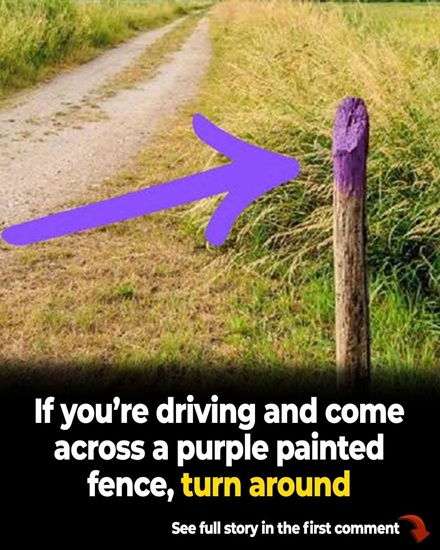
While hiking, driving along countryside routes, exploring dense woodlands, or traveling near private rural acreage in various parts of the United States, travelers occasionally encounter an unfamiliar sight along fence posts and boundary trees: a vertical band of bright purple paint. At first glance, the distinctive coloring might look like random decoration or an accidental splash, but across numerous states it carries serious legal significance. Purple paint is formally utilized in several jurisdictions as an official mechanism for property owners and land lessees to post their property and legally announce restrictions regarding unauthorized entry or recreation. Because the exact statutory force differs from state to state, noticing purple markings along a perimeter should immediately prompt caution rather than casual guesswork. Before stepping across a marked property border, the safest course of action is to establish whether the parcel is privately owned and how state law regulates access. The foundational logic behind purple-paint statutes is straightforward: landowners historically relied on physical signs to declare that acreage was posted, private, or off-limits to uninvited visitors.
Traditional signs certainly convey messages clearly, but they also suffer from significant practical vulnerabilities over extended periods. Cardboard and paper notices quickly rot, plastic boards become brittle under weather extremes, and aluminum signs can be bent, damaged, or torn down. Thick vegetation frequently conceals them, harsh weather renders their lettering illegible, and missing notices require repeated replacement. Applying specialized paint directly to tree trunks or boundary posts provides a durable alternative that removes the necessity of hanging separate physical signs along every few paces of a remote border. Travelers must not assume, however, that an entire fence coated in purple paint automatically holds identical legal standing across every jurisdiction. State statutes outline explicit paint-marking specifications rather than declaring that any purple surface creates universal legal notice. Laws commonly govern the vertical orientation, length, width, height from the ground, interval spacing, visibility, and placement of qualifying marks. A legally binding marker in one territory may fail to satisfy the statutory criteria in another, which is why accurate guidance must examine specific state regulations rather than presuming a single federal standard.
Arkansas played a pioneering role in the history of modern paint-posting legislation. In 1989, the Arkansas legislature passed Act 35, establishing a formal procedure that authorized landholders and lessees to post real property using paint markings under precise regulatory standards. The statute mandated vertical stripes measuring at least eight inches in length while dictating strict rules regarding their vertical height, placement, visibility, and perimeter spacing. The law additionally authorized the state forestry commission to designate the official color required for the warning system, which subsequently established light purple exterior-grade paint for property posting. Arkansas’s active statute continues to recognize light purple as the approved color for posting real estate. This regulatory standing elevates the color far above decorative art when applied in accordance with official Arkansas posting guidelines. Anyone encountering qualifying purple paint in Arkansas must recognize that the markings serve as an intentional, legally backed restriction against unauthorized entry.
The 1989 Arkansas statute also clarified that paint markings were intended as an additional legally authorized option alongside traditional signs rather than an exclusive replacement. The primary objective was to expand and modernize recognized posting techniques for property owners. That distinction is helpful because purple paint was never meant to eliminate every conventional sign. Instead, it equips landowners with an efficient supplementary tool for securing their land. The paint system resolves a major practical hurdle for individuals managing expansive rural acreage. Erecting and maintaining dozens or hundreds of nailed signs along remote miles of boundary requires substantial ongoing labor. Paint applied directly onto tree bark or fence posts stays in place without falling off, breaking loose, or being stolen. When maintained properly and applied according to statutory measurements, it provides an unmistakable and durable visual boundary.
Texas offers another prominent example of how purple paint carries binding legal weight. Under the Texas Penal Code’s criminal trespass provisions, qualifying purple paint stripes function as formal legal notice that unauthorized entry is strictly prohibited. The Texas statute mandates that the marks must be vertical stripes measuring a minimum of eight inches in length and at least one inch in width. Their vertical positioning is similarly defined: the bottom of every qualifying mark must sit at least three feet above the ground and no higher than five feet. The paint must also be clearly visible to any individual approaching the perimeter. Permitted spacing distances vary based on landscape classification. In forest areas, qualifying marks must appear at intervals of no more than 100 feet, whereas on open non-forest acreage, marks may be spaced up to 1,000 feet apart.
These explicit specifications illustrate why simply stating that ‘purple means no entry’ overlooks critical legal details. Texas law does not proclaim that any random purple dab automatically establishes statutory notice; rather, it prescribes an exact geometric and physical methodology for valid posting. Understanding those rules helps people distinguish deliberate boundary warnings from unrelated forestry or utility marks. For outdoor explorers navigating rural acreage, however, evaluating a purple marking as a legal loophole is unwise. If vertical purple stripes appear deliberately and repeatedly along a fence line or woodland border, the only sensible response is to stay out until property ownership and access permissions are fully verified. Respecting a marked boundary avoids the severe legal complications of discovering after the fact that the markings constituted formal criminal notice.
North Carolina further proves why state-by-state distinctions are vital. State legislation permits property owners and lessees to apply identifying purple paint stripes to trees and posts when posting land under statutes governing entry for recreational purposes, including hunting, fishing, and trapping. Under North Carolina law, the vertical stripe must measure at least eight inches long, with the bottom of each mark positioned between three and five feet from the base of the tree or post. Furthermore, marks must be placed no more than 100 yards apart and remain easily visible to approaching visitors. North Carolina statutes specify that willfully entering properly posted land to hunt, fish, or trap without required written authorization constitutes an offense, alongside separate regulations governing pine straw harvesting. This framework demonstrates that North Carolina’s system cannot be treated as identical to Texas’s general criminal trespass statute.
This jurisdictional divergence underscores a fundamental rule: while purple-paint frameworks share a visual concept, their exact legal boundaries depend on local state law. Hikers, anglers, hunters, campers, and travelers must never assume that understanding one state’s posting code explains the legal landscape across state borders. The question often arises: why do landowners prefer paint over traditional signs? Conventional ‘No Trespassing’ and ‘Private Property’ signs remain widely utilized and easy to interpret because they present their message in plain text. Yet maintaining signs across hundreds of acres presents continuous logistical challenges, particularly along rugged terrain and dense timber. Weather is a constant destructive factor. Rain, ice, heavy snow, intense sunlight, and wind steadily deteriorate paper, wood, and metal signs.
Fasteners loosen, wooden posts rot, and wild vegetation quickly overgrows signs that were once obvious. Even rugged aluminum signs demand recurring inspections. Signs are also frequently removed, whether through accidental damage, fallen branches, or intentional vandalism. Landowners relying purely on signs must continually patrol extensive perimeters to replace missing boards. Paint possesses distinctly superior durability. Once applied directly onto stable trees or fence posts, it cannot easily detach like a physical board. While paint may eventually fade over seasons, it avoids the vulnerability of separate objects nailed to posts. Applying paint is especially practical on heavily wooded acreage where dozens of trees naturally line the property line. The paint forms a cohesive, repeating visual boundary that visitors learn to recognize instantly.
Seeing purple paint should always prompt attention, though understanding surrounding context remains essential. Purple is utilized in outdoor settings for various purposes beyond property posting, including forestry timber marking, utility easements, land surveys, trail navigation, and construction projects. The true meaning of any mark depends on its physical shape, spacing pattern, local regulations, and landscape setting. This is why statutory standards are so precise: purple-paint laws describe a specific geometric pattern designed to function as unmistakable notice. A small, irregular purple dot on a tree is not legally equivalent to a series of vertical, evenly spaced statutory stripes. Nevertheless, visitors should never use visual ambiguity as an excuse to cross an apparently marked perimeter.
If acreage appears privately held and repeated vertical purple marks line its border, the correct decision is to halt and confirm access rights before advancing. Consulting trail maps, park management authorities, land records, or property owners clarifies whether entry is permitted. Securing permission beforehand prevents heated confrontations and protects both visitors and landowners. Another common misconception is the belief that purple paint carries a single, uniform federal law across the entire nation. Property rights and trespass statutes are primarily regulated at the state level, and statutory definitions differ substantially. Certain states enforce purple paint as comprehensive criminal notice for all unauthorized entry.
Other states apply paint posting exclusively to specific activities such as hunting, fishing, or trapping. Measurement specifications, required heights, and spacing intervals also vary widely between state codes. The roster of states adopting paint-posting laws continuously evolves as state legislatures introduce or amend statutes. Consequently, broad online claims declaring an exact national count of ‘purple paint states’ quickly become outdated. When planning outdoor recreation, checking the current statutory code of the destination state is far more reliable than relying on generalized summaries. This is particularly crucial for travelers crossing state lines, as a hunter accustomed to local rules may encounter different requirements in a neighboring state, while international visitors may never have heard of color-coded property posting.
Traditional signs communicate directly through written language, allowing anyone who reads ‘Private Property’ to understand immediately without prior knowledge of a color code. Purple paint operates differently because its legal significance remains unknown to uninformed observers. An inexperienced hiker might assume a purple stripe indicates a public trail blaze or forestry project. This creates a compelling need for public education regarding property posting laws. When outdoor enthusiasts learn that repeated purple stripes signify legal property boundaries, they are far more likely to stop rather than inadvertently wander onto private acreage. Statutory placement rules ensure marks are painted at eye level and spaced closely enough to prevent travelers from accidentally missing them.
Physical posting systems are essential because property lines are often invisible in natural landscapes. Someone walking through a forest may observe no obvious visual change between public parkland and private property. There may be no stone wall, no nearby residence, and no physical wire fence. A dirt track or footpath can seamlessly continue across multiple private holdings, tempting visitors to assume that public access continues uninterrupted. Vertical paint stripes, posted boards, fences, and gates communicate that legal property rights have changed even when the natural scenery remains identical. This is particularly common where national forests, state lands, and private parcels sit directly adjacent to one another.
Hikers exploring established public paths should strictly remain on designated trails and respect marked borders. If an informal path appears to diverge from public grounds and cross a boundary marked with purple paint, the mere existence of a worn path does not grant public permission to follow it. Historic logging roads, farm tracks, and utility corridors remain visible for decades after their active use ends, yet they were built for private operations rather than recreational hiking. Digital smartphone maps can also display outdated trail information, and seeing a route on a screen does not create a legal right of way across private land. When trail status is uncertain, turning around is always the safest option.
Purple-paint statutes are especially critical for hunters and anglers because several state posting laws specifically regulate recreational harvesting on private lands. North Carolina’s posting statute serves as a prime example, connecting purple paint directly to hunting, fishing, and trapping activities. Anyone engaging in outdoor field sports must understand access laws and written permission rules in the jurisdiction. The fact that land looks wild and undeveloped never implies that it is open public property. Woodlands, marshes, ponds, and streams frequently form part of privately owned parcels, regardless of whether a farmhouse is visible nearby.
Public descriptions sometimes refer to the rule as a ‘purple fence,’ but statutory systems focus on paint marks applied to posts and trees rather than requiring an entire fence line to be painted purple. If a physical fence already encloses property, the barrier itself demands respect. Fences serve vital agricultural and safety functions, including containing cattle, protecting crops, and securing land. Adding purple paint to fence posts reinforces legal notice where state law recognizes the color. Visitors must never climb over, crawl beneath, cut, or open a closed gate simply because a traditional printed sign is missing. The lack of a written sign does not grant uninvited access to private property.
Outdoor visitors must never tamper with property markers. Removing a posted sign or painting over a purple stripe interferes with a landowner’s legal notification. North Carolina, for instance, specifically outlaws the destruction, mutilation, or removal of posted property notices, and other states impose similar penalties for defacing markers. Beyond legal consequences, altering boundary marks endangers subsequent visitors by creating confusion. For landowners planning to utilize purple paint, buying random spray paint and applying arbitrary marks will not satisfy legal requirements. Texas, North Carolina, and Arkansas each define precise line lengths, widths, heights above ground, visibility standards, and spacing intervals. Property owners must consult current official statutes before applying paint for legal notice.
Purple paint succeeds because outdoor recreationists learn to associate the distinctive visual signal with property boundary restrictions. Once the code is understood, repeated vertical markings communicate access rules quickly along miles of rural perimeter where maintaining hundreds of signs would be impractical. However, the system relies entirely on public awareness. Visitors must also remember that established hiking networks often use colorful trail blazes for route navigation. If an unfamiliar hiker spots paint, they must evaluate the shape, vertical orientation, and spacing: statutory property markers follow specific vertical dimensions rather than casual trail arrows. When in doubt, verifying the route prevents unintentional trespass.
Landowners frequently combine traditional signs at gates and primary access roads with purple paint stripes along wooded perimeters, making their boundary intentions unmistakable. When fences, locked gates, signs, and purple paint all indicate a private border, proceeding without permission cannot be justified as an accident. Penalties for unlawful trespass vary across states, ranging from misdemeanors to heightened charges depending on circumstances. When legitimate access to private land is required, obtaining explicit written permission from the owner is the safest and most respectful solution, ensuring peace of mind for both landowners and outdoor visitors.