
Gilligan’s Island is still among the best-known American television comedies to emerge from the sixties, despite spending just three seasons on network television. CBS introduced the sitcom on September 26, 1964. Its story began when seven travelers became marooned on an unmapped island after setting out on what should have been an easy three-hour sightseeing trip. Bob Denver took the role of the accident-prone Gilligan, and Alan Hale Jr. became the Skipper, a captain forever irritated by him but plainly fond of him as well. Jim Backus and Natalie Schafer played wealthy husband and wife Thurston and Lovey Howell. Tina Louise appeared as film star Ginger Grant, Russell Johnson portrayed the ingenious Professor, and Dawn Wells played Mary Ann Summers.
Those seven sharply different personalities formed a comic ensemble whose popularity lasted much longer than the original broadcast. Repeated airings, reunion specials, cultural references, and decades of nostalgia eventually secured the show a permanent place in American TV history. Its straightforward setup was part of the reason the formula worked so well: within that island setting, the writers could introduce almost any kind of adventure.
Strange visitors repeatedly reached the island, including explorers, entertainers, scientists, lawbreakers, and all sorts of other unexpected guests. Yet after every encounter, the castaways somehow remained behind. The Professor was capable of assembling astonishingly elaborate machines from whatever the island supplied, but restoring the Minnow or arranging a lasting rescue always remained impossible. Gilligan often destroyed a promising escape plan without ever meaning harm. The Skipper might explode with frustration, but the warmth behind his familiar “little buddy” relationship with Gilligan was never far away. The series was designed as broad comedy, not as a credible lesson in wilderness survival, and its exaggerated logic became a major source of its appeal.
Watching the episodes closely today uncovers another layer of entertainment: visual oddities, production shortcuts, and continuity slips that were much less noticeable during their first broadcasts.
The Unexplained Extra Person Aboard the Minnow
The celebrated title sequence communicates the basic story in moments. The Minnow departs on a cheerful three-hour excursion that will end with everyone stranded. The audience expects the familiar group of seven, but a careful look at the distant boat footage reveals an intriguing discrepancy. In one shot, there appear to be eight people aboard rather than the number the story establishes.
An extra figure seems to be controlling the real vessel while the people representing the castaways are positioned elsewhere. No episode identifies that individual, and the show never explains an additional survivor. A practical production explanation makes the most sense: someone needed to operate the actual boat during filming and remained visible in the wide shot. Whatever happened behind the camera, the unidentified figure has become one of the most enjoyable mysteries hidden in the opening credits.
The sequence offers other clues about how a studio comedy was assembled. One single boat did not portray the S.S. Minnow in every circumstance. Several vessels and sets stood in for it, which means observant viewers can see differences from shot to shot. IMDb production notes associate four different vessels with the Minnow, among them a craft hired in Honolulu for title footage and a version constructed at CBS Studios.
That kind of substitution was ordinary television practice, especially for a program mixing real-location material with studio-lot scenes. People watching relatively small screens at the time had little reason or ability to stop a frame and inspect every background element. Digital copies and modern displays now allow fans to compare those tiny differences far more easily.
A National Tragedy Preserved in the Background
One of the opening’s most striking details is not a comedy mistake at all. Work on the original pilot coincided with a devastating event in American history: President John F. Kennedy was assassinated on November 22, 1963. At that time, cast and crew members were filming in Hawaii and learned the news while the production was underway.
Because the real world surrounded the fictional voyage, a historically meaningful image was captured in the harbor footage. In the first-season opening, an American flag appears briefly at half-staff as the Minnow heads away from port. The moment is very easy to overlook because the moving vessel and familiar theme naturally command the viewer’s attention. Still, that background flag connects a light fictional excursion with the genuine national grief present during filming.
The contrast becomes especially powerful many years later. Audiences associate Gilligan’s Island with harmless escapism, unlikely inventions, slapstick accidents, comic confusion, and implausible strangers arriving at an allegedly isolated place. Yet its makers were working within the same painful historical reality as everyone else. The flag was not placed there afterward as a dramatic reference. It belonged to the environment captured by the camera. A few seconds of popular entertainment therefore preserved a direct link to a major historical moment, which is precisely why production history can reveal so much beyond the scripted story.
Alan Hale Jr.’s Unusual Trip to the Skipper Role
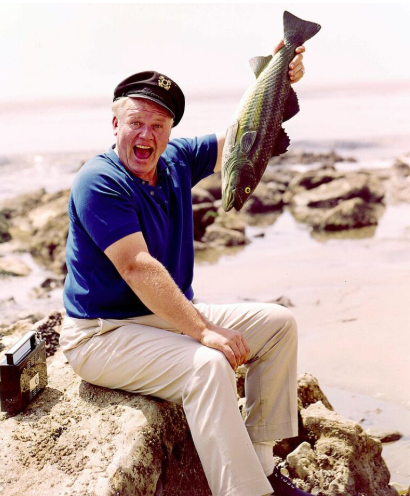
Alan Hale Jr. became so completely identified with the Skipper that another actor in the role is now hard to picture. Reaching the audition and production opportunity, however, reportedly demanded far more than crossing Los Angeles. Hale was working on the Western Bullet for a Badman at a remote Utah location when the chance to join Gilligan’s Island appeared.
Retellings of the casting story say he first rode away from the film location on horseback, made his way to a highway, caught a ride toward Las Vegas, and finally flew to Los Angeles. At the same time, he could not simply desert the movie work to which he was already committed. The remarkable effort succeeded, and Hale became Captain Jonas Grumby—the man viewers everywhere would know simply as the Skipper.
Carroll O’Connor, later famous for playing Archie Bunker in All in the Family, was reportedly among the performers considered. Hale proved an ideal choice because the character had to balance several qualities at once. The Skipper could be booming, impatient, intimidating, and furious whenever another rescue opportunity collapsed. But he could never seem truly heartless, because his devotion to Gilligan gave their partnership its emotional center.
Hale made it believable that the captain could scold Gilligan in one instant and protect him in the next. His large frame beside Bob Denver’s smaller presence also created a memorable visual pairing. Together they kept repeating variations of the same basic conflict while making those exchanges feel distinctive and affectionate. In time, “little buddy” became inseparable from both their friendship and the identity of the entire series.
The Bizarre Events of “The Friendly Physician”
Among the program’s strangest adventures is “The Friendly Physician,” broadcast during Season 2 in April 1966. Guest performer Vito Scotti played Dr. Boris Balinkoff, an eccentric researcher whose apparent promise of help turns disturbing and surreal. Instead of returning the castaways to society, Balinkoff intends to make them subjects in his experiments.
The plot eventually suggests that the characters have exchanged bodies, letting members of the ensemble copy the gestures and personalities of their costars. Episode notes point out that this is a story in which the group leaves its own island and that it contains the show’s memorable body-switching device. Scotti later reprised Balinkoff in the third-season installment “Ring Around Gilligan.”
The ending of “The Friendly Physician” contains a revealing filming error. While the castaways travel back, the framing allows buildings to appear in the distance, even though such structures clearly cannot belong beside the supposedly remote island. Creating the tropical illusion depended on sets, plants, controlled camera angles, and other production techniques. When a shot extended beyond those boundaries, pieces of the real studio surroundings could slip into view.
The error probably passed unnoticed by many people during the original transmission. It becomes much clearer when the episode is paused or replayed on modern equipment. Far from destroying the fun, it offers a brief look at the physical production hidden outside the carefully composed island world.
How the Professor and Mary Ann Escaped “The Rest”
Longtime fans know the story behind the change to the theme song. In the first season’s lyrics, the singer names Gilligan, the Skipper, the millionaire with his wife, and the movie star. The two people left over are dismissed collectively as “the rest.” Those unnamed castaways were Russell Johnson’s Professor and Dawn Wells’s Mary Ann.
Their omission feels especially peculiar now because both became indispensable to the ensemble. Starting with the second season, the theme was revised to identify the Professor and Mary Ann individually. Bob Denver was influential in pressing for Johnson and Wells to receive that opening recognition.

The correction reflected what viewers already saw in the stories. Whenever a plot required a scientific theory, a gadget, or a proposed solution, the Professor supplied it. Mary Ann’s warmth, grounded manner, and practical personality provided a counterweight to the broader figures around her. Neither performer functioned merely as decoration, and both inspired loyal followings. Wells remained closely connected to Mary Ann throughout the rest of her life.
Changing the song did more than resolve a credit dispute. It cemented the image of all seven people as one recognizable group. Syndicated repeats then carried those names to generations of viewers, including many who never watched the entire series but could still recite the castaways from the theme.
The Joke Behind the S.S. Minnow’s Name
Minnow seems like an obvious name for a modest tour vessel, yet its origin was reportedly a deliberate industry joke. The boat was named after Newton Minow, chairman of the Federal Communications Commission. In a widely remembered 1961 address, Minow criticized broadcasting and famously called television a “vast wasteland.”
Creator Sherwood Schwartz turned the commissioner’s surname into the name of the doomed craft, offering a playful response from someone making programs in the very medium Minow had attacked. The reference gives a second meaning to what most viewers understandably assumed was only the name of a small fish.
Although represented by different boats and constructed sets, the Minnow became nearly as iconic as the human cast. Its failed sightseeing trip is the reason every episode can occur. The contrast between a carefree excursion and the enormous consequences of the wreck sits at the center of the premise. Even now, merely hearing “three-hour tour” can immediately summon the tune and the castaways for people familiar with the show.
Visible Production Slips in “Two on a Raft”
The first regular installment, “Two on a Raft,” includes several small technical mistakes that dedicated viewers enjoy locating. Gilligan and the Skipper launch a handmade raft in hopes of reaching assistance. During that sequence, evidence of the crew’s equipment intrudes on the make-believe adventure: the shadow of a boom microphone can be spotted in part of the footage.
Microphone shadows were hardly unique to this sitcom. A particular combination of lights, lens position, performers, and sound equipment could easily place one inside the frame. On a sharp contemporary screen, however, the shape is much easier to notice than it would have been on an ordinary television in 1964.
The same episode includes a memorable bit in which Gilligan hides in a hollow tree and a woodpecker starts hammering at the trunk. The gag succeeds as physical comedy, even if it makes little sense as island ecology. Woodpeckers do not naturally inhabit remote oceanic islands of the kind the fictional setting is meant to resemble.
Accuracy about animals was never the purpose. Wildlife, weather, vegetation, geography, and inventions changed according to the joke or adventure needed that week. The bird belongs to classic sitcom logic: earning the laugh mattered much more than maintaining a scientifically credible habitat.
The Moment Mrs. Howell Opens Her Eyes
Another tiny slip occurs in a third-season story featuring butterfly specialist Lord Beasley. The castaways see their guest as yet another potential route home, but events lead to fermented berry juice. The drink is stronger than anticipated, and the group ends up unconscious while the newest chance for rescue disappears.

During the scene, Natalie Schafer can briefly be seen opening her eyes even though Mrs. Howell is supposed to be passed out. It is exactly the sort of moment that could remain in a finished episode produced on a demanding weekly timetable. A quick blink by an actor was unlikely to draw attention on an initial viewing.
The berry-drink plot also demonstrates how freely the show treated continuity. Fans have compared an earlier remark by the Professor about alcohol with his behavior during the later scene. Sitcom episodes in that era were usually written to stand alone, allowing people to watch without remembering every statement from past seasons. Writers favored the immediate setup and payoff over the rigorous long-term consistency that audiences now often expect from serialized television.
For present-day fans, those little contradictions have become bonus material. An oversight that was once invisible can now be another entertaining discovery during a rewatch.
Vito Scotti’s Earlier and Very Different Visitor
Before becoming Dr. Balinkoff, Vito Scotti appeared as a Japanese sailor who has no idea that World War II is over. The character arrives in “So Sorry, My Island Now.” Its comedy relies on an ethnic caricature common in American entertainment of that period, and many modern viewers can reasonably find the portrayal outdated or offensive. Scotti himself was Italian-American, not Japanese.
Classic television can still be appreciated without pretending that every depiction has aged comfortably. Some roles reflect assumptions and comedic habits that have changed dramatically since the sixties. Acknowledging that history provides a fuller understanding of the episode instead of erasing the problem.
A small submarine is central to the plot and pushes the adventure even further from plausibility. The story works best when treated as another example of the program’s cartoon-like world, not as a historically or technically reliable account. Gilligan’s Island routinely borrowed familiar ingredients from adventure films, current culture, and popular fiction, then reshaped them into broad jokes. The objective was never strict accuracy. The objective was to give the group a fresh obstacle, let chaos unfold, and restore the familiar situation before the closing credits.
Why Ginger and Mary Ann Became an Enduring Pair
Ginger Grant and Mary Ann Summers developed into two of the sixties’ most recognizable contrasting television personalities. Tina Louise presented Ginger as a polished Hollywood star whose clothes, confidence, and dramatic behavior carried show-business glamour onto the island. Dawn Wells gave Mary Ann an entirely different identity: she was approachable, capable, and practical, a young woman from Kansas whose ordinary warmth made her easy to relate to.
Their contrast eventually produced the familiar fan debate: “Ginger or Mary Ann?” But judging either character only by appearance misses the reason both contributed so much. Ginger brought theatrical sophistication and celebrity energy. Mary Ann contributed steadiness, friendliness, and a recognizable everyday quality. Each filled an important place that the other could not.
The pairing also reveals how deliberately the ensemble was assembled. These stranded people came from sharply separated social worlds: working sailors, extremely rich socialites, a movie celebrity, an intellectual problem-solver, and a rural young woman. Sherwood Schwartz later spoke about the broader premise of forcing people from very different backgrounds to depend on one another.
The series expressed that idea through unapologetically broad comedy, but the structure gave every story multiple possible reactions. Faced with the same crisis, the castaways could disagree, misunderstand one another, compete, and ultimately cooperate. That variety helped a short-lived network comedy remain engaging through decades of reruns—and it is also why viewers are still searching its frames for hidden details, real historical traces, and delightful mistakes.