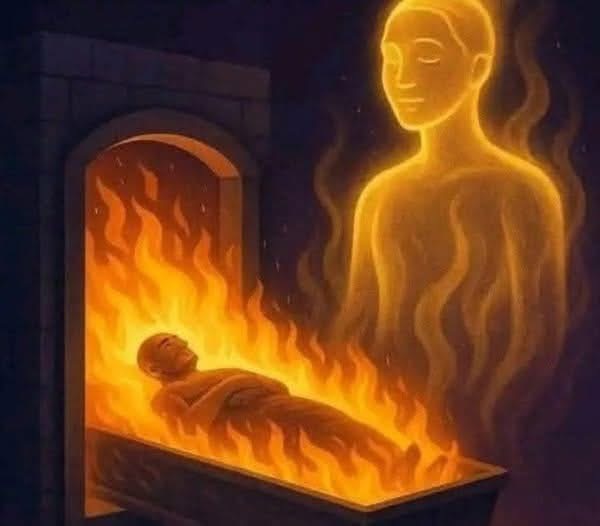
THE SIN OF CREMATION according to the religion says that…see more
Across several major faiths, cremation is treated not only as a practical decision about what happens after death, but as a question of obedience, reverence, and belief about the human body. For many religious traditions, the body is not viewed as something disposable. It is connected to the soul, to divine creation, and to the hope of life beyond death.
In Christianity, especially in Catholic and Orthodox traditions, cremation was long discouraged because it could be understood as rejecting the belief that the body will be raised again. Christian teaching has often described the body as a temple of the Holy Spirit, which means it should be handled with dignity even after a person dies. The Catholic Church now allows cremation in certain circumstances, but it still places strict importance on how the remains are treated. Ashes are expected to be kept with respect, not scattered, separated among relatives, or stored casually in private homes. Such practices can be seen as weakening or denying the teaching of the resurrection of the body.
Hinduism approaches the matter differently because cremation is traditionally part of Hindu funeral practice. However, the concern is not simply the burning of the body, but whether the sacred rites are performed properly. Hindu scriptures, including the Bhagavad Gita and other religious texts, stress the importance of correct ceremonies so the soul can pass smoothly into its next stage. If cremation is carried out without the proper mantras, offerings, and reverence, it is believed to bring spiritual harm or misfortune to the departed soul and even to the family line. In this view, cremation itself is not the wrongdoing; neglecting the holy duties attached to it is the serious offense.
Islam takes a much stricter position and forbids cremation. Islamic teaching holds that the human body must be buried whole because it will be resurrected on the Day of Judgment. Burning the body is considered disrespectful, a form of damaging what God created. The Quran emphasizes the body’s natural return to the earth, and cremation is viewed as a kind of mutilation. For Muslims, failing to follow the required burial rites dishonors the dead and may also bring divine displeasure.
Judaism also traditionally rejects cremation. Jewish law, or Halacha, requires burial in the ground, a practice reflected in the Torah accounts of the patriarchs being buried in caves. Because the body is understood as created in the image of God, cremation is seen as desecration rather than honor. It has also been associated with pagan customs and with denial of techiyat hameitim, the resurrection of the dead. Many rabbis teach that choosing cremation can affect the soul’s rightful place in the World to Come.
For these faiths, the final treatment of the body carries deep meaning. Whether cremation is forbidden, restricted, or accepted only with proper rites, the common concern is that death should be met with reverence, not convenience alone.