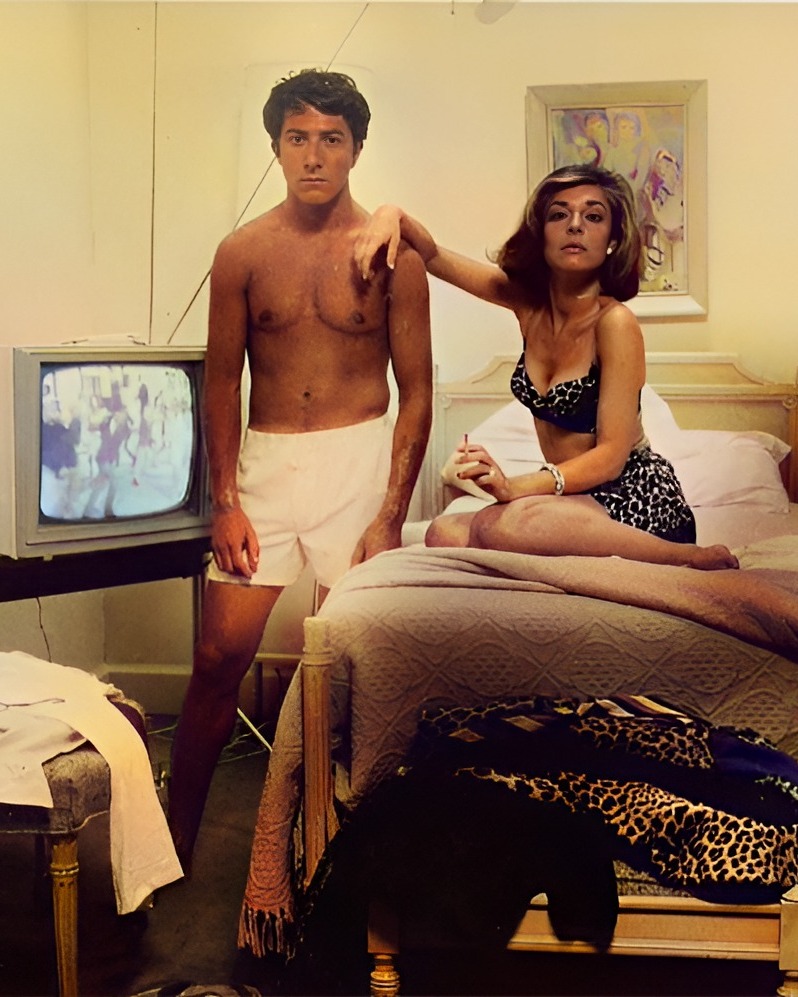
The Untold Story Behind the Making of The Graduate
Long before terms like MILF and Cougar entered the cultural lexicon, The Graduate arrived as a cinematic sensation that reshaped the landscape of film. Anne Bancroft delivered a career-defining performance, balancing sophistication with raw emotional depth, while Dustin Hoffman provided the perfect foil with his portrayal of awkward, naive innocence. Scenes such as the legendary line, Mrs. Robinson, you’re trying to seduce me, aren’t you?, have since become permanently etched in movie history.
Despite its status as a masterpiece, the film was not without its secrets and behind-the-scenes chaos. Production began in 1967, a time defined by the cultural explosion of the hippie movement and a profound shift in social norms. During the casting process, Dustin Hoffman was far from a household name. In fact, when he arrived at the casting office, producer Joseph E. Levine mistook the actor for a window cleaner. Hoffman played along with the mistake, actually cleaning a window until the producer realized who he was.
Years later, it was revealed that Robert Redford had also tested for the role of Benjamin Braddock. Director Mike Nichols ultimately rejected him, delivering a stinging critique: Bob, look in the mirror. Can you honestly imagine a guy like you having difficulty seducing a woman? Nichols preferred the underdog, awkward persona that only Hoffman could provide, even though some critics at the time leveled veiled, anti-Semitic remarks about his appearance and voice.
The production was also notoriously frugal. Despite the film becoming the biggest box office hit of 1967, earning over 104 million dollars, Hoffman walked away with a paycheck of only 20,000 dollars. After taxes and living expenses, he ended up relying on New York State unemployment benefits while residing in a tiny two-room apartment.
The role of Mrs. Robinson was equally complex. While Doris Day famously rejected the part because she was uncomfortable with the required nudity, Anne Bancroft embraced the role, though she was only 36 at the time. She was merely six years older than Hoffman and eight years older than Katharine Ross, who played her daughter. Some colleagues noted that Bancroft, a heavy drinker and smoker, appeared older than her years, which helped sell the age gap on screen. Bancroft later admitted that the role, while iconic, felt like it overshadowed her other work, as generations of men would approach her mentioning how she was their first fantasy. She passed away privately from uterine cancer in 2005.
The film is also remembered for its spontaneous moments. During the famous hotel room encounter, Hoffman went off-script to grab Bancroft’s breast, an act meant to mimic the clumsy, impulsive behavior of a schoolboy. Director Mike Nichols found the resulting awkwardness so authentic that he kept the shot in the final cut. Even the iconic soundtrack by Simon and Garfunkel was an anomaly; the duo’s songs were initially meant only as placeholders for editing, but the impact was so great that they remained, cementing the film’s unique sound.
Even a classic contains errors for eagle-eyed fans to spot. Continuity goofs include a bright lipstick mark on Benjamin’s cheek that vanishes between shots, a night scene that accidentally features daylight in the background, and a stereo system that goes silent the moment Benjamin rushes out of the room. Despite these minor lapses, the film’s legacy remains secure, its influence continuing to ripple through pop culture in homages from The Simpsons to Roseanne, proving that its blend of sharp wit and daring storytelling is truly timeless.