The Illusion of Equality
Sometimes the most revealing moments in a relationship arrive disguised as ordinary situations. For one woman, what should have been the most romantic evening of her life became the moment she discovered a truth that would change everything.
He had made the reservation three weeks in advance, planning every detail with unusual care. He told her to dress up, insisting that the night would be special. They had been together for seven years, celebrating seven Valentine’s Days, but she felt a distinct sense of anticipation that this one would be different.
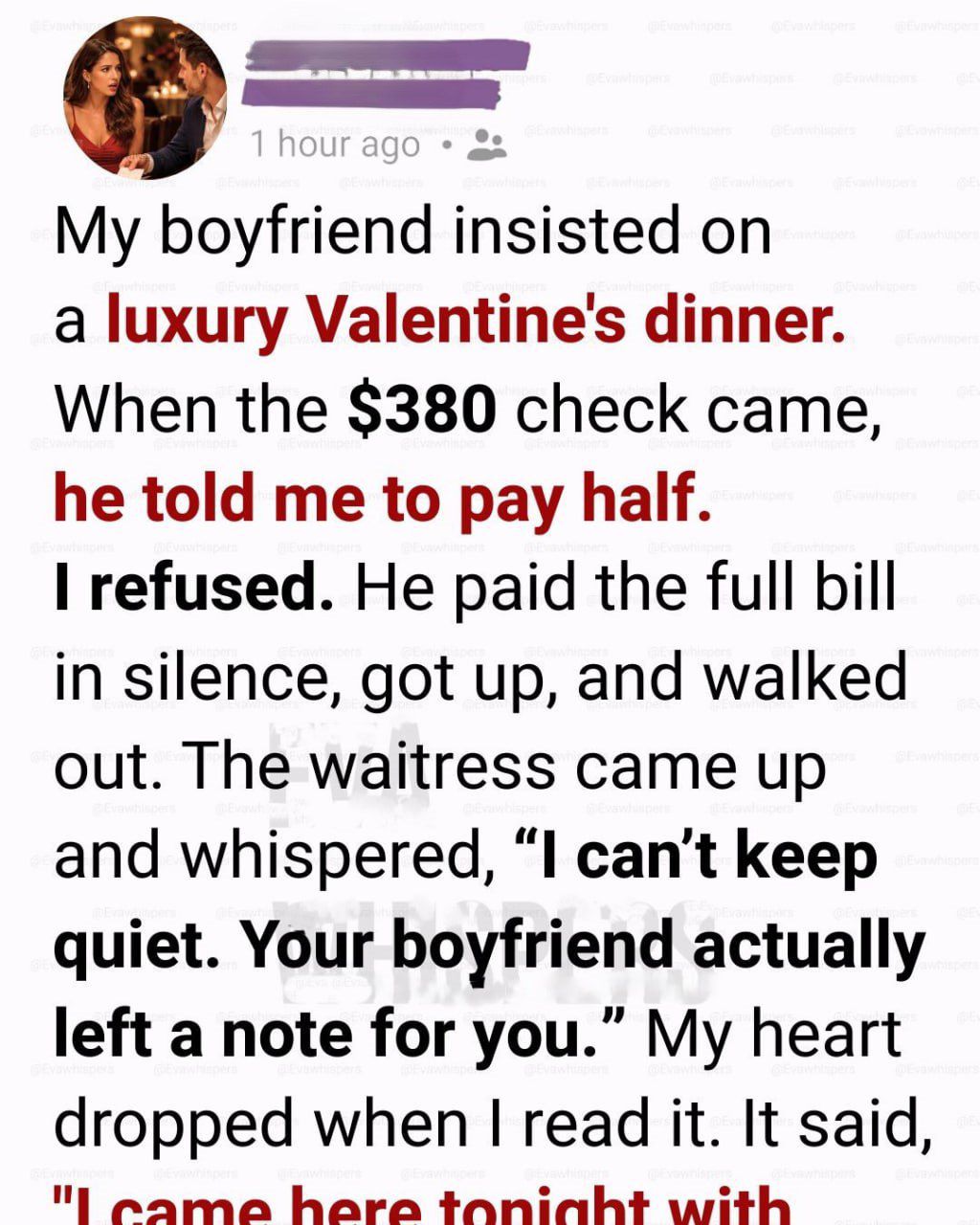
The restaurant was elegant, with candlelit tables and live music, creating an atmosphere ripe for a proposal. Throughout the meal, they reminisced about their shared history: their first apartment, road trips, and dreams of the future. When the check arrived, she was distracted by her own racing heart, fully expecting him to pull out a ring. Instead, he took the bill, placed it between them, and asked to split it evenly.
She was taken aback, not by the money, but by the request on such a significant, planned evening. When she questioned why he would ask her to pay for half of a dinner he had orchestrated as a surprise, his demeanor hardened. He argued that he was testing whether she understood the concept of an equal partnership. He eventually paid the bill, stated that he would see her around, and walked out of the restaurant without a backward glance.
Confused and humiliated, she was approached by their server, who handed her a note he had left behind. The letter revealed that he had indeed intended to propose that evening but had decided to test her reliability first. He claimed that because she questioned the cost-splitting, she had failed his assessment and proven herself unworthy of a future with him.
The reaction of the woman was one of profound clarity. She realized that real love does not involve elaborate traps, secret tests, or emotional manipulation. A partner who truly respects his significant other communicates openly about finances and expectations rather than orchestrating a scenario designed to trap them into a perceived failure.
Beyond the initial shock and grief of losing a seven-year relationship, she realized she had narrowly avoided a lifetime of living with someone who favored control over connection. By choosing to manipulate their most intimate moments, he had revealed his own inability to engage in a mature, honest partnership. Ultimately, she recognized that by refusing to be a part of his game, she had saved herself from a future defined by constant judgment and hidden conditions. Her experience serves as a stark reminder that if a relationship requires passing surprise, unexplained examinations to prove one’s worth, it was never a partnership to begin with.