The Burden of New Beginnings
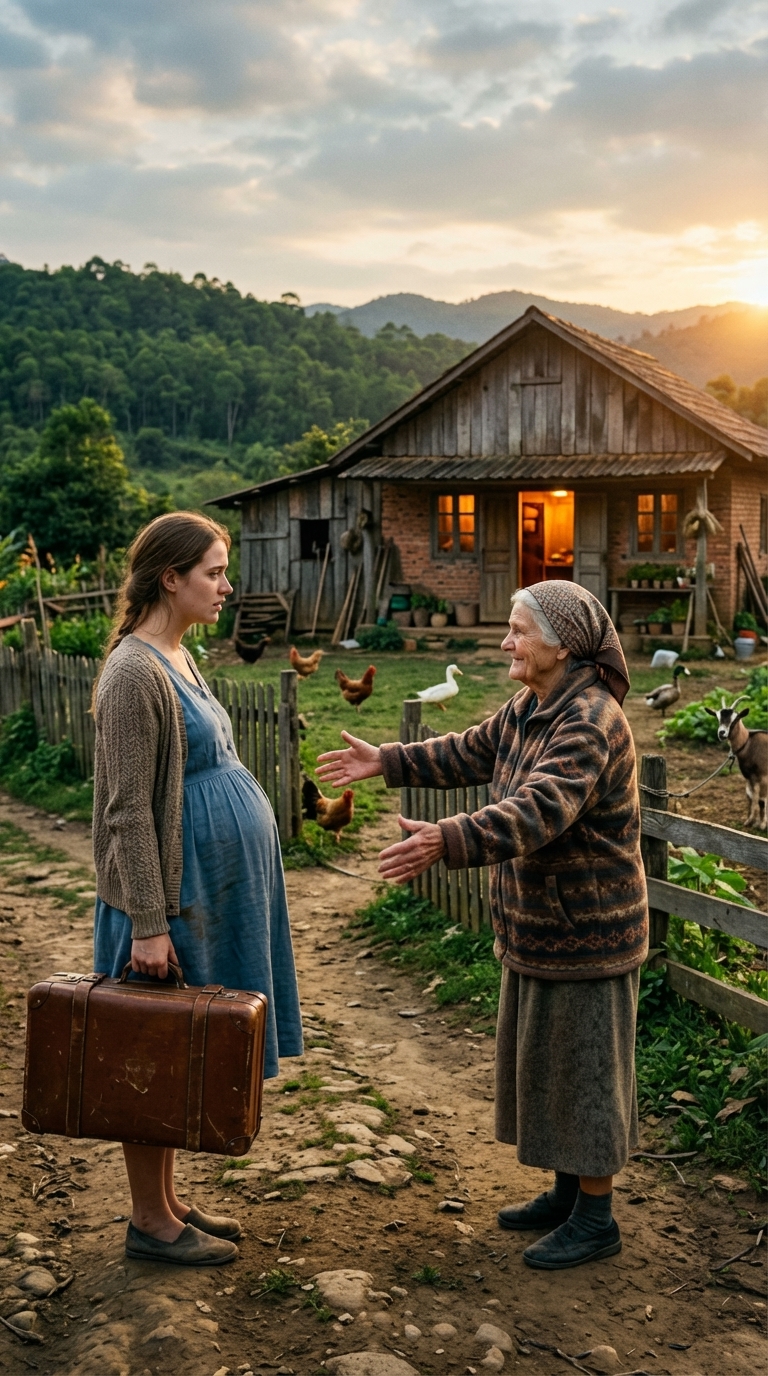
The rain fell with a relentless, biting chill the afternoon Lucia stepped off the bus, one hand resting protectively over her pregnant belly while the other gripped a worn, battered suitcase. She had traveled hundreds of miles, fleeing a life that had fractured beyond repair, her heart heavy with the weight of uncertainty. With nowhere else to turn, she had come to the only family member she had left. Her Aunt Carmen lived on a remote farm, a woman Lucia knew only through fragmented childhood stories of strength and stubborn independence.
The approach to the property was a struggle through deep, sucking mud. When the house finally emerged from the gloom, it was smaller and more decrepit than Lucia had imagined. Peeling paint and a sagging roof spoke to years of neglect, mirroring the state of her own life. A single, dim light glowed from a window, serving as the only beacon for a soul lost in the storm.
When Carmen answered the door, her face was a map of hard-earned endurance, her eyes sharp and devoid of sympathy. She did not ask how Lucia arrived there or why she was alone. With a simple, brisk invitation, she ushered her inside, where the air was thick with the scent of dust and frozen memories. That first night, Lucia shivered on a hard bed under a thin blanket, feeling the true magnitude of her isolation.
The next morning, the reality of her situation shifted from cold to unforgiving. Over a cup of bitter coffee, Carmen delivered a stern ultimatum. No one lives here for free, she stated flatly, setting the cup down with a sharp click. If you stay, you work. Lucia, though physically drained and terrified for her unborn child, understood that refusal was not an option. She nodded and accepted the terms, beginning her transformation that very day.
Life on the farm was brutal, demanding labor that left her hands blistered and her body trembling with fatigue. She rose long before the sun to tend the chickens, haul heavy buckets of water across the rocky terrain, and clear the overgrown, suffocating weeds from the fields. Yet, as the weeks turned into months, something began to change within her. The initial resentment she felt toward Carmen’s harshness began to soften into a grudging respect. She realized that Carmen was not trying to break her, but to forge her.
One evening, as they sat in the dim kitchen, Carmen finally spoke of her own past, sharing stories of the widowhood and heartbreak that had anchored her to this land. The wall between them finally cracked. The farm was no longer just a place of labor; it became a sanctuary where both women were finding a second chance.
By the time Lucia felt the first stirrings of her baby, she had become a different person. Her back was strong, her spirit was tempered, and she had mastered the skill of coaxing life from the soil. When the baby finally arrived, it was not in a hospital full of strangers, but in the house that had once felt alien and cold.
As she held her daughter in the soft light of the bedroom, she looked toward the doorway to see Carmen watching, a rare, genuine smile gracing her aged face. The farm was no longer a symbol of exile. It was a home they had rebuilt together, brick by brick and row by row. Lucia had arrived with nothing but fear and a suitcase, but as she looked at her daughter, she realized she had finally claimed a future that was entirely, and defiantly, her own.