The Sheriff’s Confrontation
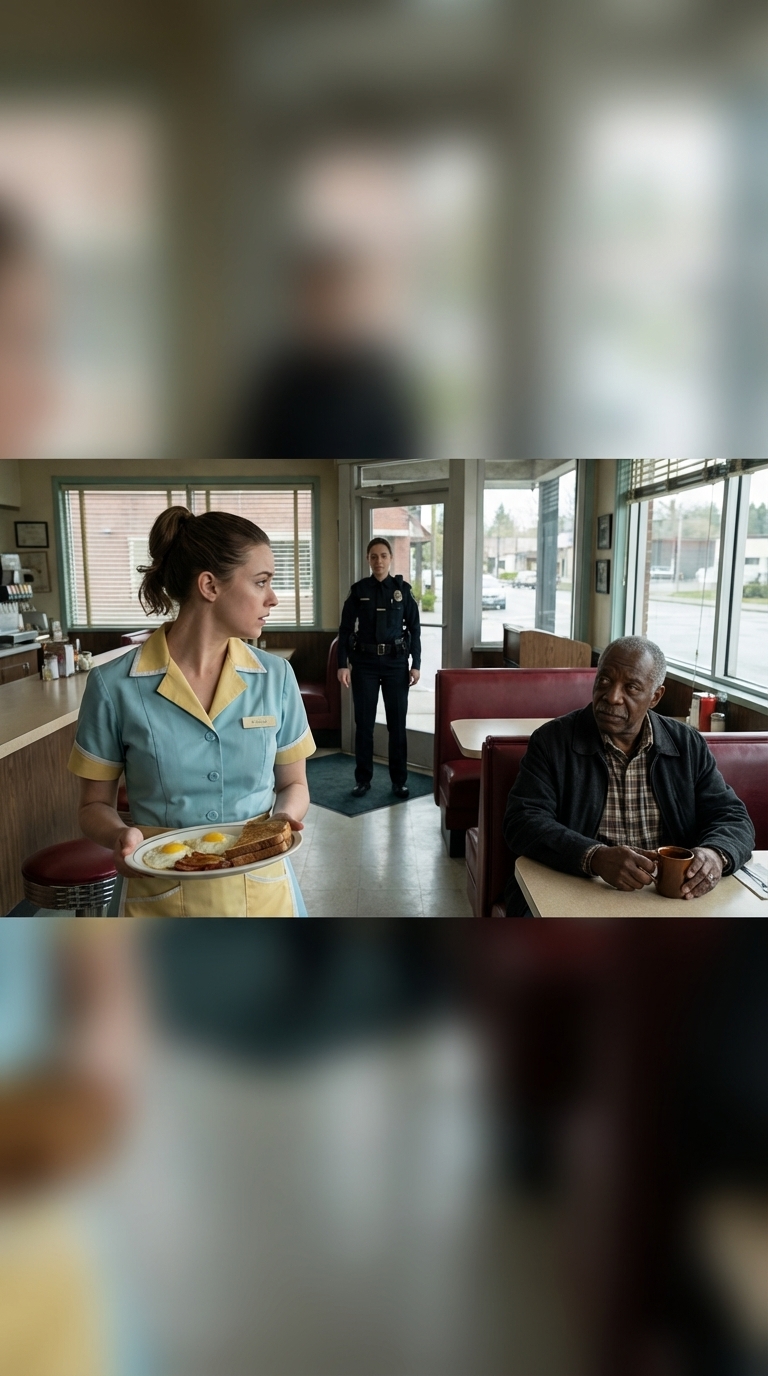
Carla paused by the booth with a pot of coffee in her hand, offering a respectful smile. She always made sure to stop by his table first, not out of protocol, but out of genuine affection for the man who had encouraged her to dream beyond the county line.
Before Michael could respond, the front door of the diner swung open with professional force. The bell above the door gave a sharp, metallic chime. Sheriff Erica Mullen stepped inside. She moved with an aggressive confidence, her hand resting habitually on the heavy duty belt at her waist. She scanned the room, not with the look of a public servant checking in on local business, but with the posture of an occupying commander.
She stopped at the booth occupied by Michael Delator. She did not ask for permission to sit, nor did she greet him. She simply loomed over him, her shadow cast across his newspaper.
Move, she said, her voice dripping with a casual, practiced cruelty. I am taking this booth for my lunch meeting.
Michael looked up calmly. He did not rush, and he did not cower. He adjusted his glasses and looked at the sheriff with the steady patience of a man who had faced worse than a local law enforcement officer with a chip on her shoulder.
There are several open booths, Sheriff, Michael said, his voice even. I am in the middle of my coffee. I will be finished shortly.
The tension in the diner became absolute. Carla froze, her hand still gripping the coffee pot. The few other patrons stopped their conversations, sensing that the air, which had been cool just moments before, was suddenly heating up with something dangerous.
Sheriff Mullen laughed, a short, sharp sound devoid of any humor. She looked around the diner, meeting the eyes of the patrons as if to signal that she was the one who decided the rules of engagement.
I told you to move, she repeated. I do not take orders from the likes of you, and I do not wait for your convenience.
She reached down, grabbed the edge of his newspaper, and jerked it out of his hands, letting it fall onto the floor. As Michael began to stand, moving slowly to accommodate the arthritis in his knees, the sheriff did not wait for him to clear the table. She shoved him. Her hand struck his shoulder with enough force to send him stumbling backward, his hip catching the edge of the table before he collapsed onto the checkered tiles. His glasses flew from his face, skidding across the floor until they rested near the jukebox.
The sound of his body hitting the floor was sickening. Silence swallowed the room, broken only by the hum of the refrigerator.
Mullen stood over him, her face twisting in a sneer. That is for wasting my time, she said, her eyes flashing with a toxic sense of entitlement. Maybe now you will learn your place.
She pulled out her phone, prepared to ignore him as if he were nothing more than debris on the floor. She had no idea that beneath the silence of the kitchen, Carla had already reached for the emergency button beneath the counter, and that Michael, with his breath coming in ragged gasps, had reached into the pocket of his slacks and pulled out a small, metallic object.
He did not look like a victim then. As the sheriff turned away to signal for her lunch, Michael dialed the memory button on his specialized phone. He did not need to speak a word. He just waited for the connection.
On the other end of the line, in a federal office in Birmingham, Judge Henry Delator heard the line open. He heard the muffled sound of a chair being overturned and the cold, unmistakable voice of Sheriff Erica Mullen gloating about teaching someone their place.
Henry did not speak to his father. He did not need to. He recognized the diner’s ambiance immediately. He stood up, his face pale with a cold, terrifying clarity. He called his bailiff, and then he called the Department of Justice.
By the time Sheriff Mullen had finished her meal, the calm of Riverside was shattered. Two unmarked federal vehicles screeched into the dirt lot outside the diner, followed quickly by cruisers from the state police, sent under direct orders from the federal bench.
Mullen stepped outside, a confused frown marring her face. She expected to see her own deputies—men she had hand-picked for their loyalty to her family name. Instead, she found herself surrounded by federal agents and state troopers who did not know her, did not care about her father, and certainly did not fear the Mullen name.
At the center of the chaos, Judge Henry Delator emerged from his car. He did not look like a man who was angry. He looked like a man who was enforcing the law. He walked past the sheriff, ignoring her entirely, and went straight to his father, who was walking out of the diner with his glasses back on his face, his dignity intact.
When the judge finally turned to face the sheriff, the look of absolute ruin was etched onto her features. She looked at his suit, his credentials, and the federal seal on the official documents being unfolded by the agents. She realized then that the man she had slapped on the floor for sport was the one person in Alabama she was legally forbidden from touching.
The fall of the Mullen dynasty was not a long, drawn-out process. It was surgical and swift. The federal investigation uncovered decades of abuse, illegal raids, and the selective enforcement that Mullen had used to keep the town under her thumb. Charges of assault were merely the beginning. As the evidence of her civil rights violations hit the press, the town of Riverside finally began to look at the history they had tried so hard to bury.
The sheriff’s badge was stripped from her chest in the middle of Main Street, in front of the very people she had spent her career intimidating. She was led away in the same cuffs she had used on so many others.
Michael Delator stayed in his home on Maple Street. He returned to his garden the very next Wednesday. The town was different now. The magnolia trees still bloomed, and the river still flowed, but the fear that had once clung to the air like humidity had evaporated. The history of the town was finally being taught in the schools, and the people of Riverside started the long, difficult work of moving toward a future that actually included everyone. Michael sat in his chair at the diner, ordered his coffee, and watched as his son sat across from him, serving as a reminder that the truth always finds a way to stand up for itself.