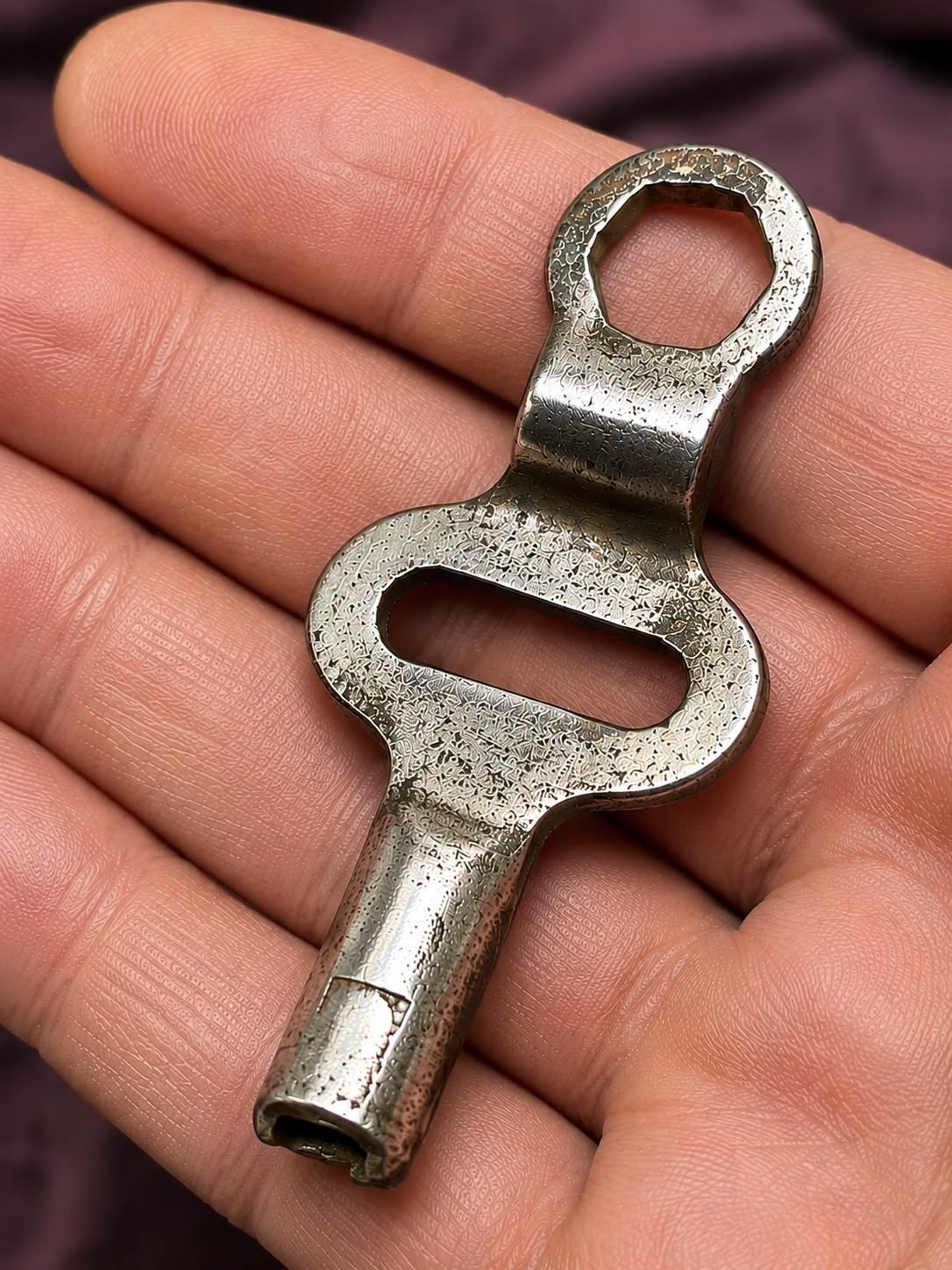
What Was This Tiny Slotted Metal Key Actually Used For?
Seen by itself, this little metal object is not easy to recognize. A slim shaft, a plain grip, and a narrow slot make it look unlike nearly every kitchen implement used in modern homes. Anyone accustomed to ring pulls, lift tabs, and geared can openers might reasonably mistake it for a miniature hardware part rather than an accessory once used with packaged food.
The object actually comes from an older chapter in the development of metal cans. It is generally called a winding key, twist key, or can key, and its purpose was to open a container manufactured with a prepared strip that could be torn away.
The mechanism was simple, but carefully coordinated with the package. Instead of using a separate blade to travel around the whole lid, the manufacturer weakened or scored a slim band of metal along both sides. One end of this band was left as a small projecting tab.
To begin opening the can, the customer pushed that tab through the key’s slot. Turning the grip caused the strip to wrap around the shaft. With every rotation, more of the band peeled away from the container until an opening was created and the contents could be reached.
This approach is far older than many people expect. J. Osterhoudt received a United States patent for a key-operated opening arrangement in 1866. His idea allowed a designated strip of the container to wind onto a key, avoiding the need to cut away an entire lid. Records of historic packaging show that the method later became especially familiar on sardine tins and other metal food cans.
That strong connection with sardines is easy to understand. Their shallow rectangular tins were often made with a detachable band and accompanied by a key designed for that exact package. The buyer did not always need a permanent opener from a kitchen drawer because the manufacturer supplied the required tool with the food. Advertisements and sales material even presented the included key as a useful convenience.
Operating it involved only a short sequence. First came the exposed tip of the tear band. The user placed it inside the slit in the key, then began rotating the handle. The band caught on the shaft and curled around it. Further turns pulled away additional metal, building a compact coil while opening enough of the tin to remove the food.
The slot was the decisive functional detail. A solid shaft without that opening could not reliably capture the tab. Once the tab passed through the slit, however, the strip and tool were effectively locked together, and a small movement of the hand became a steady pulling force. Early patents explain the operation in essentially those terms: secure the tab, turn the key, and wind the separating band around the stem.
Winding offered a useful mechanical advantage. Pulling a narrow edge of sheet metal with bare fingers would have been difficult and dangerous. Rolling it around a rigid piece of metal applied force in a gradual, controlled way. It also kept the removed band together in a coil instead of leaving a long sharp strip hanging loose. Few components were needed to achieve the result.
Inventors continued refining the arrangement after it became familiar. A patent issued in 1945 addressed the problem of removing the finished coil from the opener. It described a slotted stem that accepted the tab and collected the winding strip, along with a way to push the resulting roll off the shaft. Such a refinement shows that the method was common enough to justify improving rather than merely an obscure experiment.
The opener could function only because the container was built for it. It did not turn an ordinary sealed can into a key-open can. The body of the package needed a scored or deliberately weakened path, plus a projecting tab at the starting point. With no prepared band to peel, a twist key could not take the place of a standard cutting opener.
Packaging companies positioned the band differently according to the shape of the product. On some cans it ran near the upper edge; on others it crossed the body. Historical accounts of key-wind containers describe both side and top arrangements. Removing the band released the corresponding portion of the package and exposed the food.
Although fish tins became the most memorable example, the principle was not limited to sardines. Similar winding systems appeared on canned meats and other foods. The essential requirements stayed the same regardless of the container’s proportions: a scored tear path, an accessible tab, and a slotted key shaped to wind it.
Including the key solved a problem that can be hard to appreciate now. Preserved foods could remain usable for long periods, but early durable cans were inconvenient to open. Supplying a dedicated device with every package meant consumers did not have to own a particular household tool. They could detach the included key and immediately use the opening system selected by the manufacturer.
That package-specific role explains the object’s small size. It was never intended to be a substantial appliance with cutting wheels, gears, and large handles. A simple piece of formed metal could perform one narrow operation, cost very little, and remain light enough to fasten directly to a can.
Many versions were effectively disposable. Period patent documents noted that manufacturers commonly attached an individual key to each container and that the customer could throw it away with the coiled strip after opening. Proposals for reusable keys appeared precisely because the prevailing practice relied on inexpensive tools supplied one at a time.
Cheap construction did not mean careless design. The can and opener were matched as parts of a single system. The package supplied a weakened route for the tear. The projecting tab created a starting grip. The slit captured the tab, the shaft gave the band a surface to wrap around, and the hand supplied rotation. Each feature did one clearly defined job.
During use, the device behaved like a tiny winding machine. After the first portion was secured, each turn added more sheet metal to the roll. As the coil became thicker, it gave the fingers a firmer form to keep turning. When the scoring worked as intended, the tearing remained guided along a predictable line.
Control mattered because ripped metal can be sharp. The key reduced the need to hold the detached edge directly, though it did not eliminate every hazard. The opened container could still have exposed edges, so this historic arrangement was not automatically safer than every modern package. It was simply an economical answer suited to the materials and production methods available at the time.
The keys were especially familiar when canned foods were everyday pantry items and aluminum easy-open tops had not yet become widespread. People who handled such tins when they were young may recognize the object immediately. Others who find a loose example today can stare at it for a long time without seeing any connection to food.
The missing package removes the clue that once made the key obvious. Alone in a drawer, toolbox, or box of antiques, its slit looks like a mechanical fitting and its handle resembles a tiny wrench or machine component. Reconstructing the tear-strip can around it suddenly gives every part a logical purpose.
Its story also demonstrates how dramatically packaging has evolved. Consumers now expect to lift a ring, peel a seal, or reach for a universal rotary opener. Those options were not always available in the forms we know today. Manufacturers tried many strategies for helping customers get through strong sealed metal, and the winding key was one of the most successful specialized solutions.
Historical surveys of opening technology regularly identify Osterhoudt’s 1866 patent as an early system in which a supplied key received and rolled a narrow portion of the can. Unlike later all-purpose openers, the mechanism depended on the container’s own removable strip instead of creating a fresh cut through an intact lid.
For that reason, a key-wind package should be understood as an integrated design, not simply a normal can with an optional gadget. The scored band, exposed starter tab, and slotted tool had to fit one another. Remove any one of those elements and the planned method stopped working.
This integration benefited commercial packaging. The producer controlled both the sealed container and the way it would be opened. Customers did not need to own the right brand or style of separate opener. As long as the attached key remained present, everything required to reach the food traveled with the product.
Misplacing that tiny piece of metal could still cause trouble. Without it, the package was much harder to open in the intended manner. A person might substitute another narrow object in an emergency, but the promised convenience depended on preserving the supplied key until mealtime.
That is why keys were so often fixed physically to the tin. Fastening them to the package limited the possibility that they would be lost during shipping, display, storage, or sale. When needed, the customer removed the key from its attachment point and started winding.
The familiar fish-tin association became so strong that many people call every example a sardine-can key. Yet comparable opening bands were used with other products, so the broader names twist key, winding key, or tear-strip can opener are more accurate when the original container is unknown.
“Twist key” describes the operation particularly well. The device was not mainly a cutter like a present-day wheel opener. Its central action was rotation: it wound up a band that the factory had already prepared to separate. That distinction accounts for its unfamiliar shape.
Historians and archaeologists often use the expression “key-wind can” for the package itself. The phrase emphasizes that the removable band and the opener were built into one coordinated arrangement rather than being unrelated kitchen items.
The fundamental mechanism survived for decades with little change. A patent from 1906 describing a key-opening sardine container explained how part of the tear strip entered a narrow slit and wound around the tool. Another patent from 1945 retained the same action while attempting to make the opener more convenient. The span between those documents shows how durable the concept proved.
Individual manufacturers could change details without abandoning the idea. Handles appeared in different outlines, stems varied in width or length, and some forms were tailored to particular packages. Later designs explored reusability or easier removal of the coil. Through those variations, the combination of tab, slot, turning motion, and rolled strip remained constant.
The tight metal spiral left on the shaft is one of the best identification clues. Instead of producing a straight ribbon, the process gathered the band around the key. Patent illustrations clearly depict that coil, and a vintage tool discovered with a strip still wrapped around it may reveal its history immediately.
A bare key is harder to understand because the evidence of use has disappeared along with the can. Even so, the design is a fine example of obtaining mechanical advantage through a very small device. No electricity, gearing, or elaborate lever was required. Winding around a shaft converted modest hand movement into sustained tension on the band.
Kitchens of earlier generations contained many similarly specialized implements. Some belonged to particular bottle closures, jar lids, or can formats. Others only made sense within packaging standards that were widespread at the time. When those standards changed, the tools quietly left everyday life.
Easy-open tops transformed what shoppers expected. Pull rings let a consumer open many containers without a separate accessory, peelable seals did the same for lighter packages, and ordinary geared openers could serve numerous conventional cans. Once those options became common, providing a unique metal key with each item was less attractive.
The older approach did not vanish overnight. Certain products, especially some canned fish, retained winding keys after newer lid systems had entered the market. Consequently, an unidentified key should not be dated to a very narrow period merely because the underlying technology is old.
Key-operated packaging reaches back to the nineteenth century, but examples were made and used much later. Establishing the age of one particular object requires marks, manufacturer information, the original can, or a secure archaeological context. The invention date alone cannot tell us when an individual key was produced.
That distinction is important in any responsible antique identification. Recognizing an object’s function is not the same as proving its manufacturing year. A tool based on an old principle might have left a factory many decades after the first patent.
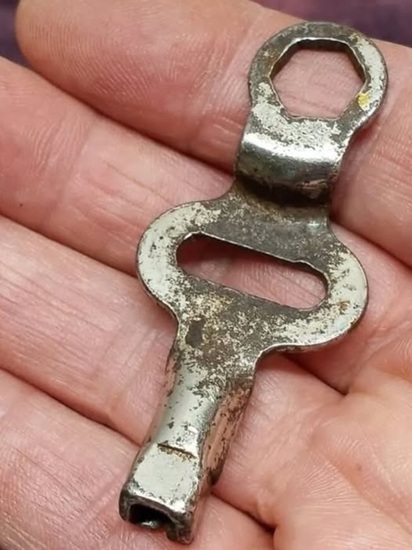
Care is also needed when interpreting holes or decorative geometry in the grip. Manufacturers created many forms, and some keys have round, square, or other openings. Without evidence tied to a specific model, it is risky to declare that every opening served as a wrench or an adjustment tool for another appliance.
Vintage objects often inspire imaginative claims online. An angular hole can encourage observers to invent a second job for the key, and that extra use may indeed be documented for a particular version. It should not, however, be generalized to every example without matching patents, catalog descriptions, or manufacturer records.
The principal purpose needs no speculation. Patent descriptions repeatedly show the projecting can tab entering a slit, after which rotation winds and tears away the band. Museum records and archaeological sources document the same key-wind system with fish and other canned foods.
That evidence is enough to explain both the object and its shape. It also gives collectors a reason to value surviving examples. Vintage utensils preserve ordinary technologies that disappeared so gradually that few people noticed their departure. A thing once considered disposable can become puzzling when its companion package is no longer part of daily experience.
Collectors may appreciate these keys less for mechanical complexity than for what they represent. Their spare construction records how mass producers addressed a practical challenge with limited material and very few parts. One small accessory can tell a broader story about preserved food, industrial packaging, and household routines.
Archaeologists can use opening hardware in similar ways. Excavated strip keys and fragments of key-wind cans help researchers understand when certain forms of packaging circulated and how manufactured foods reached consumers. These artifacts can contribute to a larger picture of trade, storage, and eating habits at historic sites.
The tool therefore belongs not only to kitchen history but also to the development of mass-market food. Preserving the contents was only half of the packaging problem. A durable sealed can also needed a realistic opening method that an ordinary buyer could use.
The earliest containers could be extremely difficult to penetrate because strength and preservation dominated their design. As metalworking improved and sheets became thinner, inventors had more freedom to create deliberate opening paths and specialized accessories. The winding system emerged as one stage in that continuing evolution.
Its efficiency came from placing much of the work inside the package design. The scored band determined where separation would occur. The key did not have to cut its own route; it only needed to apply controlled rolling and pulling force along a path already engineered into the can.
That difference explains why the tool seems almost too basic. It required no sharpened wheel, gearing, or opposing handles because the hard part had been prepared at the factory. The opener could remain minimal precisely because the container participated in the mechanism.
Small size also made economic sense. An accessory intended to be included with each product had to add little weight and little expense. Stamped or formed sheet metal provided adequate strength without introducing a complicated assembly. A large permanent grip would have raised cost without improving its single intended operation.
The key only had to give the fingers enough purchase to rotate the band around its stem. After the can was open, its assigned task was finished. Surviving specimens can look crude beside polished modern utensils because appearance was secondary to cheap, dependable performance.
People who once used the system often remember the movement as clearly as the object. Feed the tab into the slot, turn the handle, and watch a thin ribbon of metal curl tighter around the shaft. People raised with modern packages, by contrast, may have no reference point for any of those features.
That difference between generations helps explain why pictures of these keys become popular identification puzzles. Nothing about the metal object has grown more complicated. What vanished was the shared knowledge that linked it to an ordinary can.
It is a useful reminder that familiar technology can become mysterious very quickly. One generation handles an object without giving it a second thought; the next sees an unexplained artifact. Packaging changes quietly, and the accessories tied to outdated formats disappear from drawers and shops.
Ring-pull lids played a major part in that transition by moving the opening device into the container itself. Consumers no longer needed to protect a separate key until the moment of use. From a convenience standpoint, one integrated tab simplified the experience.
Still, the winding arrangement has undeniable elegance. It used very little material, contained virtually no moving parts, and relied on the consumer’s hand together with the can’s scored band. That balance between economy and function allowed it to remain useful across a long period.
Effective technology does not always have to be elaborate. When all surrounding components are designed to cooperate, a narrow slit in a metal shaft can be enough. The key demonstrates how thoughtful system design can make an extremely simple tool perform a precise job.
Context is what turns the object from a mystery into a machine. Put it alone on a tabletop and it resembles a fragment of hardware. Place it beside the correct tear-strip tin and each characteristic explains itself.
The broad part gives the fingers a grip, the stem becomes a winding core, and the slot captures the starter tab. The scored band in the can completes the mechanism. None of those features is arbitrary once the original package is reconstructed.
This is why identifying old household items often demands more than comparing silhouettes. The surrounding technology may be essential. A device made for a vanished standard can seem senseless until that environment is brought back into view.
The can key is especially revealing because its action differs from the operations people now associate with canned food. Current devices cut, puncture, lift, or pull. The traditional key peeled away a factory-prepared strip and stored it as a coil.
Although sardine tins remain the iconic example, the cautious identification for an orphaned object is a tear-strip can key. Related systems existed on several kinds of food cans, so naming sardines as a certainty would go beyond the evidence when no original package survives.
When a key is still attached to a fish tin, the conclusion is obvious. When found on its own, “twist key” or “key-type opener for a scored strip can” describes both function and limits of knowledge more accurately.
The same standard applies to claims about a second purpose. A documented model might combine jobs, but a hole in the handle alone is not proof. Markings, a matching patent, a manufacturer’s catalog, or an intact package would be needed before presenting another function as established.
The winding use, on the other hand, is supported repeatedly. The starting tab entered the slit, the user rotated the tool, and the separating strip accumulated around the stem. That three-part sequence is the essence of the device.
Seen in its proper historical setting, the odd little object becomes an ordinary and understandable utensil. It came from a time when a container and its opener were frequently engineered together instead of being treated as independent products.
Its disappearance tells us more about changing packaging than about any mechanical failure. The key continued to do its job; manufacturers redesigned the can until that job no longer existed.
Many everyday inventions vanish in exactly that way. They are not necessarily replaced by a superior version of themselves. Instead, the system around them changes so thoroughly that the original tool becomes unnecessary.
The winding key is thus a piece of packaging history as much as a kitchen artifact. It recalls an era when opening sealed metal food could require a tiny dedicated implement supplied with the product.
It also captures a clever use of basic mechanics. The tool, the prepared band, and the motion of the hand formed one uncomplicated process. There was no need for elaborate equipment because the can guided the work.
A person discovering one today might understandably call it a small wrench, an old key, or a machine component. Restoring the missing tear-strip container to the explanation reveals why the slot, stem, and handle have exactly those shapes.
There is no need to invent a sensational purpose to make the object interesting. Its confirmed history already shows how an inexpensive accessory helped make vast numbers of canned products easier to use before familiar easy-open lids became standard.
What now looks unusual was once practical industrial design in its most economical form. The container, tool, and customer’s hand cooperated in a sequence requiring almost no machinery and very little material.
That is why such a modest object deserves attention. It preserves evidence of how households managed a routine task before modern packaging made the older solution invisible. Even tiny domestic tools can carry a surprisingly rich technological story.
The winding key’s construction was sparse, its purpose specific, and its effectiveness dependent on an intelligent partnership with the can. Long after newer formats reduced the need for it, surviving specimens still display the logic of that arrangement.
Insert the tear-band tab through the slit, rotate the key, and let the strip roll onto the shaft. That straightforward action solved the puzzle for generations of consumers and explains the object completely.
The strange miniature “key” was not made for a lock at all. It was a compact opener for a particular family of scored metal cans—a reminder that everyday technology can change so completely that yesterday’s familiar utensil becomes today’s mystery.