The Swimsuit That Sparked Outrage and Transformed Beach Fashion
The history of the bikini is a story of public outrage, resistance, and sweeping cultural change. A sight that feels completely normal on today’s beaches was once condemned as dangerous, indecent, and even unlawful in parts of the world.
Before the bikini became an everyday fashion choice, women were closely controlled over what they could wear in the water. Ignoring those expectations could lead to public embarrassment, removal from the beach, or punishment.
At the start of the twentieth century, women’s bathing clothes bore little resemblance to modern swimwear. Heavy wool outfits covered nearly every part of the body, prioritizing modesty over movement.
The garments were awkward, absorbed water, and made swimming difficult. Their design reflected society’s anxiety about exposed skin far more than the practical needs of swimmers.
Strict dress rules were common on beaches throughout the United States. In many communities, showing even a little more skin than authorities allowed could be treated as a serious public offense.
Some resorts enforced those standards with remarkable intensity. Writers Kathleen Morgan Drowne and Patrick Huber described how Chicago’s Clarendon Beach employed tailors who could alter a bathing suit on the spot if officials judged it too revealing.
A hem that seemed too high or sleeves that exposed too much could be changed immediately. The purpose was unmistakable: beachgoers were expected to meet rigid ideas of decency at all times.
Similar restrictions appeared elsewhere. In 1915, Coney Island was said to have prohibited bathing socks when they revealed what officials called “dimpled knees.”
Washington, DC, went even further, with beach officers using measuring tapes to check bathing clothes. A trip to the shore could involve nearly as much scrutiny of a person’s appearance as of their conduct.
The shift toward practical swimwear began gradually. In 1907, Australian swimmer Annette Kellerman defied convention by appearing in a close-fitting one-piece suit instead of the cumbersome pantaloons women were expected to wear.
Her arms, neck, and legs were visible, a level of exposure many people of the era found shocking. Yet the outfit also allowed her to move like an athlete rather than struggle against layers of soaked fabric.
Kellerman was already celebrated for her skill in the water and had earned the nickname “The Australian Mermaid.” She repeatedly challenged rules that limited women’s freedom and athletic ability.
She later said that police arrested her because authorities considered the suit indecent. No official record has been found to establish that the arrest occurred exactly as she remembered it.
Whether every detail was accurate or not, the account traveled quickly and drew headlines. It pushed women’s bathing clothes into a much wider debate about acceptable public behavior.

Kellerman’s decision made people reconsider the relationship between morality, physical freedom, and clothing. It also showed that women wanted swimwear designed for actual swimming.
Demand for her practical style rose quickly. Instead of fighting heavy layers in the water, women could wear something fitted, lighter, and easier to move in.
Kellerman eventually created a swimwear collection of her own. The fitted one-piece became popularly known as the “Annette Kellerman” and helped prepare the way for the bikini’s arrival decades afterward.
Fashion changed more broadly during the 1920s. The flapper generation embraced shorter hemlines, relaxed shapes, and a new spirit of independence, and those attitudes slowly reached the beach.
In California, a defiant group known as the “skirts be hanged girls” demanded bathing outfits that women could genuinely swim in with comfort.
Their campaign was about more than a passing fashion. It expressed mounting frustration with rules that restricted women’s bodies, movement, and everyday choices.
Swimsuits became increasingly shaped to the body and better suited to activity. They were still conservative by present-day standards, but the boundaries of what society accepted were starting to move.
Beaches gradually became places where mobility and enjoyment mattered more than strict coverage. Even so, the controversy that would follow the bikini had not yet begun.
The decisive moment came in 1946, when French engineer Louis Réard unveiled a radically smaller two-piece swimsuit.
It exposed the wearer’s navel and revealed much more skin than earlier designs. The response was immediate, fierce, and precisely as disruptive as Réard expected.
The timing helped shape the new garment’s identity. Only days before its debut, the United States had carried out a nuclear test at Bikini Atoll in the Pacific.
Historians widely believe Réard borrowed the atoll’s name because he anticipated that his swimsuit would create an equally explosive reaction in fashion and society.
The bikini quickly ranked among the most disputed garments of the modern era. Many beaches in the United States moved to prohibit it almost as soon as it appeared.
European resistance was equally intense. France restricted bikinis on some beaches in 1949, while Germany kept them out of numerous public swimming pools for many years.

Political and religious critics denounced the design as well. Pope Pius XII called it sinful; Spain, Portugal, Belgium, and Italy imposed broad restrictions, while communist opponents portrayed it as proof of capitalist excess and moral decay.
In 1952, Australian model Ann Ferguson was reportedly ordered away from Surfers Paradise because officials regarded her Paula Stafford bikini as too revealing.
Episodes like that only deepened the garment’s rebellious reputation. Wearing a bikini became, for many women, a statement of defiance as much as a choice of style.
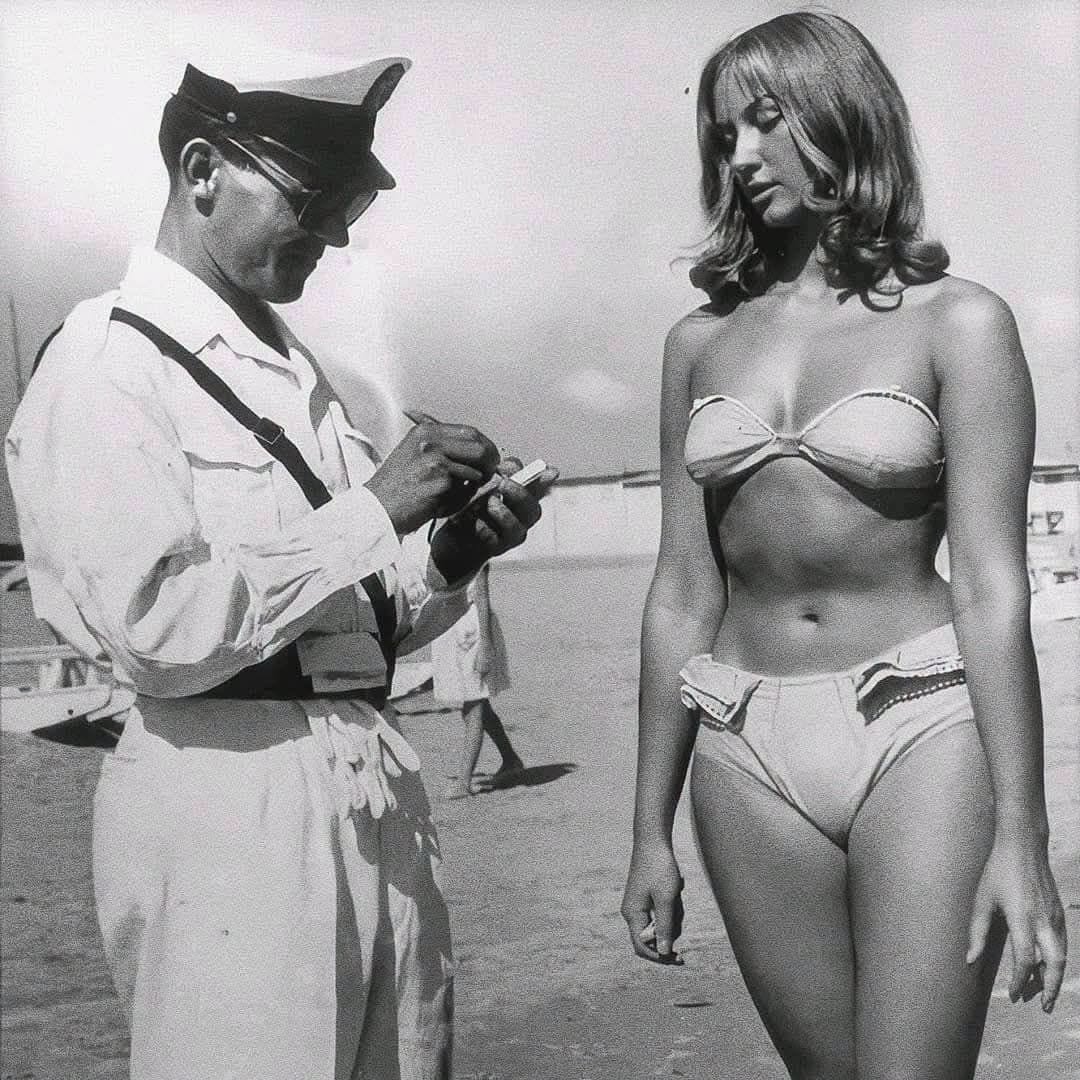
A famous black-and-white photograph came to symbolize the conflict. It depicts a uniformed man beside a young bikini-clad woman on an Italian beach.
Social media posts later claimed that the man was a police officer fining her solely for wearing the swimsuit. The image spread widely again after a Reddit post in 2023 attracted tens of thousands of reactions.
For many viewers, the picture seemed to demonstrate just how aggressively women’s clothing had once been policed. The exact circumstances captured in the photograph, however, have never been firmly established.
The photograph itself appears genuine, but historians have not confirmed what was happening. One theory says actors or models staged the scene; another suggests the uniformed man was speaking with the woman about something entirely unrelated.
Even with that uncertainty, the picture reflects a documented reality of the period. Gianluca Braschi, director of Rimini’s State Archives, confirmed that Italian rules governing bathing attire did exist.
A 1932 law barred people from bathing in public while wearing clothing deemed indecent, although enforcement differed greatly from one place and circumstance to another.
The mystery may be part of the photograph’s lasting appeal. People keep sharing it because it represents a broader truth about the powerful response the bikini provoked around the world.
Whatever occurred in that single moment, the image evokes an era when a small swimsuit stood at the center of an international argument over culture and personal freedom.
Public attitudes began to soften during the 1960s. Younger generations challenged conservative customs, social expectations loosened, and fashion became more daring, though strong opposition did not disappear immediately.
Movies helped change how audiences saw the bikini. Under the Hays Code, enforced in American cinema from 1934, two-piece costumes could appear on screen, but a visible navel was forbidden.

Religious pressure groups also urged film studios to keep bikinis out of movies. Yet the growing influence of popular actresses steadily weakened those old boundaries.
Marilyn Monroe, Brigitte Bardot, and Ursula Andress helped turn the bikini into an image of confidence and glamour. Their appearances reshaped beauty ideals for a generation.
Bardot had an especially large influence. Her breakout movie The Girl in the Bikini presented the swimsuit as a cultural statement rather than merely something worn at the beach.
Her unstudied confidence, windswept hair, and connection with sun and sea fascinated audiences. The film made the bikini central to both its atmosphere and its heroine’s identity.
By making the swimsuit part of character and storytelling, Bardot helped shift it from an object of scandal to something many viewers found stylish and aspirational.
Another landmark arrived when Ursula Andress stepped from the ocean in Dr. No wearing a white bikini. The scene instantly became iconic because it paired beauty with unmistakable strength and self-possession.
Audiences were not shown glamour alone. They saw a woman projecting confidence and power, qualities that permanently changed the garment’s cultural meaning.
By the 1970s, the bikini had entered mainstream life. Cuts became bolder, string designs and thongs gained popularity, and older standards of modesty continued to fade.
Men’s bathing suits also grew smaller and less restrictive. Beach fashion as a whole increasingly favored comfort and individual preference over inflexible social rules.
Today, swimwear ranges from full-coverage one-pieces to minimal bikinis. Choice, comfort, body positivity, and inclusion now shape the conversation far more than the strict moral codes of the past.
The bikini’s path from forbidden clothing to worldwide cultural symbol reveals how profoundly ideas about gender, freedom, and identity have changed. What once produced anger and bans now represents confidence and individuality for millions of people.
It is striking that such a small amount of fabric could generate so much controversy. But the argument was never only about a bathing suit.
At its heart, the struggle concerned who had the authority to decide how women should dress, move, behave, and express themselves in public.