The Anchoring of the Mountain House
The scream from inside the house shattered the stillness of the mountain morning. It was not the sharp yelp of a physical injury but the hollow, jagged sound of someone realizing their tether to reality had snapped. Elias stood frozen with his hand still on the latch, his face pale. Magdalena did not wait for an invitation. She shoved the door open, pushing past him with a strength born of desperation.
Inside the dim foyer, Rosa Carranza was thrashing in a heavy chair, her hands clawing at the empty air. She was sobbing, claiming the shadows were swallowing her whole. Elias moved to comfort her, but he was clumsy with his own grief, his movements frantic and useless. Magdalena stepped into the light. She moved with a surprising, quiet grace that betrayed the Bufala label the town had cruelly bestowed upon her.
She knelt at Rosa’s feet and took the older woman’s trembling hands into her own. Magdalena’s palms were calloused from years of blacksmith labor, yet her touch was steady. She spoke in a low, grounding hum, repeating the phrase she had held onto for sixteen years. Mountains do not ask permission to exist, she whispered.
For a moment, the room went silent. Rosa’s frantic movements ceased, and she leaned into the voice that sounded like a long-forgotten kindness. Elias watched, stunned, as the woman he had dismissed as an intruder took command of the room. He realized then that he had been so focused on protecting his mother from the world that he had failed to bring anything of life into their fortress.
Magdalena worked with rhythmic precision. She directed Elias to boil water and procure the specific dried bark she had carried in her bundle. She did not ask for his permission; she issued commands with the authority of someone who knew exactly what needed to be done. Elias, the man who owned the land, the copper, and the terror of the town, found himself chopping wood and boiling water beneath her watchful eye.
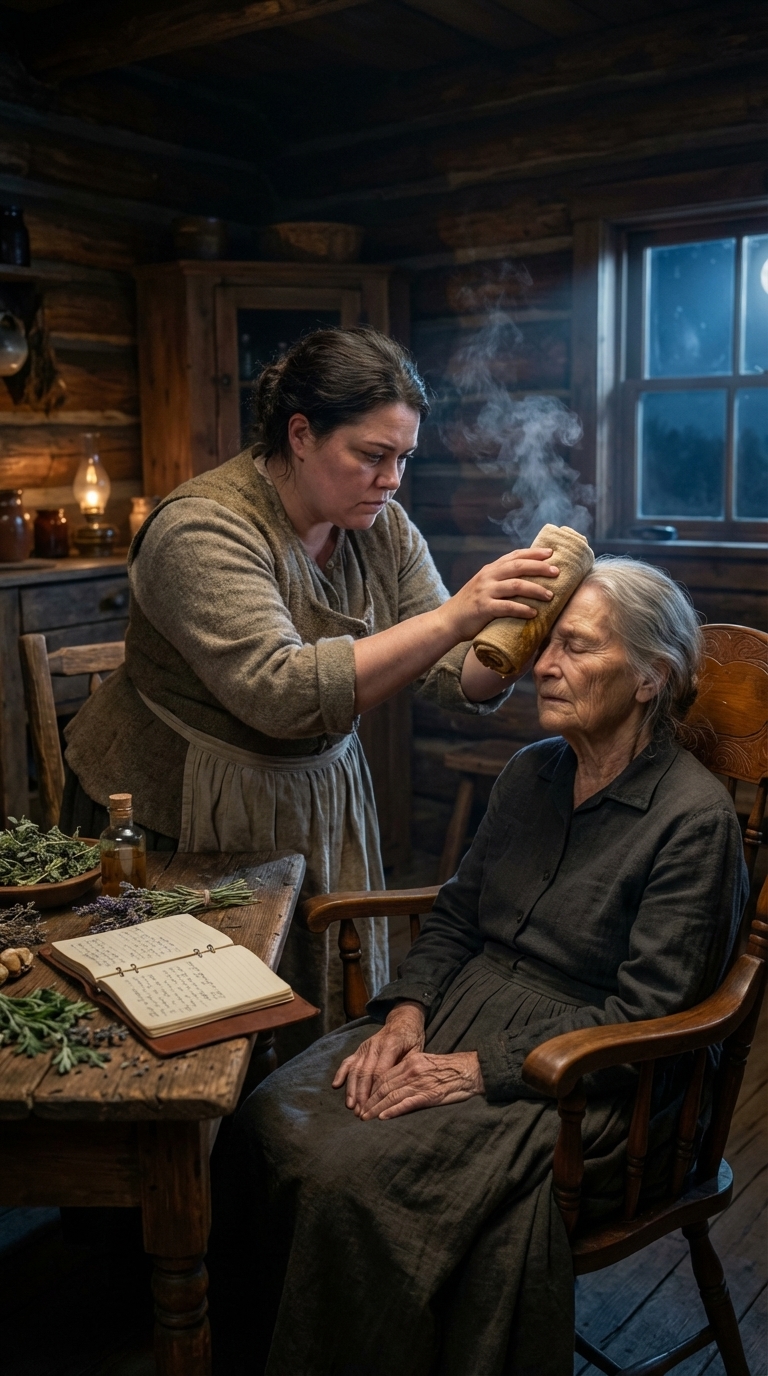
For three days and three nights, Magdalena did not sleep. She applied the poultices with the raw honey, the mixture burning with a heat that forced the stagnant nerves in Rosa’s eyes to recoil and then, agonizingly, to wake. She sat beside the bed, feeding the older woman broth, bathing her brow, and humming folk songs that seemed to pull Rosa back from the void. Elias stayed in the corner of the room, watching the girl he had tried to turn away. He watched her kindness, her intelligence, and the way she refused to break even when her own exhaustion pulled at her eyelids.
On the fourth morning, the change came. The fever broke, and the heavy, milky film that had clouded Rosa’s eyes began to recede. When the sun crested over the peaks of Aguaverde and caught the window, Rosa blinked. She did not scream. She turned her head toward the light and let out a long, shuddering breath. She looked at Elias, then scanned the room until her gaze landed on Magdalena.
I know you, Rosa whispered, her voice raspy but clear. You are the girl from the blacksmith shop. You are the mountain.
Elias walked slowly to the bedside. He looked at his mother, then at Magdalena, whose hands were stained with herbs and whose posture was slumped with pure, beautiful fatigue. The threats the judge had whispered, the land deals, the greed of the valley—it all seemed to evaporate. Elias realized that the woman he had been waiting for was never going to be a bride of status or a showpiece for his table. He needed a partner who could survive the fire, and he had found the only woman in Aguaverde brave enough to walk through it.
The judge and the doctor would eventually arrive at the gate, expecting to find the ranch in chaos and a dying woman ready to surrender her home. What they found instead was a house standing tall, a mother sitting at her window watching the sunrise, and a man standing guard at the door with a woman by his side who looked at them with eyes that saw everything. The era of the Bufala ended that morning, replaced by a new truth in Aguaverde. The mountains stood, they were stronger than ever, and at the end of the long, cold struggle, they had finally found their peace.