The Fragile Remnants of a Life Discarded
On March 12, 1897, the world as I had known it for forty-two years simply evaporated. I was fifty-three, my body weathered by decades of labor, endless washings, and the quiet sacrifices of raising three children. My husband, Major Jacinto, stood before me with eyes as cold as stone and uttered words that shattered our life together. He did not yell or lose his temper; he simply discarded me with the clinical detachment one might use to dispose of a broken tool. He told me I could keep the filthy shack at the edge of his property, a structure unfit for livestock, let alone a woman who had given him the best years of her life. When he turned his back, followed by the judgmental silence of our daughter Judith, I understood that my marriage and my standing in this world were gone.
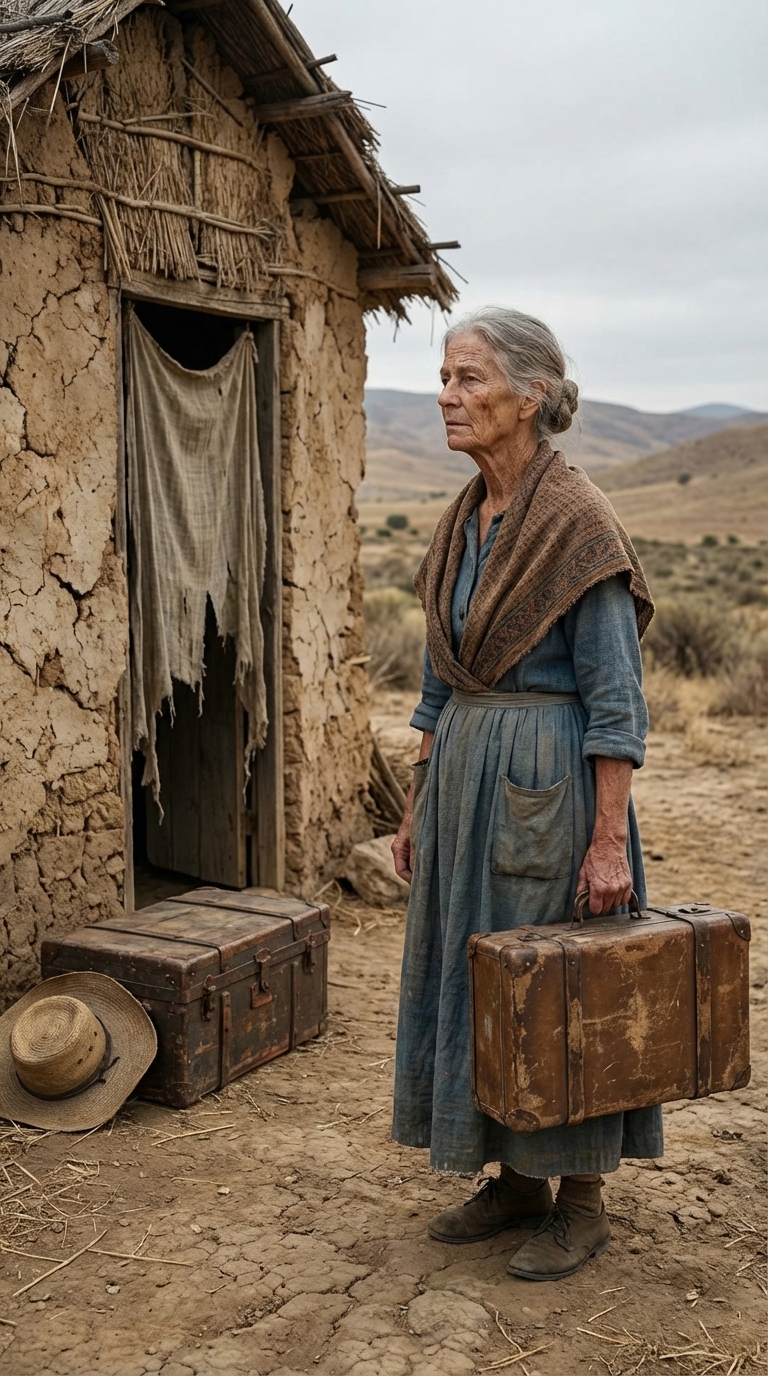
The next morning, the indignity of my exile was finalized by the arrival of a wagon. Don Lupe, tasked with my removal, barely glanced at me as he loaded my entire life into the back. Two wooden crates, a chipped iron pot, one thin blanket, and a bundle of tattered clothes. That was the sum total of forty-two years of service. As we rode toward the outskirts of the estate, the heat of the sun and the dust of the road seemed to mock my fragility. I felt as though I had turned to dust inside, a hollow shell watching the world slip away with every bump of the wagon wheels.
When we finally arrived at my new residence, the reality of my predicament took my breath away. It sat in the shadow of a harsh, rocky ravine, a pathetic collection of mud walls and a collapsing straw roof that threatened to cave in at any moment. There was no door to protect me from the elements, only a scrap of cloth that rattled violently in the wind. Don Lupe dropped my belongings in the dirt near the entrance and left without looking back, leaving me to the mercy of the desolate landscape.
As the sun began to sink behind the hills, the silence of the wilderness became deafening. I stood in the doorway of that rotting hut, listening to the howl of the wind and smelling the damp, encroaching earth. I had lost my home, my family, and my dignity, yet as I looked at the vast, uncaring horizon, something shifted within me. I realized that Major Jacinto had expected me to wither away and die in this isolation, forgotten by the world that had cast me out.
Instead of yielding to the despair that had sat heavy in my chest for days, I walked inside and began to clear the debris. I spent the night working by the light of the moon, scrubbing the mud floor and reinforcing the roof with the few tools I had salvaged. If this was to be my end, it would not be a quiet one. I possessed the land, no matter how harsh, and I still possessed the strength born of a lifetime of work.
The weeks that followed were brutal, but they were mine. I broke the unforgiving soil, planted seeds I had carried in my apron, and found water in the deep veins of the ravine. I did not just survive in that hut; I transformed it. Word began to trickle back to the town of a woman who had once been cast aside, but who was now forging a life of unexpected prosperity.
When Major Jacinto eventually sent word that I should return or lose all ties entirely, he found no broken woman waiting for his permission. He found a homestead thriving against the odds, a testament to the resilience he had failed to recognize. I had not been defeated by his cruelty. By casting me out to what he believed was a grave, he had inadvertently given me the one thing I had never had: my own independence. I looked him in the eye, standing tall in the doorway of the home I had built with my own hands, and closed the door on the life that had once enslaved me. I had lost everything, only to find that I was everything I had ever needed.