How Many Animals Are Hidden in This Optical Illusion?
The illustration looks simple for just a moment. A few dark and light silhouettes sit against a pale background, and the largest forms seem easy to name. Then the puzzle asks a more difficult question: how many separate animals are actually present? The first answer that comes to mind may describe only the shapes that demand attention, not everything the artist built into the picture.
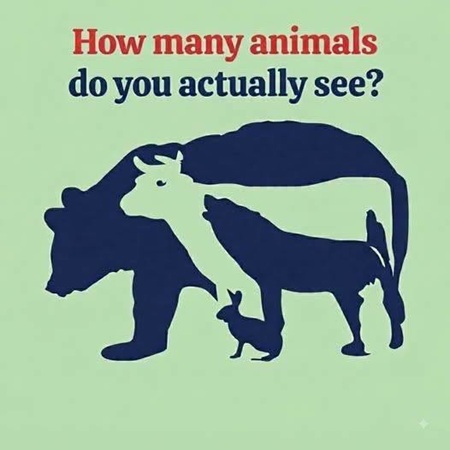
A bear occupies the left side and a large cow stretches across the center. Their strong outlines are the visual anchors of the composition. The eye recognizes them quickly because their bodies are large, familiar and clearly separated from the light background. Once those labels have been applied, the brain tends to stop investigating the same lines. That automatic shortcut is exactly what gives the illusion its challenge.
The cow’s head, horns, torso, legs and tail form a convincing single animal. Its silhouette is so coherent that viewers often treat every nearby curve as part of the cow. Yet an optical puzzle can make one boundary serve more than one purpose. A line that describes the back of the cow may help outline another form. A leg or a gap can become meaningful when the viewer changes the way the scene is organized.
The bear creates a similar trap on the left. Its dark body immediately reads as one complete figure, so many people move on after naming it. The artist uses that confidence as a distraction. Instead of accepting the bear’s outline as the end of the search, examine its face, back, belly, feet and surrounding spaces. Hidden shapes may borrow only a portion of the large silhouette rather than appearing as separate drawings.
The puzzle is therefore not simply a collection of isolated animal icons. Several figures can overlap, share borders or appear through the light areas between dark shapes. A curve that first seems to belong permanently to one creature may also act as the edge of another. The viewer has to loosen the first interpretation and ask what each line could mean in a different arrangement.
Negative space is as important as the navy silhouettes. The pale regions are not automatically blank background. A gap between bodies can form the profile of a head, a small torso or a pair of legs. When attention is directed toward those empty areas, an outline that was invisible at first may suddenly become recognizable. Many visual illusions hide their most useful clues in what appears to be nothing.
A careful search works better than a hurried scan. Divide the composition into zones and study one area at a time. Begin at the left with the bear, trace its edge slowly, then move through the center and inspect the cow. After that, check the lower edge and the right side. Looking at the entire image in one glance encourages the brain to keep using its first, simplest explanation.
The lower part deserves special attention because the smallest figures have the least visual weight. The source description points to a tiny mouse near the lower center. Its scale makes it easy to overlook beneath the dominant bodies. A viewer who focuses only on the large animals may never direct enough attention downward to see it, even though its outline is visible in the same frame.
A small cat is described on the right below the larger silhouettes. It is another example of attention being guided by size and position. The upper and central portions command the eye first, while the little figure near the edge can remain unnoticed. Searching the bottom and side margins deliberately is often enough to reveal details that disappear during a casual look.
The clearly named animals in the accompanying explanation are a bear, a cow, a mouse and a cat. Those figures provide a dependable starting count. The illustration may invite viewers to interpret additional overlaps as other creatures, but a responsible description should not announce a definite total that the original picture or an official solution does not confirm. The fun comes from observing carefully, not from forcing every curve into an answer.
Different people can reasonably report different results. One viewer may see four figures quickly, while another notices only two until a hint is offered. A shape that looks like a complete animal to one person may seem too incomplete to another. The creator’s intended solution is useful when available, but ambiguity is a normal feature of overlapping optical artwork.
This difference is connected with ordinary visual organization. Human perception does not inspect every pixel or contour with equal priority. The brain groups lines, colors and edges into objects that can be recognized rapidly. That ability is essential in daily life: it lets people identify a face, sign, tool or animal without analyzing each fragment separately. In a puzzle, the same efficiency can hide alternate readings.
Once the mind decides that a region is a cow, it is less likely to reinterpret that region as several figures. Once the surrounding pale field is classified as background, its shapes may be ignored altogether. Solving the image means interrupting those assumptions. The viewer must deliberately test whether the figure-ground relationship can be reversed and whether a familiar outline contains another intentional form.
Psychologists use terms such as selective attention to describe how focus determines which information reaches awareness. Inattentional blindness refers to missing a visible object when attention is occupied elsewhere. A cartoon puzzle is not a controlled laboratory experiment, so it should not be presented as a scientific test of an individual. Still, the broad idea explains why something can be plainly visible and yet not noticed until someone points it out.
Gestalt psychology offers another helpful lens. Principles such as closure, continuity, similarity and figure-ground grouping encourage the mind to turn separate marks into coherent wholes. The dark bear and cow become the figures, while lighter gaps become the ground. The artist exploits those habits by allowing the ground to carry a second animal or by making one contour support more than one reading.
Try changing the viewing distance. From farther away, the biggest silhouettes may become clearer. Move closer to inspect small feet, tails and gaps. A brief look away can also break the established pattern before you return to the image. Covering part of the picture and studying a single section prevents the largest silhouette from monopolizing attention.
Rotating the image mentally is another possible tactic. A curve that seems meaningless in its usual orientation may resemble an animal when imagined from a different angle. Similarly, switching from dark shapes to light shapes can expose a profile that the first pass treated as empty. These methods do not alter the illustration; they only give the brain a different starting point.
The satisfaction of the puzzle comes from a sudden change in interpretation. Before the discovery, a viewer can stare directly at a hidden animal without seeing it. After the clue is revealed, the same outline may look obvious. Nothing moved and no new mark appeared. The difference is that the brain reorganized information it had already received.
That “now I cannot unsee it” feeling makes these pictures easy to share. Friends can compare which animal appeared first and where each person searched. A useful hint such as “look near the bottom” preserves more of the challenge than immediately giving away the answer. Returning to the image after hearing another person’s count often produces a fresh discovery.
Speed should not be confused with intelligence. A casual optical illusion cannot measure IQ, personality, eyesight or mental ability. Results can depend on screen size, image quality, contrast, where a person looks first, whether a friend supplied a clue and whether the picture has been seen before. Someone who needs more time may simply be following a different visual route.
Online headlines sometimes claim that only unusually intelligent people can solve a particular animal count or that the answer reveals a deep personality trait. Such wording is usually a hook designed to increase curiosity. The reasonable conclusion is much narrower: the picture tests patience and observation in a playful setting. It does not provide a meaningful psychological diagnosis.
Scale is one of the artist’s strongest tools. Large forms are detected before small ones, especially when they sit in the center or use high contrast. Tiny silhouettes can be placed underneath a body or close to an edge where the eye rarely lingers. The described mouse and cat use exactly that strategy. Their presence is not mathematically hidden; it is perceptually deprioritized.
Contrast guides attention in the same way. Navy shapes against a pale field immediately become the visual foreground. A pale animal formed between dark silhouettes may be harder to detect because the brain labels it as background. Intentionally searching for light-on-light boundaries can therefore be more productive than staring only at the darkest areas.
Search order also changes what is noticed. Beginning on the left, in the center or at the bottom gives the eye a different first pattern. After one hidden figure is found, the mind becomes primed to look for similar constructions. That can help locate intentional shapes, but it also creates a risk: pattern-hungry viewers may start seeing animals in random curves. Careful observation requires both imagination and restraint.
Pareidolia is the tendency to perceive familiar forms in ambiguous material such as clouds, shadows or rocks. Optical puzzles deliberately encourage that tendency. The goal is to distinguish a clearly designed contour from a vague resemblance that has no supporting structure. A creator’s answer, matching edges and repeated visual logic are stronger evidence than a shape that merely looks animal-like for a second.
The picture can also be viewed as an exercise in attention switching. First identify the obvious bear and cow. Then stop naming them and examine only their edges. Ask what happens around the head, legs, belly, tail and the spaces between bodies. By removing the familiar labels temporarily, the viewer gives alternative shapes a chance to compete for awareness.
Tracing a contour with the eyes is often helpful. Start at one point and follow the line until it closes, intersects another edge or changes direction. Notice where a border seems to serve two silhouettes at once. The exercise turns a quick impression into a slower analysis and can reveal why an animal was hidden in plain sight.
The same method works on the bear. Do not treat the large dark mass as a finished answer. Inspect the area around its muzzle, shoulder, feet and underside. A smaller creature may use a section of the bear’s outline rather than having an independent border. Looking only for completely separate drawings can make an overlapping figure seem impossible to find.
The cow should receive the same treatment. Examine its horns, neck, body and legs, then study the pale interior and the dark shapes underneath. The central animal remains identifiable even when its lines are reinterpreted. The puzzle is not asking the viewer to erase the cow; it is asking whether the cow’s silhouette also participates in another image.
Negative-space searches are especially valuable near contact points. Look where the bear and cow seem to meet, under the cow’s belly, between legs and around the tail. Light shapes can be outlined by dark shapes on both sides. Because the brain prefers a solid object over an empty gap, those regions often remain the last places viewers inspect.
Display conditions influence difficulty. On a small phone, a subtle tail or tiny mouse may be lost. Enlarging the image can help, but extreme zoom can remove the overall relationship among the silhouettes. A bright or low-contrast screen can also change which edges are visible. These practical factors make it unfair to treat a single puzzle result as a judgment of a person’s ability.
A useful approach is to alternate between the full composition and close views. Start with the whole picture so you understand the large figures. Zoom into the lower center and right side for small details, then return to the full frame to see how each figure fits the overall design. This back-and-forth preserves context while still giving small outlines the attention they need.
The source’s named answer offers a clear route through the image: bear on the left, cow in the middle, mouse near the lower center and cat on the right. After locating those four, inspect the remaining shared outlines. If an official count identifies more, compare it with what you see. If it does not, avoid inflating the result with accidental shapes.
The distinction between observation and interpretation matters. Some outlines are intentionally constructed and can be followed continuously. Others may be fragments that resemble an animal only because the viewer wants to complete them. The strongest answer is supported by a coherent body, head or movement and by the way neighboring shapes share boundaries. A random bump is not automatically an additional creature.
These puzzles can illustrate the difference between seeing and noticing. The eyes may deliver the same information from the first second, but conscious recognition arrives only after attention selects and organizes it. A hidden cat does not appear from nowhere. The brain has finally assigned familiar meaning to an outline that was previously treated as background or as part of another animal.
First impressions remain useful in ordinary situations. Constantly doubting every recognition would make daily perception slow and inefficient. The puzzle simply creates a case where the first interpretation is intentionally incomplete. Looking again is not proof that the initial answer was wrong; it is a way to discover what that answer left out.
The bear remains a bear after the mouse is found, and the cow remains a cow after another contour is noticed. Several readings can coexist because the artwork was designed to support them. The most rewarding moment is not defeating the first idea but expanding it. A viewer learns that one correct label does not necessarily describe every role played by the same line.
If you want to share the challenge, let other people look before revealing the solution. Ask what they see first, which region they searched and whether a small hint changed the result. Comparing those paths is more interesting than ranking people by speed. The image becomes a conversation about attention rather than a contest with a serious winner.
The puzzle is best enjoyed without a timer. A countdown encourages the brain to settle on the fastest coherent explanation. A slower inspection gives less obvious regions time to enter awareness. Take a short break if the image seems stuck, then return and start from the opposite side. A fresh visual pass can be more effective than staring harder at the same pattern.
It is also wise to be skeptical of claims that the animal count predicts character traits. A viral illustration has not been validated as an assessment tool. Even genuine perception research uses controlled methods, defined conditions and careful analysis. This image can show how attention works in an entertaining example, but it cannot diagnose a viewer or rank their intelligence.
The intended lesson is modest and practical. Large, high-contrast objects usually win the first glance. Smaller forms and negative spaces require deliberate search. Changing distance, orientation or focus can make an existing outline available to awareness. Those observations explain the experience without any need for sensational claims.
Ultimately, begin with the obvious bear and cow, then look below them for the mouse and along the right for the cat, as described in the source. Once those figures are accounted for, inspect every overlap and pale gap with care. Accept only shapes that the actual illustration supports, and use an official solution when one exists to settle disagreements.
Whether you spot every animal immediately or need several attempts says nothing profound about you. It only shows how your attention organized this particular picture at that particular moment. The artwork stays fixed while the interpretation changes. That small shift—from a simple pair of silhouettes to a layered group of creatures—is the reason optical illusions remain so satisfying.
Look once for the obvious forms, look again for the hidden ones, and enjoy the surprise when a shape that was visible all along finally becomes clear.
+
One reason the image feels harder after the first glance is that recognition creates a stopping point. As soon as the eye has named the bear and the cow, it feels as if the task is complete. The remaining work is not to find a new picture but to question whether the first labels account for every contour. A deliberate second pass makes the search active again.
It can help to describe locations instead of names while searching. Note a dark edge on the left, a light opening under the central body, or a narrow shape beside the right leg. Describing geometry keeps the brain from locking too quickly onto a familiar animal. After the contours are recorded, ask whether they form a coherent creature or merely an accidental resemblance.
The puzzle also shows why a clue can feel both helpful and frustrating. If someone points directly to the mouse, the figure may become obvious, but the independent discovery is gone. A general hint about the lower center preserves the chance to notice the shape yourself. Good puzzle design leaves enough structure for a viewer to solve the image without making the answer immediately visible.
When comparing answers, explain which evidence supports each animal. A clear head, body and legs are stronger than a single curved line. Shared borders should be followed in both directions to see whether they close into a recognizable silhouette. This approach keeps the conversation grounded in the actual drawing instead of in a race to produce the largest possible count.
Visual attention can be affected by fatigue, distraction and the size of the display. A person looking at the puzzle after a long day may miss a shape that becomes obvious the next morning. Someone using a high-resolution screen may notice details that disappear on a compressed image. These ordinary differences are further reasons to treat the challenge as entertainment rather than as a fixed measure of ability.
The illustration’s restrained colors make its structure easy to reproduce but also increase the importance of edge contrast. The dark field draws attention to the central silhouette, while the pale field can hide lighter forms. If the screen’s brightness or contrast changes, the balance between figure and background changes with it. A careful viewer may need to adjust the display before deciding that an outline is absent.
For educators or puzzle creators, the image is a compact demonstration of figure-ground reversal and shared contours. It can start a conversation about how perception groups information, how attention is directed and how context changes interpretation. The example should still be framed honestly: it illustrates perceptual habits, not a validated intelligence exam. Its value is experiential and explanatory.
In the end, the answer matters less than the search. The picture invites a quick label, then rewards patience, perspective changes and a willingness to inspect what seemed empty. Once the bear, cow, mouse and cat are accounted for, any remaining claim should be checked against the drawing or the creator’s solution. That combination of curiosity and restraint is what makes the illusion satisfying rather than merely confusing.