Beyond Skin Deep: What Your Bruises Are Really Telling You
**Be Careful: If You Get These Bruises On Your Body, It Could Indicate…**
Have you ever noticed that you bruise easily? You know what we mean: those black and blue marks that look unsightly, and even after time turns them yellow, they are no prettier. Not only can they look alarming, but in some instances, they can also be painful. Sometimes, however, they are a cause for concern, as they may indicate an underlying medical problem that could be serious.
In today’s article, we will share some of the reasons why bruising occurs and offer tips to address the issue, hopefully allowing you to prevent future bruising or to figure out why your body is sending you this signal that something might be amiss.
Bruising can also be added to the list of potential issues that may result from a lack of specific vitamins. More on that to follow.
**Definition of Bruising**
Ecchymosis is the medical term for bruising. It sounds as unpleasant (to use a non-medical term) as your bruises can look.
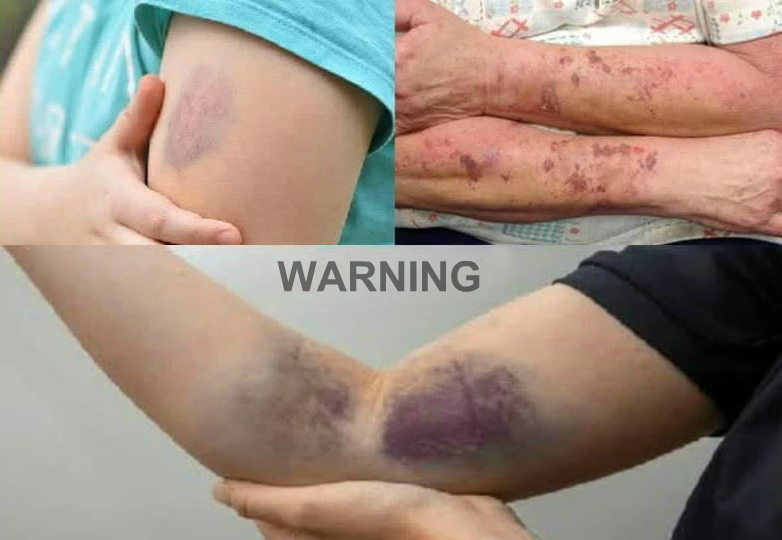
A bruise is what happens when small blood vessels burst underneath your skin’s surface, causing the blood to spill out from the capillaries and form a puddle just beneath the skin (as opposed to when you cut yourself and the blood pours out). There are many reasons why bruises happen, but some of the medical conditions associated with bruising may not directly cause the bruise but can make you more susceptible to bruising.
Bruising also generally occurs when there has been acute trauma to your skin. You may have accidentally bumped into your coffee table, walked into a wall, or banged your arm against your nightstand, perhaps even while you were sleeping. Or perhaps you have had your blood drawn, and it has left a bruise, likely because your veins were not easily accessible that day.
Whether you remember what happened or not, you will remember what a bruise looks like: typically a dark mark, such as red, black, or blue. Over the next several days, you will see the colors change, similar to the changing colors of autumn leaves, though far less aesthetically pleasing. The progression to purple or red, then green or yellow, signifies that the blood is being reabsorbed by your body and that the bruise is healing, until eventually no visible trace remains.
**More About Bruises**
Usually, bruises appear on your arms or legs and are not generally a cause for concern. However, if your bruises show up on your stomach, buttocks, genitals, ears, or the back of your hands, or if they occur more frequently, do not improve or change colors within a few days, or last longer than approximately two weeks, talk to your doctor.
We have written before about some of the problems you might encounter if you are low in certain vitamins, such as vitamin D. If you are not getting enough vitamin D or some B vitamins, you may be making yourself more susceptible to bruising.
Here are two more vitamin insufficiencies that could lead to frequent bruises:
**Vitamin C Deficiency**
When you are not getting enough vitamin C in your diet, from the foods you eat (e.g., citrus fruits, tomatoes, broccoli) and dietary supplements, you may have a deficiency in this vitamin—especially if you smoke.
Collagen is a protein that keeps your blood vessels healthy; vitamin C helps your body produce collagen. Without enough vitamin C, you may not have enough collagen. Without the right amount of collagen, your blood vessels may become more fragile, leading to an increased likelihood of easy or frequent bruising.
**Vitamin K Deficiency**
Vitamin K may not be the vitamin that is most commonly recognized. But if you are vitamin K deficient, your blood may be slower to clot, potentially leading to more bruises. Vitamin K also strengthens capillary walls, and stronger capillary walls mean they are less likely to break and result in bruises.
**Other Dietary Supplements**
Other over-the-counter dietary supplements, in addition to vitamins C, K, D, and some B vitamins, can lead to frequent bruising. Some botanical supplements, including ginkgo, ginseng, ginger, and garlic, can act as natural blood thinners. That can be beneficial, but it may also make it more difficult for your blood to clot, leading to