My Grandmother’s Kitchen Secret: Why She Always Sticks Cloves Into Onions
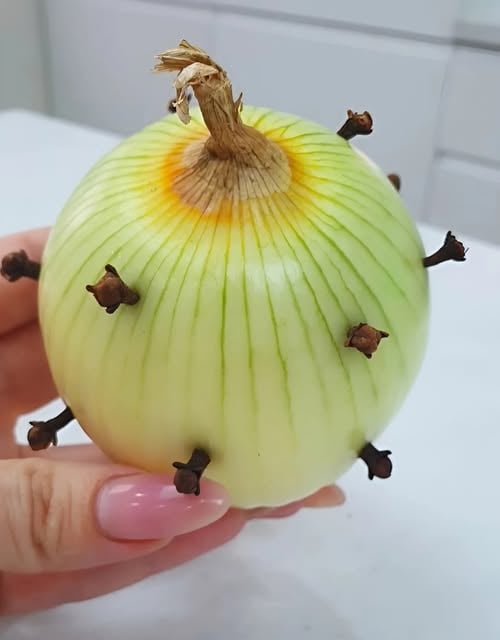
We often grow up thinking we know everything there is to know about our grandmother’s cooking. We watch them move through the kitchen with a natural grace, peeling, chopping, and stirring ingredients with a rhythm that seems almost magical. Yet, every so often, you might spot them doing something that seems entirely out of place, or perhaps even a little strange. That was exactly my reaction the first time I saw my grandmother carefully piercing a raw, peeled onion with several whole, dried cloves.
At first, I thought it was some sort of folk superstition—a quirky kitchen ritual passed down through generations that didn’t actually serve a culinary purpose. It looked bizarre, like a small, aromatic pincushion sitting on the cutting board. However, when I eventually asked her why she was doing it, she simply smiled and told me it was the secret to elevating simple dishes from ‘good’ to ‘restaurant quality.’ I was skeptical at first, but once I tried it myself, I realized why professional chefs have used this exact method for centuries.
So, what exactly is the purpose of this unusual pairing? In the culinary world, this is a version of the classic French ‘clouté’ or ‘pique,’ which essentially means to stud an ingredient with cloves. When you insert whole cloves into an onion, you are creating a simple infusion tool. The onion acts as a vessel that slowly releases its moisture and natural sweetness as it cooks, while the cloves provide a deep, warm, and slightly spicy aromatic punch that permeates the entire base of the dish.
Think about the classic preparations, such as a traditional Béchamel sauce, a savory broth, or a hearty meat stew. When you simmer the onion studded with cloves—what we call an oignon piqué—you don’t just get the flavor of the onion; you get a sophisticated, multi-layered depth. The cloves contain high concentrations of eugenol, an essential oil that is incredibly potent. By keeping them inside the onion, you ensure that the spice doesn’t overpower the sauce. The onion prevents the clove bits from floating around and getting stuck in your teeth or making the dish look messy, acting as a convenient ‘tea bag’ that you can easily fish out once the cooking is finished.
Beyond sauces and stews, this technique is a game-changer for rice and grains. Adding an onion studded with cloves to your boiling water when making basmati rice or a savory pilaf imparts a subtle, elegant perfume to the rice grains. It is a subtle shift, but it creates a professional aroma that makes any home-cooked meal feel significantly more intentional and refined. Once you begin incorporating this piece of grandmotherly wisdom into your own cooking, you’ll likely find it hard to go back to making these dishes any other way.
Using this hack is incredibly simple. All you need is a fresh, peeled white or yellow onion and a handful of whole dried cloves. Press the sharp end of the clove firmly into the flesh of the onion, spacing them out evenly across the surface. Add this directly into your liquid—whether it’s milk for a white sauce, stock for a soup, or poaching liquid for chicken—and let it simmer. As the fibers of the onion soften, the essence of the cloves is slowly extracted in a controlled, balanced way.
It is fascinating how the most effective kitchen life hacks are often the ones that have been hiding in plain sight in our grandmother’s cupboards for decades. There is no need for fancy gadgets or expensive equipment to upgrade your cooking; sometimes, it is just about understanding how ingredients interact on a molecular level. Today, I don’t start a large pot of stew or a delicate cream sauce without my ‘clove-studded onion’ at the ready. It is a small, quiet, and meaningful way to connect with traditional cooking methods that prove that, when it comes to flavor, our elders truly knew best.