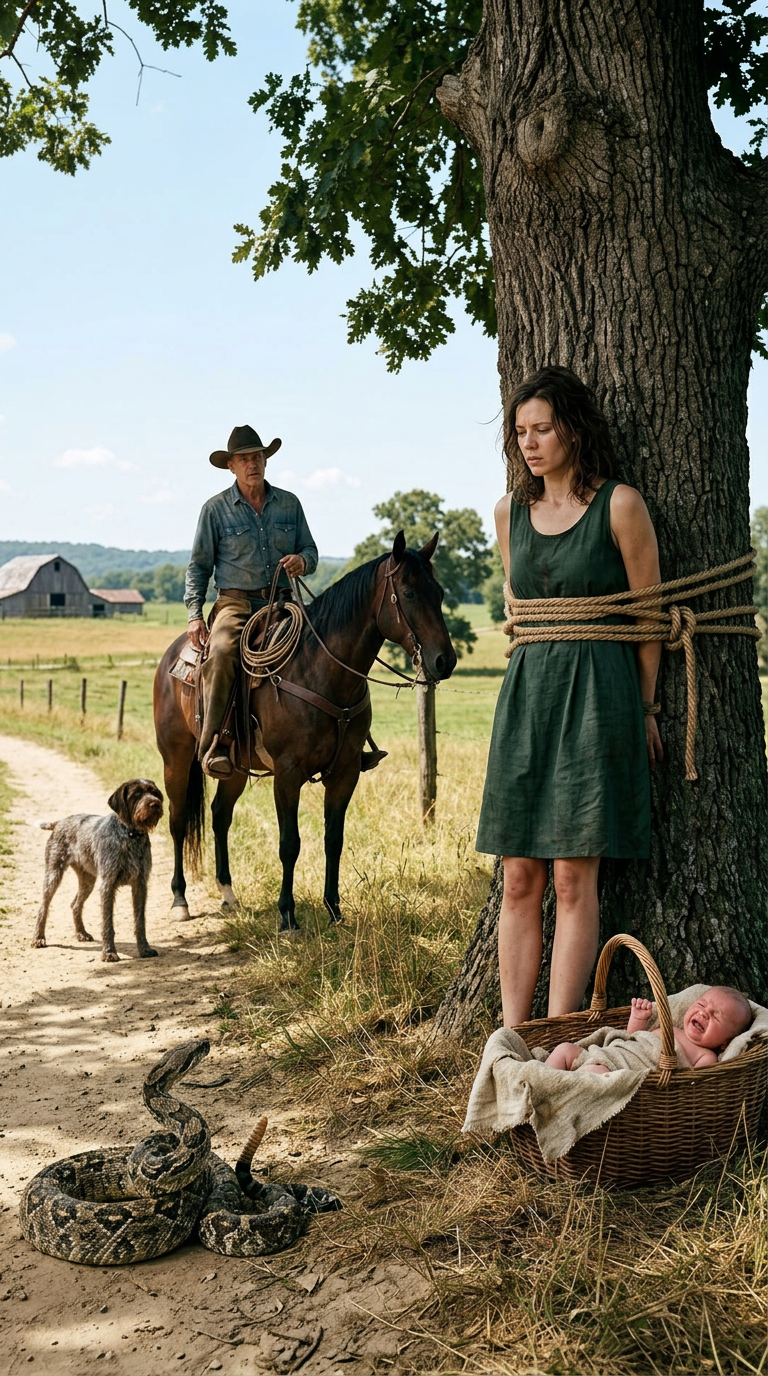
The Guardian of the Mesquite Meadow
For three years, Jacinto Rivas had lived in a hollow, rhythmic isolation. After the death of his wife, he retreated to his ranch in the Veracruz basin, where his world narrowed to the duties of daily survival. He mended fences, cared for his cattle, and walked alongside his only companion, an old dog named Canelo. He had learned the hard lesson of the countryside: to live in peace, one must keep their gaze low and their mouth shut. He had stopped asking questions and stopped interfering in the lives of others, convinced that empathy was simply a precursor to sorrow.
That changed on a sweltering afternoon under a blood-red sun. As Jacinto rode his white horse down a familiar dirt path, the natural world suddenly went silent. The crickets ceased their chirping, and the birds vanished, leaving behind a suffocating stillness. Canelo suddenly bristled and growled, alerting Jacinto to something wrong near a crooked mesquite tree some distance away.
Fighting the urge to keep riding, Jacinto approached the tree and found a young woman tied to the trunk with thick ropes. She was smeared with dirt, her face a mask of primal terror. Beside her, on the hard, scorching earth, lay a tiny newborn wrapped in tattered cloth. The baby let out a thin, frail cry, but the mother’s eyes were fixed on the tall grass near the mountain. When she gasped the words about vipers, Jacinto looked down to see two massive boa constrictors slithering toward the defenseless infant, moving with the cold, deliberate pace of predators who knew their victim could not escape.
Something within Jacinto, long buried by grief and apathy, snapped. It was not a calculated plan but an explosion of raw, protective rage. He charged the snakes with a wooden stick, shouting with a ferocity that shook the trees, while Canelo darted between the predators and the basket. The sheer intensity of their defense confused the snakes, causing them to retreat into the brush.
As soon as the danger passed, Jacinto cut the woman free. She collapsed, clutching her baby to her chest as if to anchor him back to the world of the living. She introduced herself as Alma, and her newborn son as Gael, born only five days prior. Her story was a nightmare of domestic cruelty. Her child’s father, Ismael, had orchestrated this gruesome murder plot, wanting to force Alma to watch their son be consumed by the snakes as punishment for her attempt to leave him.
The horror deepened when Alma warned that Ismael planned to return at dusk to witness the aftermath. Jacinto knew they could not stay in the woods. He rushed them toward his ranch, but as they traveled, they realized Ismael and his men were hunting them. Realizing his own home was now a trap, Jacinto led Alma and the baby to a secluded, abandoned mountain hut.
The next morning, the hunters found them. As six armed men surrounded the hut, Jacinto realized there was no escape. With quick, desperate resolve, he gathered firewood and dry debris, telling Alma to lock herself in the back of the structure. Just as the men broke through the door, Jacinto ignited the hut. The fire created a wall of smoke and flame that blinded the assailants, allowing him to usher Alma and the baby out through a rear exit. He then drew the men away into the deep forest, leading them on a harrowing chase until he was forced to drop into a steep ravine to hide, battered and bleeding, for hours.
After a long journey, Jacinto found refuge with a kind-hearted widow, Doña Teresa, who helped him reach the local church. There, he met Father Miguel, who confirmed that Alma and Gael had survived. The recovery of the mother and child brought a reckoning to the region. Alma’s testimony, combined with the intervention of the authorities, acted as a catalyst for other victims of Ismael’s criminal network to finally speak out. The culture of silence that had protected the monsters for years was shattered, leading to the arrest of Ismael and his confederates.
When Jacinto finally reunited with Alma at the rectory, she looked like a different woman, her eyes clear of the terror that had once haunted them. In the room, Canelo lay resting, having guarded Alma all the way to the village. As Jacinto knelt beside his faithful dog, he finally allowed himself to weep, not just for the trauma, but for the realization that his return to humanity had saved more than just a life. He had returned to himself, shedding the armor of apathy and finding a reason to care deeply about the world once more. Looking at the sleeping baby and the people he had saved, Jacinto understood that he had not just rescued a mother and child; he had been rescued from the loneliness of a life without purpose.