Find slice of pie, cane, trowel and artist’s brush.”
If you are searching for a screen-free activity that keeps children focused, curious, and genuinely excited, this woodland water slide hidden-object puzzle delivers exactly that. At first glance, the illustration looks like a charming coloring page filled with adorable forest animals enjoying a splashy adventure, but look closer and you will discover something far more engaging. Hidden throughout the scene are everyday objects cleverly tucked into trees, logs, and flowing water.
This is not just a cute drawing; it is a visual treasure hunt.
### A Playful Forest Water Slide Adventure
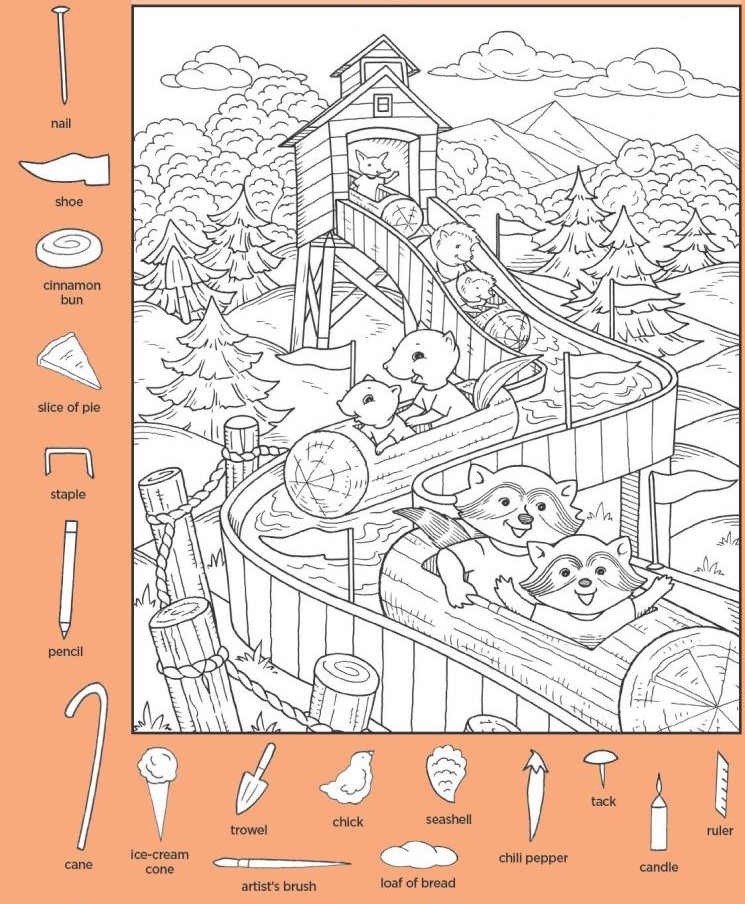
The image features raccoons and other woodland animals riding down a winding log water slide. The structure stands tall among pine trees and rolling mountains. A small wooden tower sits at the top, sending the animals down a twisting track carved from giant logs. Water flows smoothly along the slide, creating a sense of movement and excitement.
At the bottom of the page, a collection of small object icons appears, including a nail, shoe, cinnamon bun, slice of pie, staple, pencil, cane, ice cream cone, trowel, chick, seashell, chili pepper, tack, candle, and ruler. The challenge is simple but surprisingly tricky: can you find each of these hidden objects inside the forest scene?
That is where the real fun begins.
### Why Hidden-Object Puzzles Improve Focus and Concentration
Hidden-picture puzzles are more than just entertainment; they sharpen cognitive skills in a natural, enjoyable way. When children scan the page searching for a tiny nail or a disguised seashell, their brains activate pattern recognition and spatial awareness.
Instead of passively looking, they analyze. They compare shapes from the object list to the lines in the illustration, noticing curves, angles, and outlines. They double-check tree branches and water ripples, strengthening visual discrimination skills, which are essential for reading and writing development. Think of it as mental training disguised as fun.
### The Power of Black and White Coloring Pages
This woodland water slide scene uses detailed black-and-white line art. Without bright colors to guide the eye, children must rely on careful observation, which increases the challenge significantly.
Once they finish searching, they can color the entire scene. The trees might turn deep green, the raccoons could have gray fur, and the mountains might glow in soft blues and purples. Coloring after completing the puzzle adds another layer of engagement, boosting creativity while reinforcing fine motor skills.
### A Perfect Printable Activity for Classrooms and Homes
This forest water slide theme fits beautifully into multiple settings. Teachers can use it during quiet reading time or as part of a “brain break” session, while parents can print it for weekend fun or rainy-day entertainment. Because the content is wholesome and family-friendly, it is ideal for school websites, homeschool resources, and children’s activity blogs.
### Encouraging Patience in a Fast-Paced World
Modern children live in a world filled with rapid digital stimulation where games move quickly and attention spans shrink. Hidden-object puzzles slow everything down. To find a cinnamon bun shape hidden in a log or a tiny tack near the wooden posts, a child must pause and study the scene carefully. This encourages mindfulness and teaches kids that success often comes from patience and observation rather than speed alone.
### How the Woodland Theme Boosts Imagination
The forest setting adds storytelling potential. As children search for objects, they imagine the raccoons laughing as they slide down the track or invent names for the animals. Each discovery—a chick shape hidden among leaves or a trowel blending into the wooden structure—feels like solving a tiny mystery.
### High Engagement Means Longer Page Time
From a content perspective, hidden-object activities naturally increase interaction. Readers do not simply glance at the illustration and leave; they stay, zoom in, and look again. When users spend more time interacting with content, it signals high quality and usefulness, which is why parents and educators gravitate toward these types of brain games.
### Why This Puzzle Works for Multiple Age Groups
Younger children may focus on finding larger shapes, like the shoe or ice cream cone, while older kids can challenge themselves to locate more subtle objects. You can even turn it into a friendly competition:
* Who can find five objects first?
* Who can find the smallest hidden shape?
* Who can color the scene most creatively?
Because the puzzle scales in difficulty, it works for a wide range of ages.
### Conclusion
This woodland water slide hidden-object puzzle offers far more than a charming illustration. It combines cognitive development, creativity, and family-friendly fun into one engaging activity. By challenging children to find everyday objects cleverly hidden within the scenery, it strengthens focus and visual skills while encouraging imagination. In a fast-paced digital world, activities like this remind us of the value of slowing down, observing closely, and enjoying simple challenges.
Sometimes, the most powerful learning moments begin with a single question: Can you find them all?