Formula for a King
She Thought She Was Just Delivering Baby Formula — Until She Discovered the Man Bleeding in the Stairwell Was the City’s Most Feared Biker King
A Late-Night Delivery That Was Never Meant to Be Ordinary
The notification arrived at 11:43 p.m., lighting up the cracked screen of Iris Calder’s phone just as she was removing her helmet and convincing herself that exhaustion was a reasonable excuse to log off early, because some nights were too heavy even for desperation to carry alone, yet the number glowing beneath the address erased all hesitation before it could settle, three hundred and ninety dollars for a single delivery, flagged as restricted, anonymous, urgent, the kind of offer that only appeared when the system sensed someone willing to trade fear for survival.
Iris accepted without breathing.
She did not know then that the choice would dismantle her old life entirely, nor that by sunrise she would no longer be a courier scraping rent together with late-night tips, but something far more dangerous, far more permanent, and far more necessary.
The pickup location was a twenty-four-hour pharmacy wedged between abandoned storefronts on Broadmoor Avenue, where the fluorescent lights hummed too loudly and the cashier avoided eye contact as though he already knew this order carried consequences heavier than the bag he slid across the counter, sealed tight, weighted with formula, antiseptic, gauze, infant food, and painkillers strong enough to dull more than physical wounds.
“Rough night?” Iris muttered, mostly to herself.
The cashier said nothing, only watched her leave with a look that was not fear exactly, but resignation, as if he had already accepted that some people were destined to stand in the crossfire while others pretended not to notice.
The address led her east, deeper into the old manufacturing district where warehouses leaned like tired men and streetlights flickered with unreliable loyalty, and by the time her scooter slowed beside a concrete monolith tagged with years of graffiti and silence, Iris already knew something was wrong, because cities have a way of warning you when you’re about to step into a story you won’t survive unchanged.
She heard the crying before she saw anything else.
Two infants, screaming from somewhere inside the building, the sound raw and desperate and impossibly human against the dead weight of rust and rot, and Iris moved before her fear could argue, pushing open the ajar service door and stepping into darkness that smelled like metal, mold, and blood.
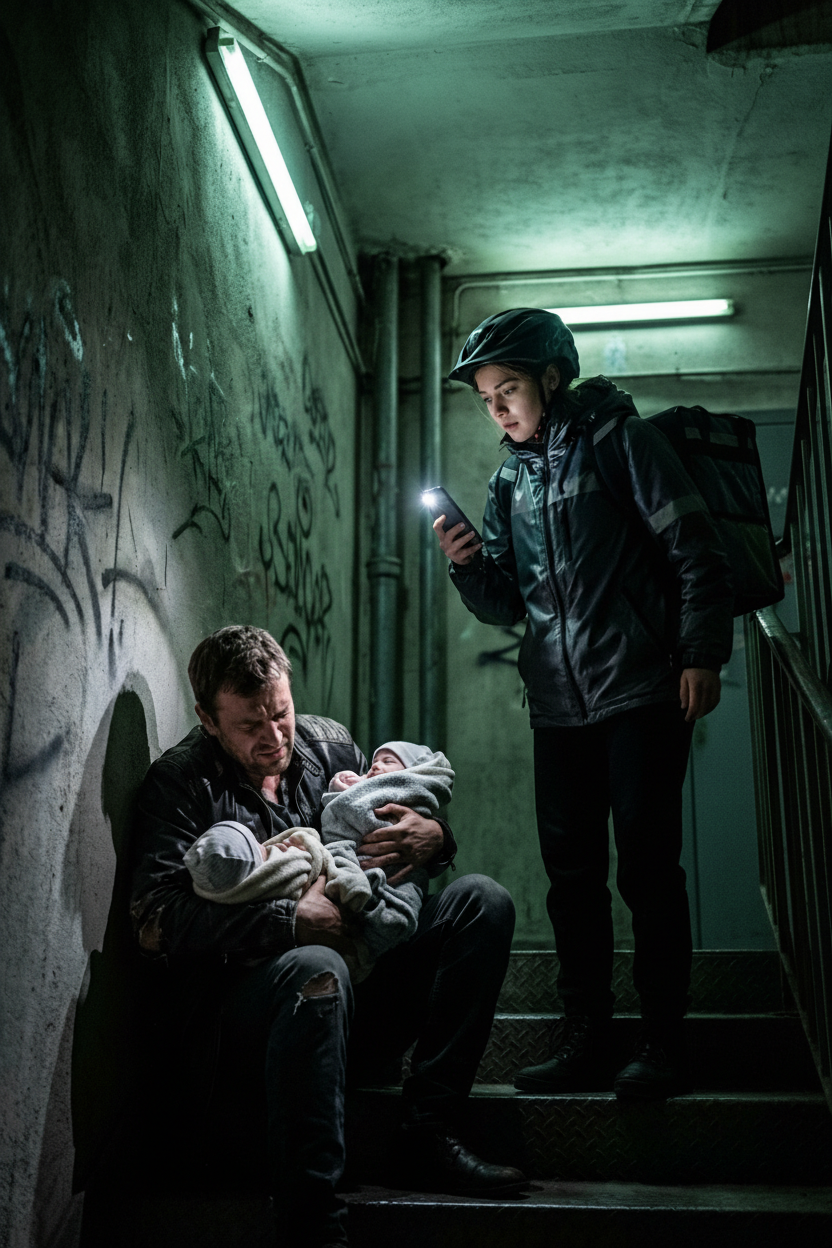
The stairwell was narrow and shadowed, illuminated only by her phone’s flashlight, and that was where she found him, slumped against the wall, leather jacket soaked through, breathing shallow, arms wrapped around two infant carriers like the last barricade between them and a world that had already failed too many children.
He looked up when she gasped.
“Don’t call anyone,” he said, his voice low, cracked, carrying authority even while bleeding out.
She had already reached for her phone.
“I said don’t,” he repeated, and this time there was something sharper beneath the weakness, something practiced and dangerous, something that made Iris pause despite herself.
The man was bleeding badly, at least two gunshot wounds, one torn through his side, another lodged deep near his shoulder, and yet his hands never loosened around the babies, one swaddled in pink, the other blue, their cries echoing against concrete like a countdown.
“I brought your order,” Iris said stupidly, as though routine could anchor reality, setting the delivery bag down and kneeling despite every survival instinct screaming for her to run.
He laughed once, a broken sound. “Good. They were hungry.”
She worked automatically, nursing-school reflexes resurfacing after years of disuse, tearing open bandages, pressing gauze, checking the babies when one began to choke on her sobs, lifting the tiny girl and patting her back until air rushed back into her lungs, and in that moment Iris forgot everything else, forgot the blood, the building, the danger, because no matter who the man was, no matter what he’d done, the babies were innocent, and innocence demanded action.
“Four hours,” he whispered when she asked how long they’d been there. “Maybe five.”
“You would’ve died,” Iris said, anger rising unexpectedly.
“I’ve survived worse.”
That was when she asked his name.
He hesitated, then smiled faintly. “They call me Wraith.”
Her hands froze.
Everyone in the city knew that name, whispered like a warning, etched into police reports and urban legends, the vanished leader of the Iron Serpents motorcycle syndicate, a man rumored dead after a violent internal collapse that left dozens of neighborhoods changed for better or worse depending on who told the story.
“That’s not funny,” Iris said.
“It’s not a joke,” he replied softly. “But tonight, it doesn’t matter.”
Sirens wailed somewhere distant, not close enough to save him, but close enough to doom him if they came sweeping, and Iris made the decision before she understood it fully, because sometimes courage is just fear with no exit left.
“Where can I take you?”
He stared at her, something calculating giving way to disbelief, then to hope so fragile it hurt to see. “There’s a place. Old rail depot. Car nine. Red stripe.”
She helped him stand, hauled his weight across her shoulders, somehow fitting two infant carriers into her scooter’s insulated compartment, praying the vents were enough, praying the universe hadn’t decided this was where her story ended, and she drove into the night as motorcycle engines ignited behind them, the sound unmistakable and closing fast.
The Truth Beneath the Legend
They barely reached the depot before the engines split, searching, hunting, and Iris followed Wraith beneath the train car into a crawlspace that smelled like oil and rust, holding her breath as boots pounded overhead and voices murmured about finding the deliver