The Divided Path
My parents kicked me out of the house three months after I turned eighteen. They did not do it because I was a delinquent, a heavy drinker, or someone who broke the law. They cast me out because I refused to become a doctor. In our family, medicine was treated as a sacred mandate rather than a career choice. My parents were both accomplished surgeons, and they had mapped out my entire future before I was even old enough to understand what a professional life entailed.
I never wanted a scalpel in my hand. My heart belonged to a guitar. Music was the only bridge that led me to a place where I felt truly alive, a sanctuary where the suffocating pressure of my home life faded into the background. When the inevitable confrontation occurred at the dinner table and I confessed that I had chosen music over medical school, my father simply looked at me and said that if I would not follow the path they built for me, I was on my own. By that same sunset, the locks on the front door were changed and I was officially homeless.
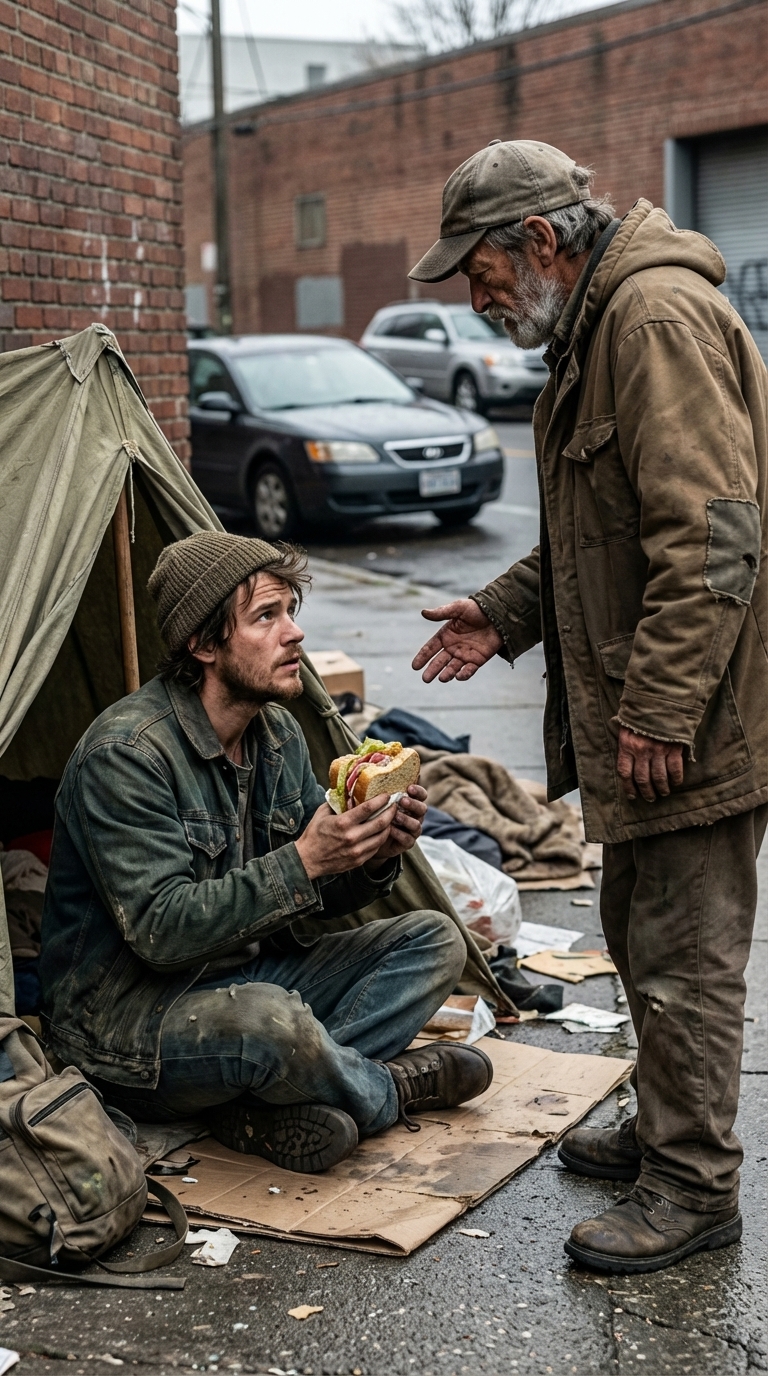
Three months later, my world had shrunk to the size of a small tent tucked under an abandoned bridge. I survived by working part-time at a local cafe, washing dishes and hauling trash behind the building. One slow afternoon, my manager handed me a leftover sandwich, telling me it was destined for the bin anyway. I retreated to the alleyway to eat, trying to make the meal last as long as possible. As I sat there, I noticed an older man in tattered, filth-covered clothes approaching passersby for food. Everyone ignored him.
When he wandered toward the alley where I was sitting, I felt a familiar ache for his plight. I called out to him and asked if he was hungry. He looked at me with a profound vulnerability, as if he had not encountered human kindness in years. I broke my only sandwich in half and handed him the larger portion. We sat together in the dirt while he ate slowly. He asked for my name and listened intently as I explained my living situation. He remarked that I was too young to be surviving in such a way, and I replied with a wry smile that he deserved better as well. For a moment, his eyes lit up with a warmth that erased his weariness, and then he stood and walked away into the city.
I thought nothing more of the encounter. I went back to my tent that evening, exhausted and resigned to another night of cold, damp air. However, the next morning, the silence of my hideaway was shattered by the rhythmic hum of an idling luxury engine. When I unzipped the canvas flap of my tent, I froze. A long, pristine black limousine was parked on the gravel road near my bridge. A driver formally dressed in a sharp suit stepped out, his eyes scanning the debris until they locked onto mine.
He approached with a measured pace and asked if I was Michael Carter. I nodded, my heart hammering against my ribs. The driver explained that I had been found, not by accident, but by request. The man I had shared my bread with was not a derelict, but a wealthy investor who had been conducting a personal study of the city streets after a profound loss in his own life. Touched by my willingness to give away my last meal despite having nothing, he had decided to invest in my future. He did not care about the medical degree my parents demanded. He saw the fire in my eyes and the integrity in my soul. He offered me a chance to study at a premier music conservatory with all my living expenses covered, plus a seat on his board of directors for his charitable foundations once I finished my education. I left my tent behind that day, not as a broken runaway, but as a person who had learned that even in the darkest circumstances, a single act of kindness can change the entire trajectory of a life.