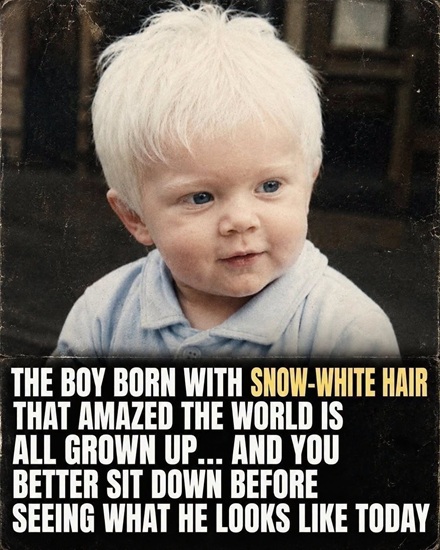
Photos of a newborn boy with strikingly white hair quickly captured global attention when they surfaced online. This baby, Csincsa Bence, was born on December 26, 2015, in Székesfehérvár, Hungary. Hungarian news at the time highlighted his thick, milk-white hair, which stood out from the typical hair color of newborns. His unique look became the focus of numerous photos and media stories. Hospital staff and family affectionately nicknamed him something akin to ‘Prince Charming.’ Naturally, Bence’s unusual hair sparked speculation about albinism, a genetic condition linked to reduced melanin production. However, doctors who examined him clarified that albinism was not the cause. According to Hungarian medical reports, Bence was not diagnosed with albinism; instead, his hair’s color was thought to result from a localized or temporary pigment deficiency. Apart from this, he was described as healthy, with routine medical checks confirming normal development. This distinction is crucial because having white or very light hair alone does not confirm a medical condition. Hair color depends on pigments produced in hair follicles and can vary widely among individuals. Additionally, newborn hair often changes as children grow. Doctors at the time predicted Bence’s hair might darken over the years, though this was a possibility rather than a certainty. Early reports also showed minor discrepancies in birth details. Hungarian sources Feol and Bors reported his length as about 54 centimeters and weight around 3.35 kilograms at birth, while some later international stories cited a higher weight of about 5.4 kilograms. Because those local accounts were produced closest to the birth, the roughly 3.35-kilogram measurement has firmer documentary support than the later viral figure. The disagreement is a reminder that even a widely repeated number can drift when a story crosses languages and outlets, so early reporting should be favored without pretending that every detail is perfectly settled. Bence’s story gained popularity mainly because his hair’s unusual color made for compelling images. In the age of rapid social media sharing, his appearance naturally sparked international curiosity. Hungarian reports noted enthusiastic reactions from internet users who saw his photos. His white hair became the defining feature of his story, even though doctors emphasized his good health. Importantly, medical professionals did not associate his hair color with illness. A doctor quoted by Hungarian outlet Origo explained that the white hair was not a sign of disease or prenatal stress but likely due to a localized, possibly temporary pigment deficiency. They suggested his hair might darken with age. This sets Bence’s case apart from many stories that label every person with pale hair as albino. Albinism is a group of inherited conditions affecting melanin production in skin, hair, and eyes. A pale hair color alone cannot establish such a diagnosis; medical evaluation is necessary. In Bence’s case, doctors explicitly stated he was not considered albino. The public fascination with Bence also shows how a single unusual physical trait can define someone’s online identity. For millions who saw his photos, his white hair was all they knew about him. Yet a child’s appearance is only a small part of who they are. Bence was first and foremost a newborn welcomed by his family, while the internet focused on one striking characteristic. Hungarian reports offer a more balanced view than many later retellings. His mother, Klaudia, shared her surprise at his birth, and the family expressed pride. There was no known similar hair color in the immediate family. Early articles focused on his unusual hair and doctors’ reassurance of his health rather than suggesting any mysterious illness. He underwent routine newborn screenings, including hearing and ultrasound tests, all of which were normal. Further analysis of his pigmentation was planned. These facts show that doctors investigated rather than assuming based on appearance alone. Their careful approach matters: the visible feature prompted questions, but the child’s overall health, routine screenings, and additional planned analysis were treated separately. That distinction keeps a striking photograph from being mistaken for a diagnosis and preserves the measured tone of the original 2015 reporting. The medical explanation in 2015 was cautious. Doctors did not label the white hair as a permanent condition or promise how his appearance would evolve. They suggested pigmentation might change and hair could darken. This careful language matters because some later internet stories turned possibilities into certainties. The story also highlights the wide range of normal human appearance. Hair color is influenced by genetics, pigmentation, development, and biological processes. Two healthy children can look very different without indicating illness. Bence’s white hair was rare enough to attract attention, but rarity does not imply medical harm. His case can be discussed without portraying visible differences as defects. Curiosity about unusual looks is natural, especially when photos spread widely, but respectful language is important. A child should not be reduced to a medical curiosity or spectacle because of one trait. The more responsible approach is to explain what is known and avoid sensationalism. Another key issue is what happened to Bence afterward. Many recent websites ask where the white-haired baby is now or show supposed photos of him years later. However, reliable public information about his later childhood is very limited. No verified recent photos, interviews, or credible public statements about his current appearance, personality, interests, or relationships are available. Therefore, claims about his hobbies, character, or family updates lack solid evidence. These details appear in viral retellings but are unsupported by contemporary Hungarian reports. Presenting them as facts risks turning speculation into biography. The same caution applies to alleged ‘before and after’ photos. A child with similar pale hair is not necessarily Bence. Different children can have light hair for various biological reasons. Without confirmation from family, original photographers, or credible sources, images claiming to show Bence later should be treated skeptically. This is especially important because the internet often favors dramatic transformations. Headlines promising to reveal what a viral child ‘looks like today’ attract attention even when photos are unverified. In Bence’s case, the honest answer is less sensational but more accurate: trustworthy public information about his life after the initial coverage is scarce. This lack of information should not be seen as mysterious. A child who briefly gains media attention is not obligated to remain in the public eye. Families may choose privacy after unexpected publicity. Unless Bence or his family share reliable updates, inventing details is irresponsible. The original photos remain a striking example of how a single physical trait can capture public interest. Bence became known not for achievements or public roles but simply because of his unusually white hair. The images turned a family milestone into a story covered internationally. This attention shows why context matters when photos go viral. Someone seeing only an image might assume the hair was dyed, that the child had albinism, or another condition. Those are guesses. Contemporary reports showed doctors examined him and offered a more specific explanation, emphasizing his health and that he was not albino. This offers a broader lesson about medical information on social media. A photo alone usually cannot diagnose a person. Visible traits like skin tone, hair color, or eye color can have multiple explanations. Medical conclusions require professional assessment, not assumptions by strangers online. The same applies when writing about rare traits. It is tempting to use dramatic terms like ‘mysterious condition’ or ‘medical miracle’ because they attract attention. However, in this case, reports do not confirm Bence had a rare genetic disorder. The accurate description is that doctors believed his white hair was due to unusual pigmentation and did not indicate albinism. This correction is important because some modern stories claim his coloring was caused by a confirmed genetic condition. Reliable contemporary sources do not support that. Genetics influence pigmentation generally but should not be turned into a specific diagnosis without evidence. It is also unsupported to say specialists later tracked his development or confirmed hair changes. Early doctors suggested pigmentation might increase with age, but a prediction from infancy is not a documented outcome. Without verified follow-up, responsible wording is that doctors thought his hair might darken—not that it definitely did. Bence’s story still carries a meaningful message without adding unverified details. His photos remind us that human appearance can vary greatly and that unusual does not mean unhealthy. They also show how quickly strangers can fixate on a child’s appearance without knowing their life. For parents of children with noticeable differences, public reactions can be challenging. Staring, questions, online comments, and assumptions may happen even if unintentional. The best response is to recognize the person before focusing on traits. Curiosity should not reduce someone to a physical feature. This is especially important for children. Adults can choose to discuss their appearance publicly, but children have less control over photos and stories shared about them. Their privacy deserves respect even if images are widely known. Bence’s early fame was not his choice. He was a newborn when the first articles appeared. His story belongs to viral content where the subject cannot decide on public recognition. This makes publishers returning to the subject years afterward especially responsible for accuracy and restraint. An honest account need not invent Bence’s present feelings about the publicity. No reliable public evidence shows his current views. It is possible to discuss the phenomenon without assigning emotions or experiences he never expressed. Similarly, there is no need to fabricate statements from his parents about his upbringing after the viral attention. Original reports provide some information about their reactions at birth but no detailed public record of his childhood. Claims about how they taught him confidence or handled curiosity should be general considerations for families, not facts about Bence. Distinguishing fact from interpretation strengthens the story. What is documented is already compelling: a Hungarian baby born with an exceptionally full head of milk-white hair, doctors said he was healthy and not albino, examinations were normal, and physicians believed the hair color might be temporary or localized pigmentation differences. His photos attracted widespread attention. What is not documented is equally important. Reliable sources do not confirm a later diagnosis, modeling career, ongoing social media presence, detailed personality descriptions, or authenticated recent photos. Those gaps should remain until credible evidence emerges. This approach protects readers from misinformation. A claim does not become reliable merely because many later pages repeat it; multiple sites may be copying the same unsupported assertion rather than confirming it independently. Looking back to local reports created near the event, noting their limits, and retaining their uncertainty offers a more dependable record than building a present-day biography out of recycled captions and unattributed images. Once inaccurate details appear in one viral article, others may repeat them, making claims seem established simply by repetition. Tracing stories back to contemporary and local reports is often the best way to understand what happened. Hungarian sources are especially valuable because they reported Bence’s story as a newborn and included comments from family, hospital staff, and doctors. Although minor inconsistencies exist, these reports provide a stronger foundation than later articles focused on his current whereabouts. Bence’s birth also reminds us how scientific language can be distorted online. A doctor may cautiously describe an observation as a probable temporary pigment difference, while later headlines turn it into a rare syndrome or genetic disorder. These are not equivalent. Maintaining original uncertainty is essential for accurate health reporting. Pigmentation is a complex biological process. Melanin affects hair, skin, and eye color, but pigmentation differences can take many forms. An unusual hair color alone does not reveal what is happening elsewhere in the body. That is why doctors considered his overall appearance and medical exams rather than diagnosing him by hair alone. Early reports even suggested the coloration might be temporary. Whether that proved true cannot be responsibly confirmed from available public material. Therefore, truthful accounts should avoid dramatic transformation endings unsupported by evidence. For readers who first saw Bence’s photo years ago, the ‘where is he now?’ question may feel unanswered. But sometimes leaving a question open is the most accurate conclusion. Not every child who briefly gains fame continues as a public figure, and lack of new information should not be replaced by speculation. There is also value in allowing uncertainty to remain. Bence’s early months attracted worldwide attention due to a trait he did not choose. If his family later chose privacy, that choice simply places reasonable limits on what strangers online may learn about him. A private life is not an unsolved puzzle for publishers to investigate. The absence of public updates may simply mean that a family chose an ordinary life after an extraordinary burst of attention. It gives publishers no permission to identify unrelated children, invent interviews, or turn silence into evidence for a dramatic theory. His story has two aspects: biological—a newborn with extraordinary hair color likely due to unusual pigmentation rather than albinism or illness; and cultural—photos of that feature spread widely, making him recognizable to many who never met him. Both can be discussed responsibly without exaggeration. The medical part requires accurate language and acknowledgment of uncertainty. The cultural part requires remembering he is a real person, not just a viral image. The most lasting lesson may be that unusual appearances invite questions but should not lead to unsupported conclusions. Bence’s white hair was real. The surprise it caused was real. His healthy condition as described then was real. Doctors’ belief that pigmentation might change was real. What happened in his later childhood is not publicly established. That boundary between known and unknown is essential for trustworthy online content. It prevents misleading readers and turning a private life into fiction. It also makes articles more credible by distinguishing documented facts from speculation. For social media, the same principle avoids deceptive presentation. There is no need to claim the writer is from Bence’s hometown or represents local residents. The story can be told neutrally based on public reports. This preserves information without pretending firsthand involvement. There is also no reason to invent dramatic reactions from neighbors, teachers, or friends. Contemporary reports already documented the attention his appearance received. Adding fabricated statements would not improve truthfulness. The strongest telling of Bence’s story is simple. Székesfehérvár welcomed Bence on December 26, 2015, and his remarkably full head of pale, almost milk-colored hair immediately stood out. Medical staff found him healthy and rejected albinism as the explanation. They believed his hair color was due to a localized or temporary pigment difference and might darken as he grew. Photos of him attracted significant online attention. Years later, curiosity remains about how he has grown and changed. However, there is insufficient reliable public information to detail his current life. Rather than invent an adult biography, responsible reporting should end where verified information ends. This does not lessen the importance of his photos. Their significance comes from what they reliably captured at the time: an unusual but healthy newborn, a family’s surprise and pride, cautious medical observations, and the speed with which one memorable image traveled beyond Hungary. None of that requires a fabricated transformation reveal. They remain memorable examples of human diversity and how quickly an unusual image can become globally recognized. They should not be used to diagnose him or create a fictional biography. Ultimately, Bence’s story is about curiosity, biological variation, online attention, and the need to separate reliable facts from appealing speculation. His appearance gave the internet something unique to discuss, but his identity cannot be reduced to the feature that made him famous. The most respectful conclusion is not a dramatic claim about his current look but an acknowledgment of what evidence shows. Bence entered public view as a healthy newborn with unusually white hair, doctors ruled out albinism, and his photos became widely known. Beyond limited documented information, the details of his life belong to him, not to internet imagination.
The Boy With Snow-White Hair Who Captivated Millions — What Is His Life Like Today?