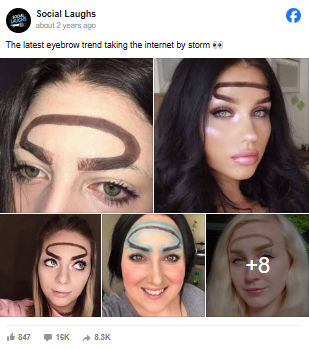
Halo Brows Arrive: The Playful Beauty Look Making the Internet Do a Double Take…
Eyebrows have been a favorite testing ground for experimentation in the beauty world for years. Makeup professionals and social media creators have altered their shape, changed their color, lengthened them, added decorations, and sometimes reimagined the brow almost completely. A few of these ideas eventually enter mainstream beauty, while many remain creative exercises designed mainly to show artistry or attract attention. One particularly unusual example surfaced on Instagram in 2018 and soon drew coverage from beauty and lifestyle media. The look became known as the “halo brow,” and it joined the two eyebrows with a large curved line stretching over the forehead. The concept was linked to British makeup creator Hannah Lyne, who was 16 years old when images of the design began spreading widely online. Lyne was already trying unconventional makeup ideas when she produced the look. Rather than letting the outer end of each eyebrow stop in the usual place, she drew the tails upward and kept extending them until the lines joined over her forehead. That created an oval, halo-like outline around the upper part of her face and made the result instantly distinctive. Beauty publications soon labeled it one of the stranger eyebrow experiments to emerge from Instagram.
The design appeared at a time when social media eyebrow makeup was especially inventive. Instagram creators had already played with feather brows, intentionally wavy eyebrows, shapes inspired by barbed wire, and several other departures from conventional styling. One related look, called the “fishtail brow,” added an upward branch near the outside edge of each eyebrow so that the brow resembled the split tail of a fish. Lyne later said that this fishtail idea directly helped inspire her own creation. Rather than ending the experiment after drawing the raised outer sections, she wondered what would happen if those lines kept going until they connected.
Reports from the period said the concept emerged while Lyne was talking with a friend about fishtail brows. During their discussion of possible new makeup ideas, she decided to try joining the two eyebrow tails together. She later presented the result as something deliberately odd, playful, and creative, not as a conventional makeup style intended for routine use. That qualification matters because describing something as a “beauty trend” can imply a level of adoption that an online experiment never actually achieved. Halo brows received considerable attention on the internet, but there is little indication that large numbers of people started wearing them as part of ordinary daily makeup.
The first widely circulated photographs were difficult to overlook because the brow shape dominated the face. Dark brow product began at Lyne’s natural eyebrows, swept upward in smooth curves, and joined near the middle of her forehead. The completed outline suggested the shape of a traditional halo, except that this version was painted directly onto the face rather than hovering above the head. Some coverage humorously compared the effect to a “reverse unibrow.” Its deliberately exaggerated appearance was central to the appeal of the photographs and helped make them easy to share.
Lyne was reported to have drawn the dark shape with NYX Professional Makeup’s Tame & Frame Brow Pomade in the shade Espresso. She paired the experimental brow work with more familiar cosmetics, including foundation, false eyelashes, and noticeable highlighter. The bright highlighting around the face reinforced the angel-like idea and increased the contrast with the darker eyebrow loop. Beauty articles published at the time specifically mentioned these products when explaining how she had assembled the finished look.
The intention was never to make the eyebrows appear natural. Instead, the brows were used almost as a piece of graphic art painted onto the face. That concept is familiar in editorial makeup, where experimentation can matter more than producing something practical enough for everyday wear. Makeup artists routinely treat a face as a creative surface and explore unexpected proportions, colors, textures, and geometric forms. Halo brows belonged comfortably within that artistic tradition, although their main stage was social media rather than a runway presentation or magazine editorial.
Social media was crucial in turning one creator’s experiment into a beauty story discussed internationally. By the late 2010s, Instagram had become an important platform for makeup artists and aspiring creators. A person could upload one visually striking photograph and potentially reach thousands or even millions of viewers without first appearing in a traditional beauty publication. If the image seemed unusual enough, people could repost it, leave reactions, share it elsewhere, and continue the discussion across several platforms. News and lifestyle outlets would sometimes pick up the most visually surprising examples, producing another round of exposure. Halo brows spread through exactly that kind of digital amplification.
The shape was unusual enough to trigger immediate reactions. Some viewers appreciated the inventiveness, while others thought the entire idea looked ridiculous. That combination of curiosity, admiration, and disbelief often helps unusual material move rapidly through online communities. A familiar eyebrow look may receive compliments, but an image showing something viewers have never encountered before is more likely to inspire arguments, screenshots, jokes, shares, and articles.
Beauty publications responded quickly to the images. Allure discussed halo brows as a puzzling new eyebrow look appearing on Instagram and explained Lyne’s connection to the earlier fishtail-brow idea. Yahoo Style reported on the design in March 2018, identified Lyne as its creator, and mentioned the makeup products involved. Marie Claire took a more humorous approach and raised the question of whether such a look could realistically qualify as a lasting trend. Taken together, the coverage confirms that the phenomenon genuinely circulated widely, even though some outlets used the word “trend” more broadly than actual everyday adoption would justify.
Viewer responses were divided, as might be expected from such an unconventional design. Some commenters admired Lyne’s readiness to experiment and regarded the halo brow as imaginative makeup artistry. They valued the fact that she created a look that was immediately identifiable instead of simply repeating a style people had already seen. For audiences interested in editorial makeup, theatrical looks, cosplay, or unusual social media aesthetics, halo brows offered another example of cosmetics being used for creative expression rather than only for enhancing familiar facial features.
Other people strongly disliked the result. A dark oval crossing the forehead was far removed from ordinary eyebrow styling, and many viewers considered it bizarre or unattractive. Reactions found in online comments ranged from straightforward confusion to jokes suggesting that Instagram itself should simply be deleted. Lifestyle publications covering the story repeated some of these responses, but those remarks represented personal reactions rather than any objective verdict on the quality or legitimacy of the makeup.
That split reaction illustrates a basic feature of internet beauty culture. An image does not have to earn broad approval in order to perform successfully online. Disagreement can sometimes make it even more visible. When one group praises a look and another group strongly rejects it, both sides may be motivated to comment, repost, or share it. High engagement can then encourage platform algorithms to expose the post to still more viewers. Similar dynamics have helped many unconventional beauty experiments enjoy brief bursts of intense online attention.
Viral visibility, however, is not the same as becoming a durable fashion movement. Halo brows appear to have existed primarily as a short-lived creative phenomenon rather than a broad change in the way people normally shaped their eyebrows. Even some reporting from the time made that limitation clear. Marie Claire, for instance, suggested that the design was better understood as a playful experiment than as a serious mainstream beauty direction. Keeping that distinction intact gives a more accurate picture of what happened and avoids presenting a viral photograph as though the entire beauty industry had adopted the idea.
Lyne herself placed the emphasis on creativity rather than on persuading people to conform. Reports quoted her expressing the idea that people should be willing to embrace looks that are silly, strange, and inventive. That helps explain the purpose behind the design. She was not necessarily trying to persuade everyone to arrive at school or work wearing a dark loop connecting both eyebrows. The experiment instead showed what could be created when someone temporarily ignored the usual assumptions about how eyebrows ought to appear.
This kind of visual play is not new to fashion or cosmetics. Professional artists have repeatedly altered brows for runway presentations, theater, movies, photography, and editorial shoots. Eyebrows can be bleached until they are barely visible, enlarged into dramatic forms, coated in glitter, or replaced with completely painted shapes. What social media changed was access: emerging and amateur creators could now perform such experiments publicly, even when they were not working inside professional studios.
The period in which halo brows appeared also contributed to the reaction. Throughout the 2010s, eyebrows had become an especially important part of beauty culture. Thick, carefully shaped brows gained popularity after a long period in which thinner eyebrows had been more fashionable. Products such as gels, pomades, pencils, powders, and specialized brushes became important parts of the cosmetics market. Online tutorials teaching audiences how to achieve precisely sculpted brows drew very large audiences.
Once highly refined eyebrows became familiar online, some creators naturally started searching for ways to take brow styling further. Certain experiments increased thickness, while others changed the underlying geometry. Feather brows separated the brow hairs so the eyebrow resembled a feather. Wavy brows replaced a familiar arch with intentionally undulating lines. Fishtail brows divided the outer section into two branches. Halo brows pushed that sequence much farther by converting two separate eyebrows into one uninterrupted graphic form.
Part of the reason these experiments could be so striking is that eyebrows are an extremely familiar feature of the face. Viewers notice immediately when their conventional shape has been changed. As a result, modifying the brow can produce a dramatic visual effect without requiring elaborate work across the rest of the face. A relatively simple alteration is enough to make an image look entirely different from ordinary everyday makeup.
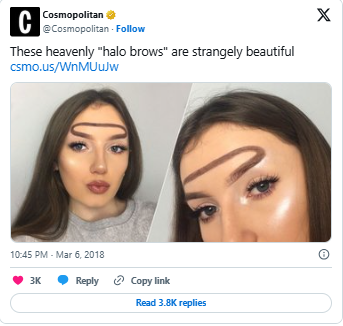
Halo brows also showed the growing overlap between cosmetic artistry and performance created specifically for the internet. Makeup made for social platforms is often designed not merely to be worn in person but to become a photograph. Something that would feel excessive in ordinary surroundings can work effectively within a tightly framed image because the photographed face itself becomes the finished artwork. In that setting, the creator works partly for the camera and partly for an online audience.
That helps explain why many viral cosmetic experiments are rarely encountered away from social media. Their priority is maximum visual impact, not everyday convenience. Drawing halo brows neatly would take substantial effort, and keeping the design intact through routine activities would not necessarily be practical. Those limitations mattered far less if the main objective was to create one memorable photograph rather than establish a makeup routine for daily life.
The episode also demonstrates how quickly new labels can develop online. Once people began calling the design “halo brows,” the phrase gave the look an easy and recognizable name. That made the photographs simpler to search for, discuss, reference, and recreate. Different beauty sites could place the same term in their headlines, allowing someone who saw one story to locate other examples and discussions with little difficulty.
The name itself helped attract attention because of the contrast between the graceful idea of a halo and the intentionally unconventional eyebrow design. Halos traditionally appear in religious and artistic representations around saints or angels. Lyne translated the familiar circular motif into a cosmetic shape while keeping it physically connected to the brows across her forehead. The concept was playful enough that the phrase “halo brow” became part of the humor surrounding the image.
Not every publication interpreted the result in the same way. Many stories emphasized how strange the makeup appeared, but some also acknowledged its artistic qualities. Certain beauty coverage at the time suggested that, despite the unusual concept, the brows could look unexpectedly appealing. Those differing interpretations underline the fact that experimental cosmetics do not demand one universally correct response. One viewer may see an amusing stunt, while another sees controlled graphic artistry. What is difficult to dispute is that creating the look required technical control. Drawing two fairly symmetrical curves upward and having them meet neatly over the forehead is considerably more demanding than producing a random line. The effect relied on reasonably careful positioning and on smooth connections between the natural eyebrows and the extensions Lyne added. A person could dislike the final appearance while still recognizing the makeup skill needed to execute it.
Instagram also gave Lyne access to feedback almost immediately. In earlier generations, an aspiring makeup artist might have shown experimental work only to friends, people in a local creative circle, or editors who accepted submitted photographs. Through Instagram, a creator could receive reactions from viewers around the world. Encouraging responses could support further experimentation, while criticism could arrive with equal speed. That visibility carried disadvantages as well. Viral posts frequently draw harsh remarks from strangers who feel comfortable commenting personally on the person shown in an image. Discussion of an unusual cosmetic style can therefore move from criticism of the design to criticism of the individual wearing it. For a young creator in particular, sudden exposure of that kind can create an uncomfortable amount of scrutiny.
A more useful way to assess experimental makeup is to keep personal preference separate from artistic merit. A viewer can decide that halo brows are unattractive while still acknowledging that Lyne was consciously testing an unconventional visual concept. Standards of beauty are subjective, and the existence of an experimental makeup design does not imply that everyone else is expected to wear it. Social platforms make it possible for many different aesthetics to coexist at the same time.
The story also shows how quickly internet attention can move from one novelty to the next. In early March 2018, halo brows appeared abruptly across numerous lifestyle and beauty publications. Not long afterward, public attention moved toward other unusual cosmetic experiments. Creators continually introduced new ideas while competing for visibility. Something that seemed almost unavoidable online for several days could vanish from wider discussion nearly as rapidly as it had appeared.
For that reason, halo brows are now most accurately remembered as a snapshot of the highly experimental Instagram beauty culture of the late 2010s. They never displaced ordinary eyebrow styling, nor were they accepted by everyone. Their importance lies more in the conversation they provoked and in the way an unusual idea created by a teenage makeup enthusiast reached international media audiences.
The episode also demonstrated how much influence social platforms had placed in the hands of individual creators. Lyne did not require the backing of a major cosmetics advertising campaign or a large fashion magazine to introduce her design. She created the makeup, photographed the result, and published it for her own audience. From there, established beauty outlets discussed the image, exposing it to people far outside her original group of followers.
Halo brows likewise highlighted the difference between creativity and conventional ideas of attractiveness. Most mainstream cosmetics are built around familiar principles such as balance, symmetry, and enhancement. Experimental makeup is free to reject those expectations deliberately. Its goal may be nothing more than surprising viewers or exploring an unusual visual possibility. In that sense, halo brows succeeded extremely well. Even viewers who strongly disliked them could generally understand the concept at once.
The underlying idea was also simple enough to be memorable: two separate eyebrows were extended until they formed a continuous halo-like loop, converting a familiar facial feature into a graphic design. That straightforward concept helped the look remain recognizable long after the initial burst of online coverage faded.
Ultimately, there was no mystery behind the sudden appearance of halo brows. They were not a sign that conventional eyebrow styling was about to disappear, and they never became a beauty rule that the public was expected to follow. The design came from one creator taking inspiration from an earlier viral brow style and carrying that idea in a new direction. Hannah Lyne’s 2018 experiment drew widespread discussion specifically because it looked so unlike familiar makeup.
Some viewers applauded it, some mocked it, and many simply looked at the photographs while deciding how they felt about what they were seeing. That broad range of responses contributed to the image’s success on social media. Strong reactions of almost any kind helped keep the pictures circulating and gave beauty publications a reason to continue discussing them.
Today, the halo brow remains an entertaining example of a period when Instagram makeup creators were continually trying to produce the next surprising visual idea. The episode demonstrates how rapidly an unconventional concept could travel from an informal conversation between friends to coverage by international beauty media. It also makes a broader point about cosmetics: makeup does not always have to be practical, durable, or flattering according to conventional standards in order to serve a purpose. It can exist simply as an exercise in creativity.
For Lyne, the simple decision to keep extending the outer ends of her eyebrows until they met created an image people continued to remember after the original post had passed from the immediate news cycle. Whether halo brows seem intelligent, bizarre, attractive, funny, or entirely impractical is ultimately a matter of personal taste. What is documented is that the design genuinely existed, received widespread online attention in 2018, and became one of the more memorable eyebrow experiments associated with Instagram’s viral beauty era.